



Use Wozber and land your dream job
Create Resume
No registration required
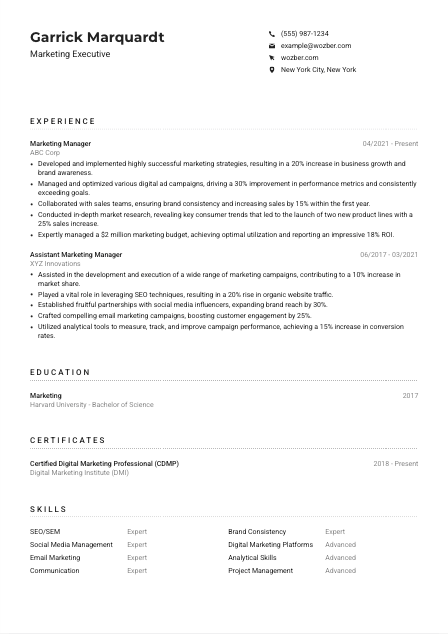
Crafting campaigns, but your resume lacks reach? Check out this Marketing Executive resume example, made with Wozber free resume builder. It shows how you can position your strategic chops to match job demands, setting your career's marketing metrics off the charts!
Marketing Executive hiring usually turns on one question fast: can this person turn market insight into campaigns that grow revenue and strengthen the brand? A resume for this role needs to make that connection obvious through channel ownership, campaign performance, budget decisions, and the business results behind the work.
When that story is tailored to the target role, the resume is easier to process in an ATS and easier for a hiring team to read as a commercial marketing profile rather than a general communications background. Wozber's free resume builder helps you align your wording with the job description, keep an ATS-compliant resume structure, and bring forward the campaign metrics, digital tools, and ROI markers that matter first for a Marketing Executive.
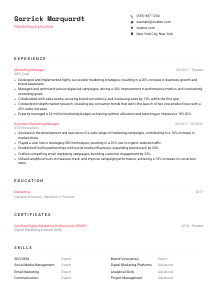
For a Marketing Executive, the top of the resume should establish professional identity fast and remove basic friction. Hiring teams should be able to see your role focus, contact channels, and any practical requirement such as location without searching for it.
Your name should be the most visible text on the page, set in a clean style that feels modern and professional. Marketing work often depends on presentation standards, so even this small detail should show sound judgment and strong formatting discipline.
Place "Marketing Executive" under your name when that is the role you are pursuing. It immediately frames the rest of the resume around strategy, campaign leadership, analytics, and brand growth instead of leaving your level or direction open to interpretation.
List a reliable phone number and a professional email address, then add a website or LinkedIn profile if it reflects your current campaigns, brand work, or leadership experience. Make sure every platform matches your resume titles, dates, and achievements so the employer sees one consistent marketing profile.
If a role calls for a specific location, add your city and state clearly. In the example here, "New York City, New York" answers a stated requirement right away and avoids unnecessary questions about relocation or availability.
A personal site, portfolio, or polished LinkedIn profile can strengthen your application if it shows campaign results, brand launches, content strategy, channel growth, or speaking engagements. Skip empty links. Every URL should add another credible layer to your marketing experience.
This header should confirm who you are, how to reach you, and whether you meet practical requirements tied to the opening. Once those basics are clear, the rest of the resume can stay focused on marketing performance.




Experience carries the most weight for a Marketing Executive because this is where strategy turns into measurable business outcomes. Hiring teams look for ownership of campaigns, channel mix, research, reporting, cross-functional coordination, and budget decisions that produced visible growth.
Read the posting closely and pull out the work themes that define the role. For this one, that includes marketing strategy, digital campaign optimization, market research, brand consistency, analytics, and budget ROI. Your bullets should reflect those areas using language that matches your real work, not generic marketing phrases.
List each role in reverse chronological order with job title, company, and dates. That structure helps the reader understand your progression from campaign support into broader ownership of strategy, performance reporting, vendor coordination, or leadership across channels.
For each role, show what changed because of your work. Instead of saying you "managed campaigns," explain what you launched, optimized, or improved and what happened next. The example resume does this well with outcomes such as a 20% increase in business growth and brand awareness, a 30% improvement in campaign performance, and a 15% sales lift through stronger brand consistency with sales teams.
Metrics give hiring managers a quicker read on scope and effectiveness. Include growth in lead volume, conversion rate, organic traffic, engagement, CAC efficiency, pipeline contribution, market share, launch results, return on ad spend, or budget ROI where you have them. A bullet about managing a $2 million budget with 18% ROI is far more persuasive than a broad claim about budget responsibility.
Keep the focus on work that supports a Marketing Executive brief. Prioritize strategy development, channel optimization, reporting, consumer insights, and cross-functional brand execution. If an accomplishment does not strengthen that story, trim it or rewrite it so the business impact is clear.
A Marketing Executive resume should read like a track record of growth decisions backed by data. When each bullet connects a marketing action to a result, the reader can quickly see the scale of your contribution and where you can add value next.
Education matters here because many Marketing Executive roles still require a degree in marketing, business, or a related field. This section does not need much space, but it should confirm that your academic background supports the commercial and strategic side of your work.
If the posting asks for a bachelor's degree in Marketing, Business, or a related discipline, make that easy to verify. In the example, a Bachelor of Science in Marketing directly addresses the requirement and needs no extra explanation.
List your degree, field of study, school, and graduation year in a clean format. Hiring teams and ATS systems should be able to read this section instantly without extra wording or design elements getting in the way.
If your degree is closely tied to brand strategy, consumer behavior, business, analytics, or communications, keep that field visible. For candidates whose degree title is broader, the major or concentration can help connect the education section more directly to marketing work.
Most experienced marketers can keep this section lean. Still, courses in digital marketing, market research, marketing analytics, consumer psychology, or brand management can be useful if they support an area the employer is emphasizing and your work history does not already show it clearly.
Honors, capstone projects, student leadership, or competition wins can stay if they show relevant marketing thinking or execution. This is most useful earlier in your career. For senior candidates, professional results should remain the main proof point.
For this role, education mainly confirms that you meet the formal requirement and have a relevant foundation in marketing or business. Present it clearly, then let your campaign outcomes and strategic experience carry the heavier load.
Marketing changes quickly across channels, platforms, analytics, and privacy expectations. Certifications can strengthen your resume when they show current knowledge in digital execution, measurement, or specialized areas that support the role's priorities.
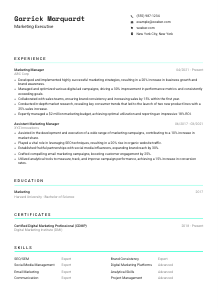
Start with certifications that match the actual work. For a Marketing Executive role focused on digital performance, credentials tied to digital marketing, analytics, paid media, SEO, CRM, or email strategy carry more value than broad or unrelated learning badges. The CDMP in the example is relevant because it supports digital marketing credibility.
Put the certifications closest to the role's needs first. If the job stresses campaign optimization and data-based decisions, lead with credentials connected to analytics, digital tools, measurement, or strategic marketing rather than general professional development courses.
Marketing platforms, attribution models, and best practices change fast, so dates matter. Showing when a certification was earned or renewed helps employers understand whether your training is current enough to support present-day channel management and reporting expectations.
If a credential requires renewal or continuing education, keep it updated. That signals that you stay current with platform changes, evolving campaign practices, and the analytical side of modern marketing leadership.
Certifications should add depth where the role needs it most, especially around digital execution and performance analysis. When they are current and relevant, they help round out the strategic story told in your experience section.
The skills section should function like a compact map of your marketing toolkit. For a Marketing Executive, that means a balanced mix of digital channel expertise, analytical ability, communication strength, and execution skills tied to campaign performance and brand growth.
Start with the terms the employer already uses. Here, that includes SEO/SEM, social media management, email marketing, analytical skills, communication, presentation, and interpersonal strength. If you genuinely use these skills, include them in language that matches the role.
Lead with abilities that connect directly to campaign execution and measurement, such as digital marketing platforms, analytics, paid search, content distribution, audience targeting, A/B testing, CRM workflows, and budget management. The example skills list works because it puts channel and performance skills near the top instead of hiding them behind softer traits.
Do not overload this section with every tool or buzzword you have encountered. Choose the skills that best support your recent work and the target role. A shorter list with strong alignment is far more convincing than a long, scattered inventory.
Every skill listed here should feel backed by something in your experience, whether that is search traffic growth, email engagement, stronger ROI, or cleaner brand execution across teams. That connection gives the section real weight.
Language skills matter in marketing when they affect communication, audience reach, client interaction, or market coverage. This section should stay straightforward and reflect the needs of the role rather than trying to add extra value where it is not relevant.
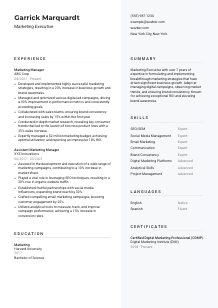
If the posting specifies a language requirement, place it first with an accurate proficiency level. In this case, English proficiency is required, so listing English clearly and prominently addresses that expectation right away.
Order languages by their usefulness to the role. If one language is required for presentations, reporting, or stakeholder communication, it belongs at the top of the section rather than being buried under secondary languages.
Extra languages can be helpful in marketing, especially for roles involving multicultural audiences, regional campaigns, international partnerships, or customer research across markets. In the example, Spanish adds breadth without distracting from the main English-language requirement.
Use clear labels such as Native, Fluent, Advanced, Intermediate, or Basic. Marketing often involves presentation, copy review, and audience-facing communication, so inflated language claims can quickly create problems in an interview or on the job.
If your language skills have helped with campaign localization, consumer research, influencer partnerships, or regional brand messaging, that context can strengthen their value. Keep the point practical and tied to marketing work rather than treating languages as decoration.
This section should confirm required language proficiency and, where relevant, show added reach across markets or audiences. Presented honestly, it supports the communication side of your marketing profile without overstating it.
The summary sits at the top of the resume, so it needs to establish your level, marketing focus, and commercial value within a few lines. For a Marketing Executive, that usually means showing strategic ownership, digital fluency, analytical decision-making, and a track record of brand and revenue impact.
Start with a direct description of who you are professionally, such as years of experience and your core marketing scope. For example, "Marketing Executive with 7+ years of experience in digital strategy, campaign optimization, and brand growth" gives the reader a faster and more useful read than a generic personal statement.
Follow with strengths that line up with the job description, such as building marketing strategies, managing digital channels, interpreting performance data, or coordinating with cross-functional teams. Keep the wording close to the employer's language when it matches your background.
A summary becomes much stronger when it includes concrete results. The example summary works because it references business growth, campaign execution, and ROI. You can sharpen that further with numbers when space allows, such as revenue growth, conversion lift, or return on budget.
Aim for a short paragraph that reads with momentum. Cut filler, avoid broad claims about passion, and concentrate on what you have led, improved, or delivered. By the time the reader finishes these lines, they should already understand your marketing scope and performance level.
A useful summary tells the employer what kind of marketer you are and what results tend to follow your work. When it is tailored well, the sections below simply expand on a clear, credible marketing story.
A Marketing Executive resume should make three things easy to see: the channels you know, the growth you delivered, and the decisions you can defend with data. When those points are clear across your summary, experience, and skills, the employer can picture you managing strategy, budget, reporting, and brand consistency from day one.
Use Wozber's free resume builder to organize that story in an ATS-friendly resume format, then refine the wording with its ATS resume scanner and tailoring tools so your achievements, digital platform experience, and ROI metrics align tightly with the job description. The finished resume should make your marketing judgment and commercial impact easy to read.




