



Use Wozber and land your dream job
Create Resume
No registration required
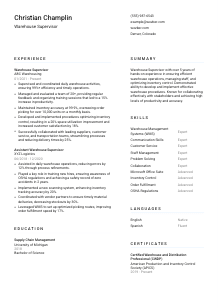
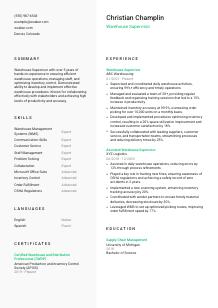
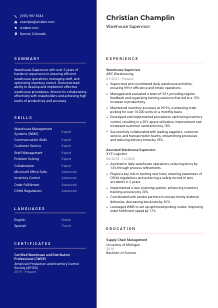
Organized the bins, but your resume seems chaotic? Check out this Warehouse Supervisor resume example, created with Wozber free resume builder. Learn how to show your floor finesse in a way that fits job benchmarks, and lead your career path as efficiently as you do the supply chain!
Warehouse supervisors are trusted with the part of the operation where speed, accuracy, labor planning, and safety meet. Hiring teams want to see that you can keep orders moving, maintain inventory control, coach floor staff, and prevent small process issues from turning into shipping delays, count errors, or safety incidents. Your resume should make that operating discipline visible from the first section onward.
A tailored resume helps separate warehouse leadership experience from general logistics support by showing your scope clearly: team size, inventory accuracy, WMS use, cycle counts, training, and cross-functional coordination. Wozber's free resume builder helps you organize those details into an ATS-compliant resume that matches the language of the posting, so employers can quickly understand whether you've already handled the kind of warehouse flow, staffing, and control standards the job requires.
This section should answer the practical questions fast: who you are, what role you do, and whether you can be reached without friction. For warehouse hiring, that kind of clarity matters because supervisors are often screened quickly against role title, location, and communication basics.
Use your full name in a clean, readable format at the top of the resume. Keep it slightly more prominent than the rest of the header so the document is easy to identify during interview scheduling, shift planning discussions, or internal resume sharing.
Place the role title directly under your name and align it with the job you want. If you are applying for a Warehouse Supervisor job, say "Warehouse Supervisor" rather than a broader label like "Logistics Professional." That instantly frames you around floor supervision, inventory control, and warehouse execution.
List a reliable phone number and a professional email address. Warehouse leadership roles move through screening quickly, and interview requests often come with little delay. Double-check accuracy, especially if you are applying across multiple facilities or shift-based operations where a missed call can slow the process.
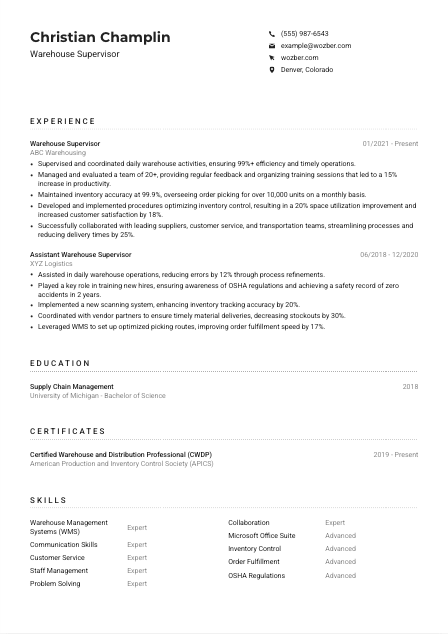
If the posting names a required location, reflect that clearly in your header when it applies. In the example, listing Denver, Colorado immediately supports the employer's stated preference and removes uncertainty around relocation or commute logistics. Use this only when it is true for your situation.
Include LinkedIn or a relevant professional profile only if it is current and consistent with your resume. For a warehouse supervisor, that profile should reinforce leadership scope, operations experience, safety focus, and systems knowledge rather than introduce conflicting job titles or dates.
Your personal details should clear the basic checks without distraction: role alignment, contact accuracy, and any stated location requirement. When those details are clean, the hiring team can move straight to your warehouse experience.




For a Warehouse Supervisor, experience is where hiring managers look for operational control. They want to know whether you have led teams, maintained inventory accuracy, improved throughput, enforced safety standards, and worked across customer service, transportation, and suppliers without losing pace on the floor.
Read the posting for the work patterns it emphasizes, then mirror those priorities in your bullets. Here, the clearest themes are supervising daily warehouse activity, evaluating staff, maintaining inventory accuracy, conducting cycle counts, improving space utilization, and coordinating with outside partners. Those should appear in your experience in the language of actual results, not generic responsibility statements.
Start with your most recent role and work backward. For each position, include job title, company, and dates, then make it easy to understand the scale of the work. In warehouse supervision, relevance often comes from team size, order volume, shipping pace, inventory scope, or the type of operation you supported.
Your bullets should show what improved because of your supervision. Good examples include higher inventory accuracy, faster order fulfillment, fewer stockouts, better pick rates, stronger space utilization, or improved customer satisfaction. The sample resume does this well by tying supervision to a 15% productivity gain and process changes to a 20% improvement in space utilization.
Metrics carry weight in this field because operations are tracked constantly. Include numbers that reflect how the warehouse actually performs, such as team headcount, units picked, fill rate, inventory accuracy, cycle count compliance, error reduction, on-time shipment performance, or delivery time improvements. "Managed a team of 20+" and "maintained 99.9% inventory accuracy" are much stronger than broad claims about leadership or efficiency.
Not every past task belongs here. Prioritize experience that shows scheduling, coaching, KPI ownership, WMS usage, safety awareness, process improvement, and coordination across the warehouse operation. Earlier roles can stay on the resume, but give the most space to work that proves you can supervise labor, protect accuracy, and keep daily execution on track.
By the end of your experience section, a hiring manager should understand the scale you have supervised, the warehouse metrics you have improved, and the processes you have controlled. That is what turns prior work into a credible case for warehouse leadership.
Education usually plays a supporting role for warehouse supervisors, but it still helps frame your background. It can reinforce your understanding of supply chain operations, inventory flow, and logistics planning, especially when the posting prefers a related degree.
Start with the education requirement in the posting. Here, a high school diploma is required and a bachelor's degree in Supply Chain Management or a related field is preferred. If you have that degree, make sure it is easy to find because it strengthens your fit for a role tied to inventory control and warehouse operations.
List the school, degree, field of study, and graduation year. That is usually enough for this level of role. Clean formatting matters more than extra detail, especially when the hiring team is reviewing your operational background first.
If your education directly supports the job, do not bury it. In the example, a Bachelor of Science in Supply Chain Management aligns neatly with the employer's preference and complements the hands-on warehouse track record. Similar degrees in logistics, operations, or business can also support your candidacy when they are relevant.
Specific courses can help if you are early in your career or if your degree needs context. Topics such as inventory management, logistics, procurement, or operations planning may be worth noting. For experienced supervisors, though, the resume usually gains more from stronger accomplishment bullets than from a longer education section.
Honors, projects, or extracurricular activities belong here only if they strengthen your case for the warehouse role. If they show process analysis, team leadership, or supply chain work, they may help. If not, keep the section lean and let your operational results do the heavy lifting.
Use education to reinforce your foundation in logistics or supply chain work, especially when the employer mentions a preferred degree. Then let your warehouse results, systems knowledge, and leadership history carry the application.
Certifications can strengthen a Warehouse Supervisor resume when they point to warehouse operations, inventory control, safety, or distribution management. They are especially useful when they show you have invested in the technical and compliance side of running a facility.
Start with certifications that support warehouse supervision directly. A credential such as Certified Warehouse and Distribution Professional fits well because it reinforces knowledge of distribution workflows, inventory practices, and warehouse management standards. Put the most role-relevant certification first.
Choose certifications that connect to the posting's needs, such as warehouse operations, safety practices, inventory management, or process improvement. The job description here does not require a specific certification, so use this section to strengthen your profile rather than fill space with unrelated courses.
Include the certification date, and if applicable, show whether it is active. That matters most for credentials with renewal cycles or those tied to current standards. In warehouse environments, recency can support your credibility around evolving safety procedures and operational methods.
Ongoing training can support advancement, especially in areas like OSHA awareness, inventory systems, lean operations, or leadership development. Add new credentials when they reflect real tools or standards you use in warehouse supervision, not just general professional development.
A well-chosen certification section tells the employer that your experience is backed by current warehouse knowledge. When the credentials connect to safety, inventory control, or distribution performance, they add practical value to your resume.
The skills section should mirror how warehouse supervisors are actually evaluated. Employers look for a mix of floor leadership, inventory discipline, systems fluency, and communication with teams and partner functions. A short, focused list works better than a long catalog of generic strengths.
Start with the skills the job calls out, then add closely related capabilities you can genuinely support with experience. In this case, WMS proficiency, Microsoft Office, leadership, communication, interpersonal skills, and OSHA familiarity are explicit. Inventory control, order fulfillment, staff training, and process improvement are natural companion skills for the role.
Use the same terminology the employer uses when it matches your background. "Warehouse Management Systems (WMS)" should appear exactly if you have used them. This helps both ATS matching and hiring review, especially when the screening process is looking for warehouse-specific systems knowledge rather than broad software comfort.
Order the list around operational relevance. For most Warehouse Supervisor roles, systems, inventory accuracy, people leadership, safety awareness, and order execution belong near the top. The example resume handles this well by foregrounding WMS, staff management, inventory control, order fulfillment, and OSHA regulations instead of generic soft skills alone.
A useful skills section should read like the toolset of someone who can run a warehouse shift, coach a team, and keep inventory reliable. If every skill on the page connects back to daily operations, the section is doing its job.
Language matters in warehouse supervision because instructions, safety communication, shift handoffs, and written reporting all depend on clarity. If the posting mentions English proficiency, treat that as a direct requirement rather than a minor detail.
Check whether the employer names a required language and list it first. Here, the ability to write effectively in English is specifically requested, so your English proficiency should be clearly stated. That supports your ability to handle reports, training communication, and day-to-day coordination.
Describe your level with straightforward terms such as Native, Fluent, Advanced, or Conversational. For warehouse leadership roles, precision matters because language skills affect written instructions, incident reporting, and communication across shifts and departments.
Extra languages can be valuable when they improve communication with warehouse associates, drivers, vendors, or customer-facing teams. In the example, Spanish is listed as Fluent, which could be useful in many warehouse environments with multilingual teams. Include additional languages only when they are real working skills.
Do not overstate proficiency. If you can hold basic conversations but cannot manage training, reporting, or issue escalation in that language, label it honestly. Clear communication is a practical management need, not a decorative resume detail.
Choose language details that support the actual work. For most Warehouse Supervisor roles, strong English matters most because of documentation, safety expectations, and coordination with internal partners. Additional languages are a plus when they improve team communication or support a diverse workforce.
Your language section should confirm that you can handle the written and verbal communication the warehouse depends on. For a supervisor, that means clear English first, with any additional language skills adding practical team value.
Your summary should quickly establish the kind of warehouse operation you have run and the results you have delivered. This is where you connect years of experience with the core supervisory outcomes employers care about: reliable execution, accurate inventory, productive teams, and safe, efficient workflows.
Before writing the summary, pull out the themes that define the role. Here, that includes daily warehouse coordination, team supervision, training, inventory accuracy, process improvement, and cross-functional collaboration. Those are the ideas your summary should echo in a compact way.
Start with a direct line that states your profession and years of relevant work. "Warehouse Supervisor with 5+ years of experience" immediately positions you in warehouse leadership rather than in a broader logistics category. If your background is split across assistant and full supervisor roles, you can still total the relevant years if the experience is continuous and clearly related.
Use the next lines to highlight the work you are known for. Good themes include inventory accuracy, team productivity, WMS-driven process control, OSHA-aware supervision, or collaboration with transportation and customer service. The example summary works because it combines operations efficiency, staff management, and inventory optimization without drifting into vague language.
Aim for three to five lines. That is enough space to establish your background, mention a few high-value strengths, and set up the experience section. Skip broad claims like "hardworking professional" and use wording that sounds native to warehouse operations and leadership.
A sharp summary gives the employer an immediate read on your warehouse leadership scope and the standards you work to. When it mentions the right mix of team supervision, inventory control, systems use, and operational improvement, the rest of the resume lands more clearly.
A Warehouse Supervisor resume should show that you can keep operations moving, maintain inventory accuracy, lead staff, and support safe, dependable execution. Each section should contribute to that picture, from the title in your header to the metrics in your experience bullets.
Use Wozber to build an ATS-friendly resume template that reflects the language of the job posting, then refine it with the ATS resume scanner so your supervisory experience, WMS skills, safety awareness, and warehouse results are easy to read and easy to match. That leaves hiring teams with a clear view of how you would run the floor.




