




Use Wozber and land your dream job
Create Resume
No registration required
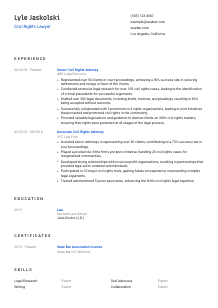
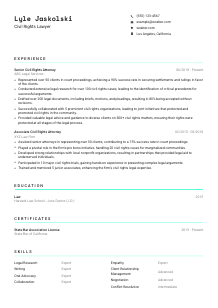
Fighting for justice, but your resume feels held back? Review this Civil Rights Lawyer resume example, created with Wozber free resume builder. Learn how to present your advocacy and litigation skills to match the job requirements, making sure your career journey stands tall in the fight for equality!
Civil rights law is reviewed through the quality of your legal judgment under pressure. Hiring teams want to see whether you can investigate alleged violations, build arguments from precedent, draft clean motions and briefs, and stand up for clients in hearings, negotiations, and trial work. Your resume needs to make that practice visible, not just state that you care about justice.
The first pass often hinges on whether your background clearly maps to civil rights litigation rather than general legal practice. Wozber's free resume builder helps you align your wording with the posting, keep an ATS-compliant resume structure, and surface role-specific terms like pleadings, legal research, oral advocacy, and client counseling so your experience reads as relevant civil rights work from the start.
This section is straightforward, but it still carries useful hiring information. For a Civil Rights Lawyer, it should confirm your identity, target role, contact access, and any location detail the employer has made explicit.
Place your full name at the top in a clean, professional format. In legal hiring, your resume may be reviewed alongside writing samples, bar credentials, and case-related materials, so consistency matters. Use the same version of your name across all application documents.
Add "Civil Rights Lawyer" directly under your name if that is the role you are pursuing. This helps position your background immediately, especially if your recent title was broader, such as attorney or litigation associate. When your actual work centers on constitutional claims, discrimination matters, police misconduct, disability rights, housing rights, or other civil rights issues, say so clearly.
List a phone number and professional email address that you actively monitor. Legal employers move quickly when scheduling interviews, requesting references, or asking for writing samples. Double-check every character. A missed digit or an outdated email can cost you traction at the very stage where your litigation background has started to stand out.
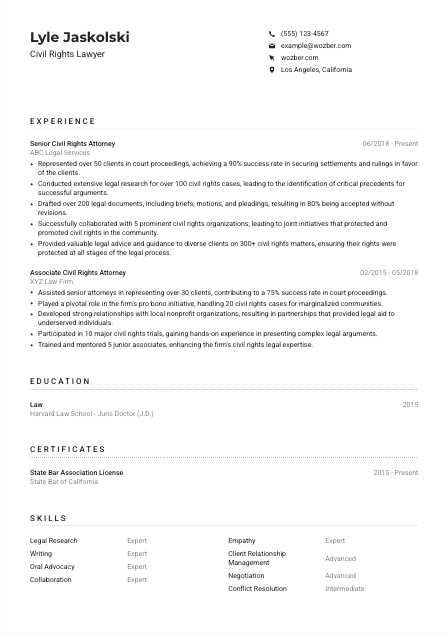
If the posting requires you to be in a specific market or willing to relocate, include your city and state. Here, listing "Los Angeles, California" works because the employer asked for local presence or relocation readiness. For other applications, follow the posting rather than assuming location always needs emphasis.
A LinkedIn profile or personal website can help if it reinforces your legal practice with bar information, publications, speaking engagements, or civil rights advocacy work. Keep it current and consistent with your resume. If you link to articles, case summaries, or organization work, make sure the material supports the same professional story you are telling in the application.
Your personal details should remove friction, not create it. Make it easy for a legal employer to see who you are, what role you practice in, and whether you meet any stated location requirement.




For this profession, experience carries the most weight. Employers want to know what kinds of matters you handled, how you performed in litigation and client advocacy, and whether your work shows real command of civil rights claims, legal writing, and courtroom responsibility.
Read the posting closely and mark the work that defines success in the role. In this one, that includes investigating potential civil rights violations, representing clients in court, drafting briefs, motions, and pleadings, advising clients, and collaborating with outside organizations. Those are the themes your bullets should reflect. If your background includes adjacent public interest or litigation work, frame it through those same functions where accurate.
List jobs in reverse chronological order with title, employer, and dates. Use titles that accurately show your level and specialty. "Senior Civil Rights Attorney" and "Associate Civil Rights Attorney" immediately tell a reviewer that the candidate has practiced in the field, progressed in responsibility, and stayed close to the kind of docket the employer is hiring for.
Each bullet should show what you handled and what changed because of your work. Focus on matters like client representation, hearings, trial support, negotiated resolutions, legal research, motion practice, or community-facing advocacy. The sample resume does this well with bullets about representing more than 50 clients, identifying critical precedent across 100+ cases, and advising clients on 300+ civil rights matters. Those details make the practice concrete.
Numbers are useful when they reflect how legal performance is actually measured. Good examples include case volume, hearing or trial exposure, settlement rate, number of briefs or motions drafted, revision rates, pro bono caseload, or size of community partnerships. "Drafted over 200 legal documents, with 80% accepted without revisions" works because it shows both production and writing quality.
Civil rights employers look for focused legal experience. Keep bullets that strengthen your litigation, research, writing, counseling, and community engagement profile. Reduce space spent on unrelated practice areas unless they add a relevant dimension, such as trial advocacy, constitutional analysis, or work with underserved clients. The point is to show a lawyer who can step into civil rights matters with minimal translation.
Your experience section should read like a lawyer's practice history, not a generic list of responsibilities. When the scope of your cases, written work, courtroom exposure, and client results are clear, the employer can quickly picture you handling the work.
Education matters in legal hiring because it confirms the credential foundation for practice. For a Civil Rights Lawyer, this section should establish your J.D. clearly and keep the focus on academic information that supports your legal path.
If the posting asks for a Juris Doctor from an accredited law school, make that easy to see. Your law degree should appear first, ahead of undergraduate study. In the example, the J.D. from Harvard Law School does exactly that, which helps the employer confirm the minimum academic requirement in seconds.
List school, degree, field, and graduation year in a clean order. Legal resumes do not need elaborate formatting here. Clarity matters more than design flourishes, especially when your academic record is being checked alongside bar status and years in practice.
For many legal roles, the J.D. is a baseline credential rather than a differentiator, but it still needs proper prominence. Make sure the degree name is complete and accurate. If you have advanced legal study, clinics, or concentration work directly tied to civil rights, include it only if it strengthens the section without distracting from your professional experience.
You do not need to list every course, but civil rights clinics, constitutional law research, human rights seminars, or public interest fellowships can help early-career candidates show direction. For a lawyer with 5+ years of practice, keep this brief unless the academic work is especially notable or directly relevant to the target role.
Academic honors, law review, moot court, or public interest awards can support your profile, particularly if they connect to writing, advocacy, or civil rights commitment. Use judgment. Senior candidates should treat these as supporting details, not the center of the section.
This section should confirm that you meet the profession's academic standard without pulling attention away from your actual practice. A clearly listed J.D. gives the employer what they need and keeps the resume moving.
In law, credentials are less about collecting certificates and more about proving you are authorized and current in practice. For this role, bar admission is the key credential, and it should be presented with the same clarity as any other core requirement.
Check the posting before listing anything here. In this case, the critical requirement is admission to and good standing with the relevant State Bar Association. That matters more than optional legal coursework or general professional development certificates.
If space is limited, your bar license belongs here first. The example lists a State Bar of California license, which is exactly the kind of credential a Los Angeles employer would expect to see. Add other certifications only when they strengthen your civil rights profile in a meaningful way.
A license entry should show enough detail to confirm current standing. Listing the year admitted and noting an active range such as "2015 - Present" helps establish continuity in practice. For time-sensitive credentials, current status is more useful than decorative formatting.
Bar admissions, special authorizations, mediation training, or relevant continuing legal education can become more important as your caseload changes. Review this section regularly so it reflects the jurisdictions and legal tools you can actually bring to the role today.
For a Civil Rights Lawyer, this section should answer one practical question immediately: are you licensed and in position to practice? Once that is clear, any added credential becomes supporting context rather than clutter.
A legal skills section works best when it reflects how you actually practice. For civil rights roles, that usually means a mix of litigation skills, research and writing strength, client-facing judgment, and the ability to work credibly across diverse communities and partner organizations.
Start with the language used in the job description. Here, the essentials include strong research, writing, and oral advocacy, plus the ability to work effectively with diverse clients and communities. Those are concrete hiring priorities, so they should appear in your skills section if they are backed by your experience.
Civil rights practice is not only brief writing and hearings. It also involves interviewing clients, navigating sensitive facts, building trust, coordinating with nonprofits or advocacy groups, and negotiating outcomes. Skills like legal research, oral advocacy, negotiation, empathy, and client relationship management make sense here because they reflect the actual workflow of the practice.
Avoid padding the section with broad traits that could belong on any resume. Prioritize skills that connect directly to your matters and deliverables. In the example, legal research, writing, oral advocacy, collaboration, and negotiation support the case experience described elsewhere. That kind of alignment makes the section believable and useful.
When your skills echo the legal tasks and outcomes in your experience section, the resume feels coherent. That makes it easier for a reviewer to trust that your strengths are practiced, not just claimed.
Language ability can be a real advantage in civil rights law, especially when client communication, community outreach, or culturally responsive advocacy are part of the work. Even when only English is required, this section can still add practical value.
If the posting names a language requirement, list it clearly and use an honest proficiency label. Here, fluent and articulate English communication is essential, so English should be easy to find. For legal work, that means more than conversational ability. It means you can explain rights, draft clearly, and communicate persuasively in professional settings.
Describe each language with plain labels such as Native, Fluent, Intermediate, or Basic. Legal employers need a realistic picture of how you can operate with clients, courts, and community partners. Avoid vague terms that do not translate into actual working ability.
Extra languages can strengthen a civil rights profile when they help you serve diverse communities, reduce reliance on interpretation in some settings, or build trust during client intake and counseling. The sample resume lists Spanish as Fluent, which is a practical addition in many community-facing legal environments, though it is not a universal requirement for every role.
Only claim the level you can use in real legal or client-facing situations. If you can conduct intake conversations but not draft legal analysis, do not overstate your fluency. Precision matters, especially in a field where miscommunication can affect advice, testimony, or client understanding.
In civil rights practice, language ability matters most when it improves client access and communication. Present it that way. The value is not simply that you know another language, but that you can engage more effectively with the people and communities your work serves.
This section helps when it reflects real communication ability that can support client work, outreach, and advocacy. If a language changes how you can serve people in practice, it belongs here.
Your summary should quickly establish what kind of lawyer you are and what civil rights work you have actually done. In a few lines, it needs to connect years of practice, litigation strengths, and client-facing credibility without drifting into generic mission language.
Use the posting to identify the few points that deserve space in the opening paragraph of your resume. For this role, that means civil rights law experience, legal research and writing, oral advocacy, client guidance, and work with diverse communities. Those elements should shape the summary rather than broad statements about passion or purpose.
Open with your title and years of relevant experience. "Civil Rights Lawyer with over 7 years of dedicated practice" works because it gives both specialty and seniority right away. That is more useful than a vague introduction about being driven, committed, or results-oriented.
Follow with specifics that show how you operate. High settlement or case success rates, strong motion and brief drafting, substantial client counseling volume, or collaboration with civil rights organizations all work if they are true to your record. The example summary succeeds because it pairs outcomes with legal capabilities like research, writing, and courtroom advocacy.
Aim for 3 to 5 lines. That is enough room to establish your practice focus and strongest qualifications without repeating the entire experience section. A concise summary helps a reviewer grasp your civil rights background before they move into the case history and metrics below.
A well-written summary gives the employer a fast, accurate read on your civil rights practice. When it names your specialty, level, and strongest legal strengths clearly, the rest of the resume has a strong frame to build on.
A Civil Rights Lawyer resume should show legal judgment, written advocacy, courtroom experience, and the ability to serve clients and communities with credibility. Each section should reinforce those same practice signals, from your bar admission and J.D. to your case outcomes, drafting volume, and community-facing work.
Wozber's free resume builder and ATS resume scanner can help you tighten that alignment, map the posting's language to the right sections, and produce an ATS-friendly resume format that keeps your civil rights practice easy to read in both software and human review. The final document should make one thing clear quickly: you are ready to handle the legal work this role requires.




