



Use Wozber and land your dream job
Create Resume
No registration required
Navigating property laws but feeling lost in the job market? Check out this Real Estate Lawyer resume example, created with Wozber free resume builder. Learn how to present your legal strengths in a way that clicks with realty firms, making your career prospects as valuable as prime real estate!
Real estate law work gets judged quickly by the quality of your drafting, the deals you can move forward safely, and the judgment you bring when title issues, financing terms, or disputes start to complicate a transaction. A Real Estate Lawyer resume needs to make that visible early. Hiring teams want to see whether you have handled contracts, leases, due diligence, negotiations, and client advice in settings where mistakes carry financial and legal consequences.
A tailored resume also changes how your background is read in both legal screening and ATS review. When your experience uses the same language employers use for transactions, title examinations, dispute work, and stakeholder coordination, Wozber's free resume builder helps you shape an ATS-compliant resume that surfaces the right legal scope faster. That makes it easier for a firm or legal department to recognize whether your practice matches the matters they need covered.
For a Real Estate Lawyer, the header should read like a professional file opening. It needs to identify you clearly, show that you are practicing in the right area of law, and cover any location detail that matters for the specific role without cluttering the page.
Put your full name at the top in a clean, readable format. Law firms and in-house legal teams often move quickly between resumes, writing samples, and correspondence, so your name should be easy to spot and consistent across every application document.
Place "Real Estate Lawyer" under your name when that is the role you are pursuing. That immediate label helps frame the rest of the resume around transactional work, property law, leasing, financing, and dispute handling rather than general legal practice.
List a current phone number and a professional email address. Add a LinkedIn profile or professional site only if it supports your legal profile with bar details, representative matters, publications, or speaking work related to real estate, land use, or property transactions.
If a role specifies New York City, state that city and state in your header when it truthfully reflects your situation. For this opening, that detail removes an immediate question about availability and local practice context. If you are relocating, make that clear in a simple, direct way rather than leaving employers to guess.
Do not use resume space for age, marital status, photo, or other personal details unrelated to legal qualification. For this profession, the useful facts are your practice area, contact information, licensing status elsewhere on the resume, and location when requested.
Your personal details should confirm that you are a practicing legal professional applying to the right specialty and available for the role as posted. Keep it precise and easy to review.




This is the section where employers look for proof that you have handled real estate matters with real client exposure and real stakes. For a Real Estate Lawyer, that usually means transaction volume, document types, negotiation responsibility, due diligence depth, dispute involvement, and the business results of your legal work.
Read the job description closely and mark the core work: reviewing and negotiating contracts and leases, advising on transactions, conducting due diligence and title examinations, representing clients in disputes, and coordinating with lenders, title companies, and realtors. Those duties should shape which matters, bullets, and verbs you choose in your experience section.
Start with your most recent position and make each entry easy to scan with title, employer, and dates. In legal hiring, progression matters. A move from associate-level support into lead drafting, client counseling, negotiation, or court representation shows expanding trust and stronger command of real estate matters.
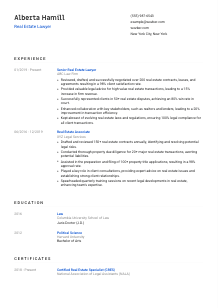
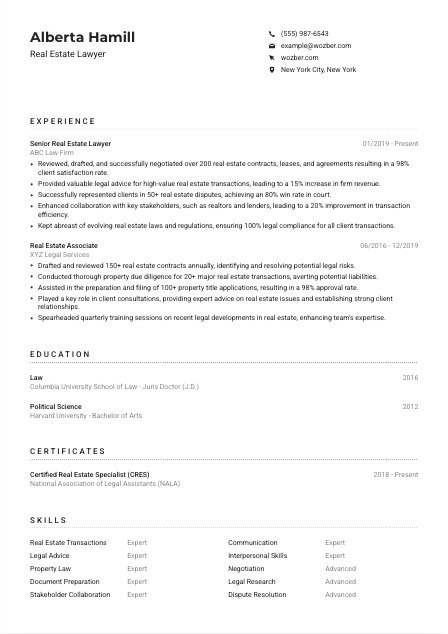
Do not stop at "drafted agreements" or "handled transactions." Show the work in terms of outcomes, scope, and matter type. The sample resume does this well by pointing to contract volume, dispute results, transaction support, and stronger stakeholder coordination. That kind of phrasing tells an employer what legal work you actually carried and how effectively you delivered it.
Metrics work well here when they reflect the profession naturally: number of contracts reviewed, transaction value or volume, dispute win rate, approval rate on title-related filings, revenue tied to client matters, or efficiency gains in closing timelines. "Negotiated over 200 real estate contracts" or "achieved an 80% win rate in court" says far more than broad claims about being results-driven.
Prioritize experience that shows command of property law, financing, leasing, title work, compliance, and client representation. If you have broader legal experience, keep only the pieces that support your candidacy for this practice area. A focused record reads far better than a mixed list of unrelated legal tasks.
By the end of this section, an employer should be able to tell what kinds of real estate matters you have handled, how much responsibility you carried, and whether your work improved transactions, reduced risk, or held up in dispute settings.
Education matters differently in legal resumes than in many other professions. Employers need to see the baseline legal qualification quickly, then any academic details that strengthen your credibility in real estate, property, finance, or related practice areas.
The posting explicitly requires a Juris Doctor from an accredited law school, so that degree should be listed clearly and without delay. If your bar admission is included elsewhere, make sure the education section still leaves no doubt that you meet the core legal training requirement.
Use a clean format with school, degree, field of study, and graduation year. Legal hiring does not need decorative formatting here. It needs accuracy and a structure that lets reviewers confirm your qualifications quickly.
Your undergraduate degree can stay concise, but keep it if it adds context to your analytical training or industry fluency. In the example, a Bachelor of Arts in Political Science complements the J.D. without distracting from the main legal qualification.
If you studied property law, land use, real estate finance, secured transactions, zoning, or related subjects in a meaningful way, mention them when they reinforce your practice area. This is especially useful for earlier-career candidates whose transaction record is still developing.
Law review, honors, moot court, or academic awards can add value, particularly if they point to strong legal writing, research, or advocacy. Keep them brief and relevant. Once you have several years of practice, these details should support, not overshadow, your matter experience.
Your education section should settle the foundational question quickly: you have the legal training required to practice, and your academic background supports the kind of real estate work this employer handles.
Certifications are rarely the core of a Real Estate Lawyer resume, but they can strengthen it when they connect to the way you practice. They are most useful when they show specialized knowledge, software familiarity, or ongoing development in transactional real estate work.
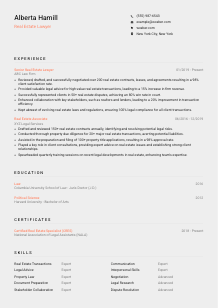
Choose certifications that reinforce real estate transactions, title work, leasing, compliance, or closely related legal specialization. In this example, a real-estate-focused credential supports the candidate's positioning, especially since the posting mentions familiarity with real estate software or platforms.
Do not crowd this section with generic seminars or low-signal certificates. A short list of relevant credentials is stronger than a long inventory. Pick the certifications that help an employer connect your background to deal work, client advisory work, or specialized systems used in the field.
If a credential is current, active, or recently earned, include the date. That is particularly useful for certifications linked to software platforms, continuing legal education, or specialty areas where current knowledge matters.
Real estate law changes with case law, regulation, financing practices, and transaction technology. Continuing education in leasing, title issues, land use, or digital transaction platforms helps you stay current and gives you stronger material for future applications.
Use certifications to reinforce your specialty, not to compensate for missing experience. When they are relevant and current, they add another layer of credibility to your real estate practice.
A skills section should read like a compact map of your legal practice. For this role, that means balancing technical legal capability with the client-facing and deal-facing skills that keep transactions moving and disputes under control.
Go beyond the surface wording of the posting and identify the real capabilities underneath it. Reviewing and negotiating agreements points to contract drafting, negotiation, issue spotting, and risk allocation. Due diligence and title examinations point to legal research, document analysis, and transaction support. Court appearances point to dispute resolution and advocacy.
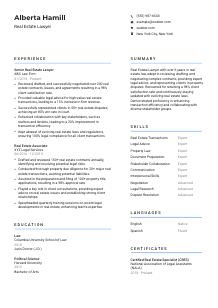
Use skill names that align naturally with the posting, such as real estate transactions, property law, legal advice, negotiation, and stakeholder collaboration. The sample resume handles this well by staying close to the vocabulary of the role instead of filling the section with broad legal terms that could belong to any attorney.
Keep the list focused on capabilities that matter in day-to-day real estate practice. A shorter list of precise skills is more convincing than a long one padded with generic items. If you include soft skills like communication or interpersonal skills, anchor them with stronger legal and transactional skills so the section still reads like a specialist's profile.
Your skills should show that you can handle the documents, negotiations, legal analysis, and stakeholder coordination that real estate matters demand. Precision matters more than length.
Language ability can matter in real estate law because the work is client-facing and often involves negotiations, explanations of legal risk, and coordination across multiple parties. Even when English is the only stated requirement, additional language fluency can broaden the kinds of clients and matters you can support.
This posting asks for proficient English speaking skills, so list English clearly with an honest level such as Native or Fluent. For a lawyer, this is not a minor point. Drafting contracts, advising clients, negotiating terms, and appearing in court all depend on precise language control.
If you can work with clients, brokers, or counterparties in another language, include it. In a market like New York City, languages such as Spanish, Mandarin, or Russian can be especially useful in residential, commercial, or investor-side matters, though they are an advantage rather than a universal requirement.
Use clear levels such as Native, Fluent, Intermediate, or Basic. That helps employers judge whether the language is strong enough for client communication, document review support, or only conversational use.
If a second language helps you work directly with a specific client base, explain that elsewhere in your experience or summary if it is relevant. The language section itself can stay short, but it may support a broader story about client service and market reach.
Only include languages you would be comfortable using in a professional context. When they are real working tools, they can strengthen your profile in negotiations, client counseling, and cross-party coordination.
For a Real Estate Lawyer, language skills can support clearer client communication and wider market coverage. List them accurately and only when they add genuine professional value.
The summary should give an employer a quick read on your legal specialty, years of practice, and the kind of real estate matters you handle well. In a few lines, it should connect your experience to the work this employer needs covered.
Before writing the summary, identify the practice priorities in the posting. Here, those include contracts and leases, transaction support, due diligence, title examinations, dispute representation, and coordination with lenders and title companies. Your summary should reflect the parts of that list that genuinely match your background.
Lead with a direct statement such as your title and years of experience in real estate law. The sample summary does this effectively by establishing more than 6 years in the practice area before moving into contract work and legal advice. That opening immediately places the candidate in the right legal lane.
Follow with the strongest practice-relevant points from your record, such as complex contract negotiation, transaction counsel, title or due diligence work, dispute results, client satisfaction, or improved closing efficiency. Choose highlights that show how you operate as a lawyer, not just what tasks you have touched.
Aim for a concise paragraph, not a biography. Four or five lines are usually enough to establish your practice area, level, and standout value. If every sentence names real estate work, legal responsibility, or measurable outcomes, the section will do its job well.
A strong summary should quickly tell an employer that you are a practicing Real Estate Lawyer with relevant matter experience and the judgment to handle transactions, negotiations, and client advice with confidence.
A Real Estate Lawyer resume should make your transaction work, drafting strength, negotiation range, and client counsel easy to follow from top to bottom. When those elements are aligned to the posting, your application feels far more credible than a generic legal resume.
Wozber's free resume builder can help you organize that experience into an ATS-friendly resume template, and its ATS resume scanner can help you match your language to the role's required work without slipping into keyword stuffing. The result should be a resume that makes your real estate practice, bar-ready professionalism, and deal-side value clear at a glance.




