



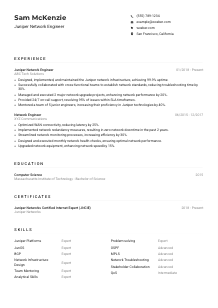
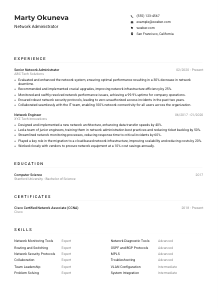
Use Wozber and land your dream job
Create Resume
No registration required
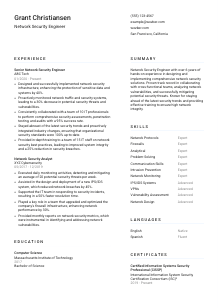
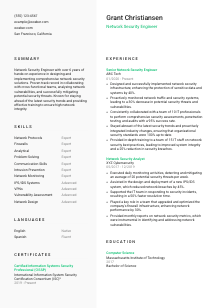
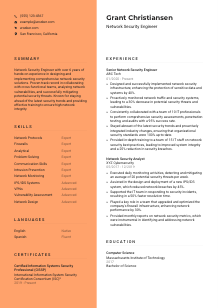
Fending off virtual threats, but your resume feels exposed? Check out this Network Security Engineer resume example, built with Wozber free resume builder. Learn how to align your cybersecurity know-how with job requisites, cementing your career as a guardian of secure networks!
Network Security Engineers are hired to protect environments that cannot afford blind spots. A resume for this work has to make your technical judgment visible quickly, especially around secure network design, threat detection, incident response support, and the practical upkeep of controls such as firewalls, IDS or IPS, and VPNs. Vague cybersecurity language will not carry much weight if the document does not show what you actually secured, monitored, improved, or reduced.
Screening often starts by separating broad IT security backgrounds from candidates who have hands-on network security depth. That is where targeted wording matters. Wozber's free resume builder helps you align your experience with the job description in an ATS-friendly resume format, so core terms like network protocols, security infrastructure, assessments, and monitoring appear naturally and make your operating scope easier to recognize.
This section should identify you fast and remove avoidable questions. For a Network Security Engineer, that means clear contact details, the exact target title, and any practical information that affects eligibility, such as location when the posting specifies it.
Use your full name as the clearest heading on the page. Keep the formatting clean and slightly more prominent than the rest of the resume so it anchors the document immediately. No icons, nicknames, or extra labels are needed here.
Place "Network Security Engineer" under your name if that is the role you are targeting. This is especially useful when your recent title was something adjacent, such as Network Security Analyst or Security Engineer, because it helps position your background for the specific opening from the first line.
List one phone number and a professional email address you check regularly. If you include a LinkedIn profile or personal site, make sure it supports the same story as the resume, such as certifications, security projects, or technical writeups relevant to networking and cyber defense.
Some network security roles are tied to on-site access, regulated environments, or local response expectations. This example specifically asks for San Francisco, California, so showing that location in your header removes an immediate screening obstacle. If a role does not mention location, keep the line concise and practical.
A portfolio is optional in this field, but a strong LinkedIn page, GitHub repository, or personal site can help if it includes security labs, network architecture work, tooling projects, or conference material. Skip anything outdated or loosely related. Every link should reinforce your credibility with network infrastructure and security operations.
When this section is accurate and job-aligned, the hiring team can move straight to your security background instead of stopping on logistics. That is exactly what you want at the top of a Network Security Engineer resume.




This is the section most likely to decide whether you move forward. Hiring teams want to see how you handled real network security work, what systems you touched, how you measured outcomes, and whether your scope matches the environment they need to protect.
Before rewriting your bullets, isolate the role's working priorities. Here, the recurring themes are network security infrastructure, traffic monitoring, threat response, assessments, penetration testing, audits, and training other IT staff. Those priorities should shape the order and wording of your experience so the reader can map your background to the opening without guesswork.
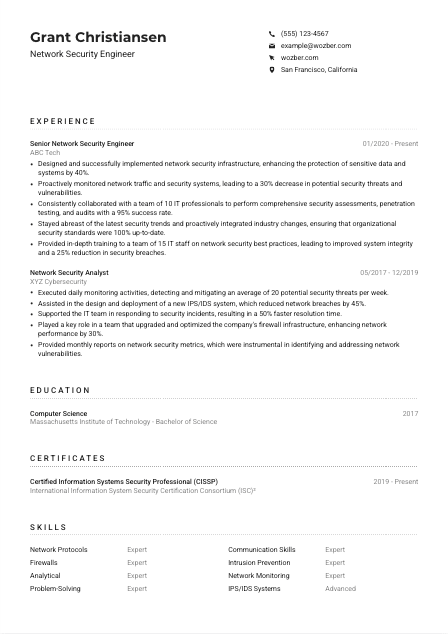
List each position with job title, employer, and dates, starting with the most recent role. For security hiring, progression matters. A move from Network Security Analyst into a Senior Network Security Engineer role, as shown in the example, immediately tells the reader that your scope expanded from monitoring and support into architecture, implementation, and team collaboration.
Each bullet should show what you worked on, what you did, and what changed because of it. Strong examples in this field include designing network security infrastructure, tuning firewall or IDS rules, reducing incident volume, improving response time, or contributing to audit and assessment outcomes. The sample resume does this well with bullets like improving protection by 40% and cutting potential threats by 30%, which makes the work concrete instead of abstract.
Use numbers that make sense for network security operations. That might be threat reduction, resolution speed, breach reduction, audit success rate, uptime preservation, reporting cadence, number of systems covered, or staff trained. The example's "20 potential security threats per week" and "50% faster resolution time" are useful because they reflect real operational performance, not generic productivity claims.
Prioritize experience tied to network devices, protocols, segmentation, secure access, vulnerability assessment, incident handling, and collaboration with infrastructure or IT teams. If you have broader IT or general security work, keep only the parts that strengthen your case for network security engineering. A focused set of five relevant bullets is usually stronger than a long list that buries firewall, IPS, VPN, or monitoring work under unrelated tasks.
A strong experience section shows that you have already protected networks in ways that resemble the target environment. Titles matter, but the bullets need to show technical ownership, measurable outcomes, and steady judgment under security pressure.
Education is often a straightforward section in infrastructure security hiring, but it still serves a practical purpose. It confirms that you meet the academic baseline and can support a technically demanding role built around networks, systems, and security architecture.
This posting calls for a bachelor's degree in Computer Science, Information Technology, or a related field. If you hold one of those degrees, place it clearly so the requirement is easy to confirm. If your degree is in a related discipline, use the exact field name and let the rest of your resume show how it connects to network security work.
Include degree, field of study, school, and graduation year or date range. That is enough for most experienced Network Security Engineers. The example, "Bachelor of Science, Computer Science, Massachusetts Institute of Technology," works because it is clean and complete without overexplaining.
When your education lines up directly with the posting, there is no reason to bury it. A Computer Science degree supports the networking, protocol, systems, and analytical background many employers expect for this kind of role. Put the degree name and field in plain view rather than abbreviating them into something harder to parse.
Most candidates with 5+ years of experience do not need a long academic breakdown. Still, relevant coursework or capstone work can help if it strengthens a weaker area, such as network architecture, information assurance, secure systems, or cryptography. Use this selectively, especially if your professional experience already covers those areas in depth.
Honors, scholarships, or relevant research can be worth mentioning when they point to technical rigor or early specialization in networking or security. If they do not add much to your current profile, leave them out and keep attention on your hands-on engineering experience.
For an experienced Network Security Engineer, education should confirm the baseline without taking attention away from infrastructure, monitoring, and security delivery. Clear formatting is usually all you need.
Certifications carry real weight in network security because they help show current knowledge in a field where tools, attack paths, and defensive practices change constantly. They are especially useful when the posting names specific credentials or says you must already hold one or be able to obtain one.
This employer mentions CISSP, CCNP Security, and GIAC as recognized options. That tells you two things. First, certification matters here. Second, the hiring team values both broad security knowledge and network-focused specialization. If you have one of the listed credentials, make it easy to find.
Lead with credentials tied to security architecture, network defense, or secure operations. In the example, CISSP and CCNP Security work well together because one signals broad security competence while the other speaks directly to network security depth. If you hold several certifications, do not crowd the section with expired or less relevant ones that dilute the focus.
Include the certification name, issuing body, and active date or earned year. This matters in security hiring because current credentials often carry more weight than old ones, especially when technologies and standards evolve quickly. Clear dates also prevent confusion about whether a certification is active, renewed, or historical.
If you do not yet have one of the listed certifications, note progress only when it is real and current, such as an exam scheduled or coursework underway. Ongoing certification development is common in this field, especially for engineers moving toward senior design responsibility, audit participation, or broader security leadership.
Good certifications support the story told by your experience. They should strengthen your case for handling secure network design, monitoring, and incident defense, not sit on the page as unrelated badges.
This section should read like a practical snapshot of how you operate, not a generic cybersecurity keyword bank. Hiring teams look for a mix of core network security technologies, security operations capabilities, and the judgment needed to work across IT, compliance, and incident response conversations.
Read beyond the explicit skill list in the posting. This description points to network protocols, network devices, firewalls, IPS or IDS, VPNs, monitoring, assessments, penetration testing support, and communication. Those are not interchangeable buzzwords. They describe the actual control areas and working habits the role depends on, so your skills section should echo the ones you genuinely use.
Start with technical capabilities such as firewalls, network monitoring, intrusion prevention, VPNs, vulnerability assessment, and network design. Then include a smaller set of supporting skills that matter in security work, like analytical problem-solving, written communication, or training others on best practices. The example resume handles this balance well by pairing tools and concepts with analytical and communication strengths.
Place the most job-relevant skills first, especially the technologies and functions mentioned in the posting. If your format allows ratings, keep them believable and consistent. Whether you use proficiency levels or a plain list, the section should help the reader confirm that you can work with the network security stack they care about, not force them to hunt through paragraphs for terms like IPS, VPN, or network protocols.
Every item here should connect back to a project, toolset, incident, or operational responsibility from your experience. If the skills section and experience section reinforce each other, your technical profile reads much more convincingly.
Language is not usually the biggest decision point for Network Security Engineer roles, but it can matter when a posting calls it out directly. In security work, reading precision matters. Policies, vendor documentation, threat intelligence, audit findings, and incident reports all depend on careful comprehension.
This posting specifically requires the ability to read complex texts in English. If English is one of your working languages, list it clearly with an honest proficiency level. That helps confirm you can handle documentation, security advisories, configuration guidance, and written communication tied to the role.
After the required language, include additional languages if they are relevant to the environments or teams you work with. Multilingual ability is not a core requirement for every network security role, but it can help in global organizations, distributed operations teams, or support contexts where cross-border communication is routine.
Terms like Native, Fluent, Intermediate, and Basic are usually enough. Avoid inflating your level. In technical roles, overstating language ability can quickly create issues when documentation review, report writing, or stakeholder communication becomes part of the interview process.
Unless the job has a strong international or multilingual component, this section should stay brief. One required language and one additional language, as in the example with English and Spanish, is often enough to cover the point without pulling attention away from your security background.
For this profession, language skills matter most when they support technical understanding and cross-team communication. Keep the section concise and directly tied to how the work gets done.
The summary sits at the top of the resume, so it should frame your experience in terms that make sense for network security hiring. A hiring manager should understand your level, your specialty, and the kind of environments or outcomes you have handled within a few lines.
Use the posting to decide what belongs in the opening lines. Here, the emphasis is on network security infrastructure, monitoring, threat response, assessments, and current security practices. Those themes should shape your wording more than broad cybersecurity statements that could apply to dozens of different roles.
Open with your professional identity and relevant tenure, such as "Network Security Engineer with 6+ years of experience" if that is accurate. Then specify your focus, whether that is designing secure network environments, hardening infrastructure, monitoring traffic, or reducing vulnerabilities across enterprise systems.
Highlight the capabilities that matter most for the target role, then tie them to outcomes or scope. The example summary works because it mentions designing and implementing security solutions, collaborating across teams, analyzing vulnerabilities, and mitigating threats. You can strengthen yours further with one concrete result, tool area, or environment detail if space allows.
Aim for 3 to 5 lines. Avoid soft opening claims that do not tell the reader anything about your network security practice. A concise summary that references infrastructure protection, threat reduction, assessments, certifications, or training responsibilities will do far more than generic statements about passion or results-driven performance.
A good summary tells the reader, early and clearly, that your background belongs in a network security engineering conversation. Once that framing is in place, the rest of the resume can support it with tools, metrics, and delivery history.
Your final resume should make it easy to see where you have designed secure network infrastructure, monitored traffic, reduced risk, and supported assessments or audits. That is the level of clarity hiring teams need when they are reviewing candidates with overlapping security backgrounds.
Wozber's free resume builder can help you shape that story into an ATS-compliant resume, strengthen wording with role-specific terminology, and refine sections through ATS optimization and the ATS resume scanner. The finished document should show, without much interpretation, that you can protect networks, respond to threats, and operate at the level the role requires.