



Use Wozber and land your dream job
Create Resume
No registration required
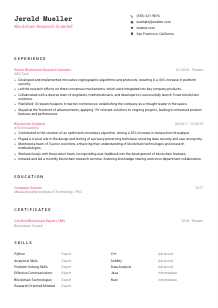
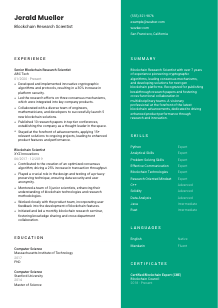
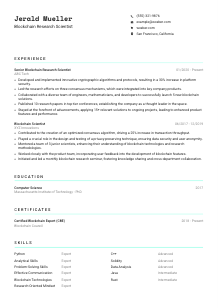
Decoding data chains, but your resume feels chained up? Sync up with this Blockchain Research Scientist resume example, created with Wozber free resume builder. Learn how to pin your research credentials to job requirements, so your career in decentralized solutions stays on the cutting edge!
Blockchain research hiring rarely turns on broad claims about innovation. Teams want to see whether you can move from theory to protocol design, analyze consensus tradeoffs, and turn cryptographic research into systems that improve security, privacy, throughput, or scalability. Your resume needs to make that technical depth visible quickly.
A tailored resume also changes how your background is read by both reviewers and screening systems. Wozber's free resume builder helps you align your wording with the role's research focus and create an ATS-compliant resume that clearly surfaces work in cryptographic protocols, consensus mechanisms, and blockchain implementation, so hiring teams can spot the right blend of publication record and applied engineering faster.
For a Blockchain Research Scientist, the header does more than identify you. It confirms practical requirements up front and points reviewers toward the research profile behind your application. Keep this section clean, accurate, and directly tied to the role you want.
Use your full name in a slightly larger font than the rest of the resume so it anchors the page immediately. In research-driven hiring, clear identity matters because your name may also connect to publications, conference papers, patent filings, GitHub work, or university profiles.
Place "Blockchain Research Scientist" directly under your name if that is the position you are pursuing. This helps frame the rest of the resume around protocol research, applied cryptography, and blockchain systems work instead of leaving your profile open to broader labels like software engineer or data scientist.
Include a current phone number and a professional email address that you check regularly. If a hiring manager wants to discuss your consensus research, publication history, or Solidity experience, they should not have to work around outdated details or casual email formatting.
If the posting specifies location, include it plainly in your header. In the example role, listing San Francisco, California immediately answers a stated requirement and removes a common point of hesitation before the hiring team even reaches your research background.
Include a personal website, Google Scholar profile, GitHub, or other professional page if it strengthens your candidacy. For this profession, the best links support your resume with papers, protocol writeups, code samples, audits, or open-source blockchain research rather than generic social content.
Do not add age, marital status, photo, or other personal details unless a specific market requires them. Blockchain research roles are evaluated on academic training, protocol work, implementation skill, publication quality, and collaboration across engineering and research teams.
Keep the top of the resume factual and useful. When your role title, contact details, location, and research links are easy to review, the reader can move straight to the work that proves your depth in blockchain science.




This is where a Blockchain Research Scientist resume earns attention. Hiring teams look for concrete proof that you have designed protocols, studied consensus behavior, improved security or performance, and worked closely enough with engineers to move research into production-grade systems.
Start by identifying the work themes repeated in the posting. For this role, the priorities are clear: cryptographic protocols, consensus algorithms, blockchain technologies, research output, and cross-functional collaboration. Those themes should shape which projects, bullets, and technical achievements you emphasize first.
List your most recent position first and keep each entry easy to scan. For every role, include the title, organization, and dates so reviewers can quickly understand the level, continuity, and progression of your blockchain research career.
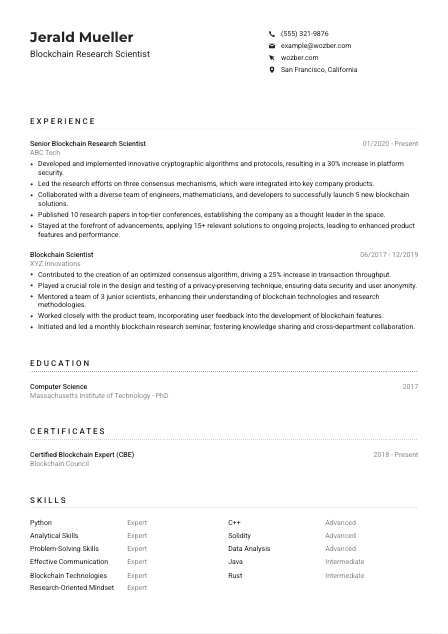
Focus each bullet on work that matters in this field: designing a protocol, analyzing a consensus mechanism, implementing privacy-preserving methods, testing scalability improvements, or publishing findings. The example resume does this well by describing cryptographic algorithm development, consensus research, and product integration instead of relying on vague claims about innovation.
Numbers carry weight when they reflect how blockchain work is actually measured. Use metrics such as security improvement, transaction throughput, latency reduction, papers published, solutions launched, or number of protocols integrated into products. A bullet like "increased platform security by 30%" or "improved transaction throughput by 25%" gives hiring teams a far clearer picture than "improved performance."
Trim accomplishments that do not support the target role. For a research scientist position, protocol design, cryptographic analysis, peer-reviewed publication, benchmarking, and collaboration with engineers or mathematicians should take priority over general software tasks unless those tasks directly supported blockchain research or implementation.
By the end of the experience section, the reader should understand the scale of your research, the technical problems you worked on, and the results your work produced in real blockchain systems or respected research venues.
Education carries unusual weight in blockchain research hiring because the work often sits at the intersection of computer science, cryptography, mathematics, and distributed systems. This section should make your formal training easy to confirm and easy to connect to the role's technical demands.
If the posting asks for a PhD, place that credential first and make it unmistakable. Here, a PhD in Computer Science, Cryptography, Mathematics, or a related field is a core requirement, so your doctorate should be one of the easiest details to find on the page.
Keep each education entry structured and compact so the substance stands out. Include the field of study, degree earned, institution name, and graduation year or completion date if appropriate.
Use your degree titles and fields exactly as they appear officially, especially when they map closely to the posting. In the sample resume, the PhD in Computer Science immediately satisfies the educational baseline, while the additional degrees reinforce long-term depth in technical and mathematical work.
Senior candidates usually do not need a long course list. Include coursework only when it sharpens your fit, such as advanced cryptography, distributed systems, zero-knowledge proofs, game theory, or formal methods, and only if that detail strengthens your case beyond the degree itself.
Honors, fellowships, dissertation topics, teaching assistantships, or major research awards can be useful when they connect to blockchain science. Choose distinctions that reinforce analytical rigor, publication quality, or depth in relevant areas rather than listing every university activity.
For this profession, education is not filler. It establishes the theoretical base behind your protocol design, research methods, and technical judgment, so present it with the same clarity you would use in a paper abstract.
Certifications are usually secondary to your research record, degree, and technical work, but they can still strengthen a blockchain application when they reflect current domain knowledge. Keep this section selective and tied to the target role rather than treating it as a catch-all list of courses.
Some blockchain research roles mention a certification and others do not. If the employer calls out a blockchain specialization or related credential, include the exact certification that matches. In this example, a blockchain-focused certification is worth listing because the description explicitly leaves room for it.
Choose certifications that support your work in blockchain architecture, cryptographic systems, smart contracts, or specialized protocol knowledge. A focused credential such as a blockchain expert certification helps more than a long list of generic online courses with weak connection to research work.
Add the issue date and renewal period if applicable. In fast-moving areas such as privacy techniques, smart contract security, and blockchain infrastructure, date information helps reviewers understand whether the credential reflects current knowledge or older exposure.
Use this section to reflect continued learning in areas that matter to the profession, such as zero-knowledge systems, rollups, formal verification, cryptoeconomics, or secure protocol design. That matters most when your recent certificate supports the direction of the role you are targeting.
Certifications will not replace a PhD, publications, or strong protocol work, but the right one can reinforce your specialization and show that you stay current in a field that evolves quickly.
A Blockchain Research Scientist skills section should read like a concise map of your technical toolkit and working style. Reviewers want to see the languages, research capabilities, and collaboration strengths that support protocol design, analysis, experimentation, and implementation.
Separate the must-have skills from the supporting ones before you start listing anything. For this role, that means putting cryptographic protocols, consensus algorithms, blockchain technologies, Python, C++, Solidity, analytical strength, and collaboration near the top because they are central to the actual work described.
List the hard skills that let you build and test blockchain systems alongside the professional skills that matter in research environments. Programming languages, distributed systems knowledge, cryptography, data analysis, and smart contract development belong here, as do analytical problem-solving and the ability to communicate findings to engineers, product teams, and other researchers.
Do not bury the important skills under a long inventory. Put the most relevant capabilities first, group them logically if your format allows it, and make sure the section reflects the target role rather than every tool you have touched. The sample resume works because Python, blockchain technologies, C++, Solidity, and research-oriented strengths are all easy to spot quickly.
This section should let a reviewer identify your technical stack and research profile in seconds. Lead with the skills you would actually bring into protocol research, experimentation, and cross-functional blockchain development.
Language ability matters in blockchain research because the role often involves publishing, presenting, documenting, and working across technical teams. Keep this section simple, but make sure it supports the communication demands of the job.
If the posting specifies a language requirement, list it first and use a clear proficiency label. Here, English fluency is essential, so it should appear at the top of the section rather than being buried after optional languages.
Include additional languages when they are real working strengths and may help in international research settings, global developer communities, or collaboration with distributed teams. They are supplementary, but they can still add value in a field with broad global participation.
Terms such as native, fluent, intermediate, and basic are enough. Avoid inflating your level, especially if the role involves presenting research, writing technical documentation, or discussing protocol tradeoffs with cross-functional stakeholders.
Additional languages are most helpful when they support a practical context, such as reading technical material, participating in international collaboration, or communicating with a broader developer ecosystem. For example, Mandarin may be relevant in some research networks, but it should remain secondary unless the role specifically calls for it.
In a research scientist role, language proficiency complements written papers, conference presentations, and collaboration with engineers and product teams. Use the section to support that broader picture of communication rather than treating it as an unrelated extra.
Keep the language section factual and brief. Its job is to confirm that you can write, present, and collaborate at the level the research role demands.
The summary should quickly establish what kind of blockchain researcher you are and where your strongest value sits. In a few lines, it should connect your years of experience, technical focus, and most credible results without drifting into broad claims about passion or innovation.
Read the posting closely and identify the two or three themes that define the job. For this one, a useful summary would foreground blockchain research, cryptographic protocols, consensus mechanisms, and applied work that reaches real platforms or products.
Lead with your title and level of experience so the reader knows your seniority immediately. A line like the sample's "over 7 years of experience" works because it quickly establishes depth before moving into specialization.
Choose two or three details that show credible range, such as published papers, protocol design, security improvements, throughput gains, privacy-preserving research, or cross-functional launches. This is where you show whether your work stays theoretical or has also shaped deployed blockchain solutions.
Aim for a compact paragraph with precise language. Avoid adjectives that could apply to anyone and favor concrete terms tied to your work, such as cryptographic algorithms, consensus research, scalability, publication record, and blockchain platform performance.
A well-written summary gives the hiring team a fast technical read on your background and focus. By the time they move into the experience section, they should already understand the kind of blockchain research problems you are equipped to solve.
With these sections aligned, your resume should present a coherent case for blockchain research work: advanced academic training, applied protocol and consensus experience, measurable technical outcomes, and communication strong enough for papers, product collaboration, and multidisciplinary teams.
Use Wozber to tighten the wording, check ATS optimization, and structure everything in an ATS-friendly resume format that keeps your cryptography, blockchain, and research credentials easy to parse. The finished document should make it clear, quickly, that you can contribute both to frontier research and to blockchain systems that need to work in practice.




