




Use Wozber and land your dream job
Create Resume
No registration required
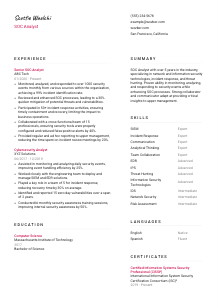
Defending networks, but your resume feels vulnerable? Check out this SOC Analyst resume example, built with Wozber free resume builder. Learn how to translate your cyber-sleuth skills and risk assessment acumen to line up with job criteria, so your career's security profile stays breach-proof!
SOC hiring moves quickly when a resume makes the operational work easy to recognize. Teams want to see how you handle alert volume, investigate suspicious activity, support containment, and improve monitoring without losing sight of business impact. If your resume stays vague about incident response, tooling, or measurable outcomes, it can read more like general IT support than frontline security operations.
A tailored resume helps separate true SOC experience from adjacent cybersecurity work by showing the tools, workflows, and results that matter in day-to-day defense. Wozber's free resume builder helps you align your wording with the posting, keep an ATS-compliant resume structure, and surface terms such as SIEM, EDR, threat hunting, and incident response in the sections where hiring teams expect to find them. That gives reviewers a faster read on whether you can step into monitoring, triage, and escalation with confidence.
The top of a SOC Analyst resume should remove friction right away. In security hiring, small details matter because the work itself depends on accuracy, escalation paths, and clean documentation. Your contact information does not need flair. It needs to be precise, professional, and aligned with any clear requirement in the posting.
Use your full name as the main header in a clean, readable font. Keep it more prominent than the rest of the contact block so the resume is easy to reference during interview loops, ticket reviews, or internal handoffs between recruiters and security leads.
Place "SOC Analyst" beneath your name when that is the role you are pursuing. This immediately frames your background around monitoring, analysis, incident handling, and security operations instead of broader IT or general cybersecurity work.
List one phone number you answer and a professional email address, ideally in a straightforward format such as firstname.lastname@email.com. Hiring teams often move quickly when screening security candidates, so make it easy to reach you without hunting through extra links or informal usernames.
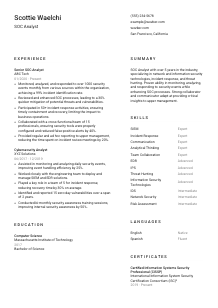
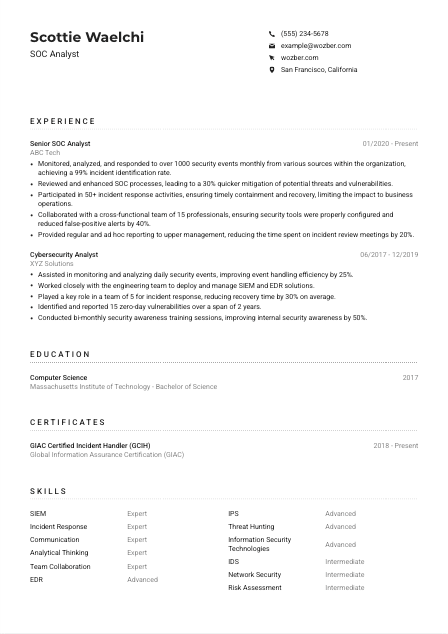
If the posting requires a specific location or relocation, show that clearly in this section. Here, listing "San Francisco, California" directly supports the stated requirement and removes a common screening question before it starts. If you are relocating, make that clear without adding a full street address.
Include LinkedIn or another professional profile if it strengthens your application. For SOC roles, that profile should reflect the same dates, titles, certifications, and security focus shown on your resume. Consistency matters when employers are checking for a clear progression from analyst work into incident response, threat detection, or tool administration.
Your personal details should confirm that you are reachable, professionally presented, and already aligned with any practical filter in the posting. Wozber's free resume builder makes that top section easy to organize so the hiring team can move straight to your security experience.




This is the section security leaders read most closely. SOC resumes are strongest when they show how you worked inside an alerting environment, what kinds of incidents you handled, which tools you used, and how your actions improved detection, triage, containment, or reporting. General claims about being "responsible for security" do not carry much weight without that operating detail.
Start with the posting's core responsibilities and map your experience to them. For this role, that means security event monitoring, incident response, process improvement, tool configuration support, and reporting to management. Write bullets that mirror that workflow so the reader can immediately connect your background to a live SOC environment.
List roles in reverse chronological order with job title, employer, and dates. Give the clearest, most relevant security title possible. A progression from Cybersecurity Analyst to Senior SOC Analyst, as shown in the example, quickly tells the employer that your work has moved from supporting detection and tooling into owning investigations and response.
Each bullet should show what you handled and what changed because of your work. "Monitored, analyzed, and responded to over 1000 security events monthly" is effective because it shows alert volume, analytical responsibility, and hands-on response in one line. Use this same approach for triage, escalation, rule tuning, hunting, or post-incident review.
SOC work produces metrics, so use them. Strong numbers include event volume, false-positive reduction, incident identification rate, recovery time, mean time to respond, escalation accuracy, or reporting efficiency. The sample bullets do this well with figures such as a 40% reduction in false positives and a 30% faster mitigation cycle, both of which translate directly to SOC performance.
Prioritize accomplishments tied to detection engineering, incident handling, cross-functional coordination, and process improvements. If a bullet does not help the employer picture you inside a SOC workflow, trim it or reframe it. Even worthwhile work should support the target role, whether that is SIEM administration, EDR response, vulnerability identification, or security reporting cadence.
By the end of your experience section, a reviewer should understand the scale of your monitoring work, the incidents you have helped manage, and the operational improvements you delivered. Wozber's ATS-friendly resume format helps keep those wins readable to both screening systems and security leaders.
Education matters in SOC hiring when it confirms the technical foundation behind your analysis work. It will not outweigh solid incident response experience, but it does help establish grounding in computer science, networks, systems, and security concepts that feed into daily monitoring and investigation.
If the posting asks for a bachelor's degree in Computer Science, Information Technology, or a related field, place that information clearly and early in the section. A Bachelor of Science in Computer Science, like the example uses, directly answers the stated requirement without extra explanation.
List degree, field of study, school, and graduation year in a clean order. Recruiters and hiring managers should be able to confirm your academic background in seconds, especially when they are balancing that check against stronger factors such as SOC experience and certifications.
Degrees in computer science, information technology, cybersecurity, or related disciplines already speak to your baseline knowledge. You do not need to overstate them. Simply presenting the right field clearly can reinforce your readiness for work involving log analysis, network security concepts, and incident investigation.
If you are earlier in your career, relevant coursework or academic projects can help fill out this section. Focus on items that connect to SOC work, such as network defense, operating systems, malware analysis, digital forensics, or security architecture. Skip generic classes that do not sharpen your security profile.
Honors, notable projects, or security competition work can add value when they relate to detection, response, or technical problem solving. Keep them brief. Once you have a few years of SOC or cybersecurity experience, this section should stay supportive rather than trying to carry the whole resume.
Your education should quietly establish the technical base behind your security operations work. With an ATS-friendly resume template from Wozber, the section stays clean, searchable, and easy to verify alongside your hands-on experience.
For SOC roles, certifications often help validate the depth of your security knowledge, especially around incident handling, security operations, and broader information security practice. They are particularly useful when the job description names specific credentials or when you want to show continued growth beyond your degree.
When a job description calls out credentials such as GCIH or CISSP, put those first if you hold them. That is direct alignment, not decoration. In this case, listing both immediately supports the employer's preference for analysts with recognized incident response and security leadership knowledge.
Lead with certifications tied to monitoring, incident response, threat analysis, network defense, or platform expertise. If you have a longer list, do not bury the most relevant ones under unrelated coursework or entry-level badges. The first credentials shown should reinforce your ability to work inside a security operations environment.
Security moves fast, so dates matter. Showing when a certification was earned, or that it remains active, helps the employer understand how current your training is. The example's "2018 - Present" and "2019 - Present" format works well for credentials that require ongoing maintenance.
A concise certifications section already signals that you invest in staying current. There is no need for extra commentary about lifelong learning. Let current, relevant credentials do that work, especially if they support areas like incident handling, threat hunting, governance, or advanced security operations.
Relevant certifications can sharpen your resume quickly because they connect your experience to recognized security standards and training. When you align them to the posting with Wozber, they reinforce your technical credibility before the first interview.
A SOC Analyst skills section works best when it reads like the environment you can operate in. Hiring teams look for a mix of platform knowledge, analytical ability, and communication skills that support detection, triage, response, and reporting. Random keyword lists weaken this section. Focused skills make it useful.
Read the job description closely and note both the technologies and the workflows. Here, the obvious technical priorities include SIEM, EDR, NGFW, IDS/IPS, incident response, and threat hunting. Those terms should appear if they reflect your actual experience, because they describe the core toolset and methods of the role.
SOC hiring is not only about tools. Add skills that show how you work with those tools, such as analytical thinking, event correlation, escalation judgment, reporting, and cross-functional collaboration. The example does this by pairing platforms like EDR and IPS with human-side strengths such as communication and team collaboration.
Do not dump every security term you know into one section. Prioritize the technologies, methods, and working strengths that are most relevant to the job you want. A focused list makes ATS optimization cleaner and gives the hiring manager a fast picture of whether your background matches their SOC environment.
Your skills section should show that you understand the tools, terminology, and day-to-day judgment the role requires. Wozber's ATS optimization helps you align those terms with the posting while keeping the section natural and readable.
SOC work depends on communication as much as analysis. Analysts write incident notes, escalate urgent issues, brief stakeholders, and sometimes explain technical risk to people outside the security team. If the posting mentions language ability, treat it as a practical requirement rather than a minor extra.
If the job requires strong English communication, list your English proficiency directly. A simple entry such as "English: Native" or "English: Fluent" is enough to show that you can document incidents, join response calls, and write clear updates for management.
Lead with the language named in the posting, then any others that could support the job. For many SOC environments, English comes first because it is the language of ticketing systems, incident documentation, and cross-team coordination.
Extra languages can be useful in global companies, follow-the-sun SOCs, or organizations working across regions. If you also speak Spanish, as in the example, include it. It may support collaboration across distributed teams even when it is not a formal requirement.
Choose clear levels such as Native, Fluent, Advanced, or Intermediate, and avoid inflating your ability. In a security setting, overstatement can become obvious quickly when the role involves live calls, written summaries, or stakeholder reporting.
Unless multilingual communication is central to the role, keep this section brief. Language skills should support your profile, not compete with the more important proof in your experience, certifications, and technical skills.
Clear language ability supports accurate incident documentation and smoother coordination during investigations. When the role calls it out, your resume should answer that requirement cleanly and without clutter.
Your summary should quickly establish what kind of SOC analyst you are, how much experience you bring, and where your strongest value sits. Avoid generic statements about passion for cybersecurity. The better opening is a compact view of your years in security operations, your technical focus, and the results you tend to deliver.
Start with the main demands of the target job. For a SOC Analyst, that usually means security monitoring, incident response, threat hunting, and familiarity with tools such as SIEM or EDR. Use those themes to shape the summary so it sounds grounded in operational security work from the first line.
A line like "SOC Analyst with over 5 years in security operations" works because it gives immediate context. Add a specialty that fits your background, such as network security technologies, incident response, or threat detection, so the reader knows where your experience is strongest.
Include a brief result that supports your credibility, especially if it ties to SOC performance. The sample summary mentions monitoring and responding to security events while improving SOC processes, which is effective because it combines operational work with measurable improvement. You can also mention outcomes such as lowering false positives, improving response time, or strengthening reporting to management.
Aim for three to five lines with no filler. This is not the place for a full career story. It should read as a crisp introduction to your monitoring scope, response strengths, tool familiarity, and collaboration style, giving the hiring team a clear reason to keep reading your experience section.
A good SOC summary makes your level, focus, and operational value clear within seconds. Wozber's free resume builder helps you refine that opening so it matches the posting and leads naturally into the evidence below.
A SOC Analyst resume works when it reflects real security operations work in the language employers use to hire for it. Focus on alert monitoring, investigation, incident response, tooling, process improvement, and the metrics that show how you improved detection or recovery.
Use Wozber's free resume builder, ATS-friendly resume templates, and ATS resume scanner to align your wording with the job description, strengthen ATS optimization, and organize your experience in a format that reads clearly to both recruiters and security leaders. The result should make one thing easy to judge: you can step into the SOC and contribute from day one.