



Use Wozber and land your dream job
Create Resume
No registration required
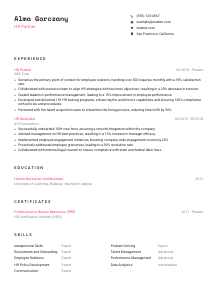
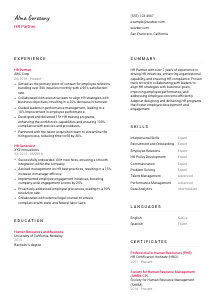
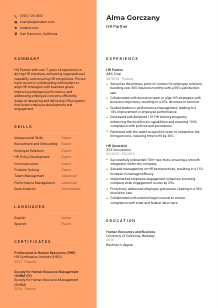
Navigating the dynamics of HR but feeling lost on your resume? Check out this HR Partner resume example, created with Wozber free resume builder. It shows how to connect your strategic HR proficiency with job expectations, ensuring your career narrative is always in perfect partnership with success!
HR Partner hiring usually turns on one question quickly: have you worked as a trusted advisor to managers, not just as an HR support contact. A resume for this role needs to show how you handled employee relations, guided performance conversations, supported hiring and onboarding, and translated business goals into practical people decisions.
When that context is tailored clearly, the resume is easier to rank in both human review and ATS screening. Wozber's free resume builder helps you line up your language with the posting, keep an ATS-compliant resume format, and surface the HR work that matters most first, so hiring teams can quickly see your scope, judgment, and credibility with leaders.
For an HR Partner, the top of the resume should read like someone who is organized, credible, and easy to contact. Keep it straightforward, then tailor the few details that remove friction for the employer.
Place your full name prominently and keep the formatting clean. HR roles deal with policy, documentation, and communication every day, so even simple layout choices should suggest professionalism and consistency.
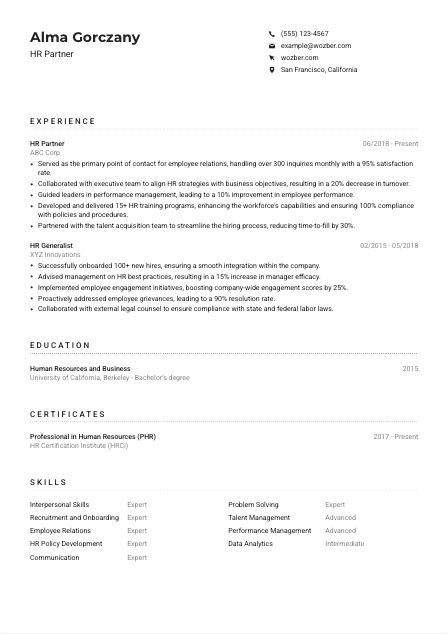
If you are applying for an HR Partner opening, put "HR Partner" beneath your name when it accurately reflects your background. This immediately positions you in the right lane, especially when your previous titles include related roles such as HR Generalist or HR Business Partner.
Include a reliable phone number and a professional email address. HR hiring often moves through several interview stages with recruiters, managers, and leadership, so your contact information needs to be error-free and easy to use.
Location matters when the employer needs someone already based in a specific market. In the example, listing "San Francisco, California" directly supports a stated requirement. Use that kind of detail when it removes doubt about availability or commuting expectations, but do not overemphasize it if the job does not ask for it.
A LinkedIn profile or personal website can strengthen this section if it reflects the same employment dates, titles, and HR focus shown on your resume. For HR Partner candidates, consistency across platforms matters because your role depends on trust, discretion, and clear communication.
Your personal details should answer the practical questions fast: who you are, how to reach you, and whether you match any basic requirements such as location. Keep it clean and credible, then move quickly into the experience that proves your HR judgment.




This is the section where HR Partner resumes usually separate themselves. Hiring teams want to see how you supported managers, handled employee issues, improved people processes, and tied HR work to business outcomes such as retention, performance, compliance, and hiring efficiency.
Read the posting for recurring themes, then map your experience to them. Here, the emphasis is on employee relations, talent management, policy guidance, training, recruitment partnership, and performance management. The sample does this well by aligning experience directly to those needs, such as serving as a primary contact for employee relations and partnering with talent acquisition to reduce time-to-fill.
List your jobs in reverse chronological order with title, employer, and dates. For HR roles, career progression matters. A move from HR Generalist into HR Partner, for example, helps show growing scope, stronger leader partnership, and greater ownership of workforce issues.
Focus each bullet on a real HR responsibility followed by the result. Strong examples include resolving employee concerns, improving manager effectiveness, running onboarding at scale, or delivering training tied to policy compliance. The sample bullet about handling more than 300 employee relations inquiries monthly with a 95% satisfaction rate works because it pairs service volume with a clear outcome.
Numbers are especially useful in HR when they show scale, quality, or business impact. Use metrics such as turnover reduction, engagement score improvement, time-to-fill, onboarding volume, training completion, grievance resolution rate, or policy compliance. A 20% decrease in turnover or a 30% faster hiring process tells a hiring manager much more than "supported retention" or "improved recruitment."
Every bullet should help answer whether you can advise leaders, manage employee issues fairly, and support business goals through sound HR practice. If an accomplishment does not connect to people strategy, compliance, workforce capability, or manager support, it likely belongs off the page. Keep the section focused on partnership, judgment, and measurable HR results.
Your experience section should make it easy to picture you handling real HR Partner work: guiding leaders, resolving employee concerns, improving processes, and delivering outcomes the business can feel. If the bullets show that clearly, the rest of the resume becomes much easier to trust.
Education is usually a straightforward section for HR Partner roles, but it still carries weight when the posting asks for a degree in Human Resources, Business, or a related field. Present it clearly so the requirement is easy to confirm.
If the role asks for a bachelor's degree, list it clearly with the field of study. In the example, "Bachelor's degree" paired with "Human Resources and Business" directly supports the requirement and removes guesswork for the reviewer.
Include the degree, school, field, and graduation year or date. HR resumes do not benefit from overdesigned education sections. Clear formatting helps the reader verify qualifications quickly and move on to the more decision-making-heavy parts of your background.
When your degree aligns with HR, Business, organizational development, or a related discipline, spell that out clearly. If your degree title is broader, your field or concentration can help connect it back to the role's expectations.
Most experienced HR Partner candidates do not need to list classes, but it can help if your coursework supports employment law, organizational behavior, conflict resolution, training, or talent management. Use this selectively and only when it adds something the experience section does not already show.
Honors, leadership roles, or relevant projects can be worth adding if you are early in your career or if they tie directly to HR work. For a more experienced candidate, keep these details brief so the section stays secondary to your hands-on HR accomplishments.
Education should quickly confirm that you meet the academic baseline and have a foundation relevant to HR work. Once that is clear, your resume should return the focus to business partnership, employee support, and operational impact.
Certifications carry real weight in HR because they show current knowledge of employment practices, compliance, and professional standards. When a posting mentions HRCI or SHRM credentials, list them clearly and make them easy to find.
If the employer prefers HRCI or SHRM certification, place those credentials in this section exactly as recognized in the market. The sample uses both PHR and SHRM-CP, which immediately supports the preference stated in the job description.
Do not crowd this section with every workshop or short course you have completed. For an HR Partner role, recognized certifications tied to HR practice, compliance, employee relations, or people management carry the most value.
Dates help show whether the certification is current and whether you have maintained it over time. That matters in HR, where policy interpretation, labor law awareness, and best practices evolve regularly.
An active credential suggests that you stay engaged with changes in the field, from performance management practices to employment regulation. If you are pursuing a certification now, note that only when the exam or completion timeline is real and close enough to matter.
For HR Partner roles, certifications can strengthen trust quickly because they reinforce your grasp of current practice and your commitment to the profession. If the posting names a credential, make sure the reviewer does not have to search for it.
The skills section should echo how HR Partner work is actually performed. That means balancing people-facing strengths with practical HR capabilities such as policy guidance, performance support, onboarding, and talent collaboration.
Start with the capabilities the role depends on every day. In this posting, that includes interpersonal strength, employee relations, talent management, performance management, communication, and knowledge of HR best practices and regulations. Build your list from that operating reality, not from a generic master list.
Lead with skills that map directly to the target role. For example, employee relations, recruitment and onboarding, HR policy development, and performance management tell a clearer HR Partner story than broad terms that could belong on almost any resume.
Group or order skills so the reviewer can scan them quickly. A concise list of role-relevant strengths works better than a long inventory. In the sample, the strongest entries are the ones tied directly to core HR Partner responsibilities, while a broader skill like data analytics adds value as a supporting capability rather than a headline item.
Your skills section should confirm the capabilities already shown in your experience. If the top skills reflect employee relations judgment, manager support, hiring partnership, compliance awareness, and communication strength, the section is doing its job.
Language ability matters in HR because so much of the work depends on clear communication, trust, and accurate interpretation of policy. Keep this section honest and relevant to the environment you will be supporting.
If the job requires English, list it clearly with an accurate proficiency level. That is especially important for HR Partner roles, where the work includes policy conversations, manager coaching, training delivery, and sensitive employee discussions.
Additional languages can be useful when they reflect the employee population or business setting. In the example, Spanish strengthens the profile because it suggests broader communication reach, though it should be treated as an added advantage unless the employer specifically requires it.
Terms such as Native, Fluent, Advanced, or Intermediate help set expectations. Avoid vague descriptions. HR work relies on precision, so the way you describe language ability should be as clear as the rest of the resume.
A second language can be especially valuable in organizations with multilingual teams, frontline workforces, or broad employee service needs. If that applies, the language section can quietly reinforce your ability to build rapport and handle conversations effectively across groups.
List languages because they strengthen your ability to train, advise, explain, and de-escalate, not simply because they look impressive. For HR Partner roles, communication range matters most when it improves employee understanding and manager support.
Treat language ability as a practical communication asset. In HR, that means helping people understand policy, navigate concerns, and engage with the organization more confidently.
The summary needs to establish your level, your HR focus, and the kind of organizational impact you have delivered. For this role, that usually means showing a mix of employee relations judgment, business partnership, manager support, and process improvement in just a few lines.
Use the posting to decide which themes belong in your opening lines. Here, the priority areas are employee relations, talent management, policy guidance, training, recruitment partnership, and performance management. Your summary should reflect that mix rather than describing yourself in broad HR terms only.
Start with a direct identifier such as "HR Partner with 7+ years of experience" or, if more accurate, a related title that still supports the target role. The sample handles this well by establishing seniority immediately and keeping the opening relevant to HR leadership support.
Choose strengths that matter for the job and that you can prove in the experience section. For example, aligning HR strategy with business goals, improving employee performance, reducing turnover, supporting compliance, or strengthening onboarding gives the summary real substance.
Aim for a short paragraph that can be scanned in seconds. Three to five lines is usually enough. Every phrase should earn its place by clarifying the kind of HR problems you solve, the stakeholders you support, or the results you deliver.
A hiring manager should finish your summary with a clear picture of your HR scope and judgment. If those lines show that you can support leaders, handle employee issues thoughtfully, and contribute to business goals, they have done their work.
A well-tailored HR Partner resume should make your value clear fast: you understand employee relations, you can coach managers, you know how to support compliant people practices, and you can connect HR work to business goals.
Use Wozber to tighten that alignment with an ATS-friendly resume template, stronger ATS optimization, and job-specific language drawn from the posting. The finished resume should make it easy to judge your credibility as a people partner from the first scan.




