



Use Wozber and land your dream job
Create Resume
No registration required
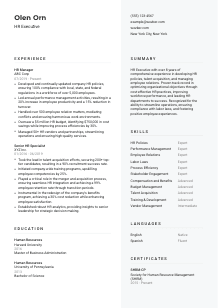
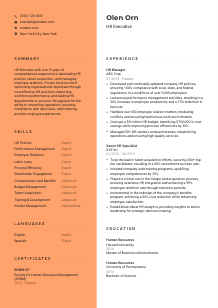
Driving employee engagement, but your resume feels disengaged? Perk up with this HR Executive resume example, created with Wozber free resume builder. Learn how to align your people-empowering prowess with job expectations, ensuring your HR career gets the recognition it deserves!
HR Executive hiring usually turns on a practical question: can this person run people operations with enough judgment to protect the business, guide managers, and keep employees engaged through change. A resume for this level needs to show more than general HR experience. It should make your leadership visible through policy ownership, employee relations, performance management, compensation decisions, and the scale of teams or budgets you have handled.
That becomes much easier to read when your resume mirrors the language of the target role and stays clean in an ATS-friendly resume format. Wozber's free resume builder helps organize that tailoring around the right terminology, from labor law compliance to vendor and budget oversight, so hiring teams can quickly see whether your background matches the level of HR leadership they need.
For an HR Executive, the header sets a professional tone before anyone reaches your policy work or leadership results. Keep it concise, accurate, and aligned with practical requirements such as location, communication channels, and role title.
Place your full name at the top in a clear, readable size. Senior HR hiring often involves multiple reviewers, including recruiters, department leaders, and executives, so your name should be immediately visible without distracting design choices.
Add "HR Executive" beneath your name when that reflects the role you are pursuing. This creates instant alignment with the opening and helps position your background around executive-level HR leadership rather than broader HR generalist work.
Include a direct phone number and a professional email address. HR leadership roles move through interview scheduling, panel coordination, and follow-up discussions quickly, so your contact information should be current and simple to scan.
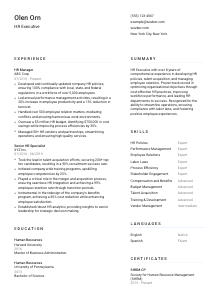
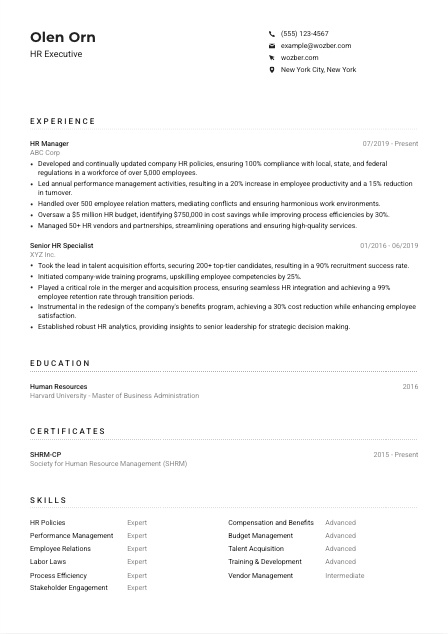
If a role has a stated location requirement, include your city and state in the header. In the example, New York City, New York matters because the posting explicitly asks candidates to be located there or willing to relocate. Treat that as a tailoring move, not a rule for every HR Executive resume.
A LinkedIn profile can strengthen your application if it reflects the same career progression, certifications, and leadership scope shown on your resume. For HR executives, consistency across platforms matters because employers often review your public profile for team size, strategic initiatives, and visible career growth.
Do not include age, marital status, photo, or other personal identifiers unless a local standard specifically requires them. HR leaders are expected to understand professional hiring norms, privacy boundaries, and bias-aware presentation.
This section should confirm who you are, how to reach you, and whether any logistical requirement is already covered. When those basics are handled cleanly, the reader can move straight to your HR leadership record.




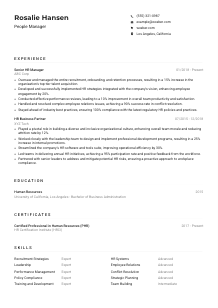
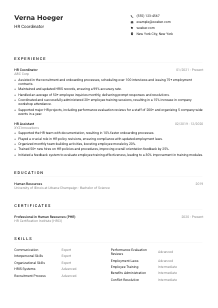
The experience section carries the most weight for an HR Executive. Hiring teams want to see how you have handled compliance, leadership, employee issues, performance systems, compensation decisions, and operational efficiency in real organizations, not just which departments you supported.
Start by identifying the work this employer needs covered. For an HR Executive, that often includes policy development, labor law compliance, talent acquisition, employee relations, performance management, compensation and benefits, and budget or vendor oversight. Build your bullets around the areas where you have owned outcomes, especially if you have managed managers, supported senior leadership, or led cross-functional HR initiatives.
List positions in reverse chronological order and make each entry easy to scan with job title, employer, and employment dates. That structure matters in HR hiring because progression from specialist to manager to executive-level responsibility often signals readiness for broader oversight and supervisory scope.
Use accomplishment-driven bullets instead of duty lists. Good HR Executive bullets show what changed because of your work: improved compliance, reduced turnover, stronger hiring outcomes, smoother conflict resolution, lower benefits costs, better manager adoption of performance reviews, or more efficient vendor operations. The sample resume does this well by tying policy updates, employee relations work, and training initiatives to operational results instead of generic HR support.
Numbers make senior HR work concrete. Include headcount supported, budget size, retention improvement, productivity gains, hiring volume, cost savings, training completion rates, or employee relations caseload where appropriate. In the example, metrics such as a 5,000-employee workforce, a $5 million HR budget, and $750,000 in savings immediately clarify scale and executive-level accountability.
Prioritize roles and bullets that strengthen your case for HR leadership. If an older position does not relate to policy, people management, compliance, recruiting, or organizational development, trim it back. Every line should reinforce that you can lead HR operations, advise leadership, and handle sensitive workforce decisions with sound judgment.
A well-built experience section should show the level you operated at, the HR functions you owned, and the measurable outcomes you delivered. By the end of this section, the reader should already understand your leadership range.
Education matters in HR Executive hiring, but mostly as a foundation for the work you now lead. Degrees in Human Resources, Business Administration, or related fields help confirm formal grounding in people operations, organizational behavior, and business decision-making.
Check the posting for its minimum academic requirement and make sure that credential is easy to find. Here, a bachelor's degree in Human Resources, Business Administration, or a related field is the baseline, so your education section should clearly confirm it.
List your degree, school, and graduation details in a consistent structure. HR leaders are expected to communicate clearly and organize information well, so your education section should feel orderly and easy to verify.
If you hold a degree directly tied to HR, business, or organizational leadership, make that field of study visible. In the example, both Human Resources education and an MBA support the candidate's movement into strategic HR leadership, though not every HR Executive role requires graduate study.
For senior candidates, coursework and projects are usually less important than executive experience. Include them only if they connect directly to workforce analytics, labor relations, compensation strategy, organizational development, or another area central to the role.
Academic honors can stay if they reinforce leadership, analytical rigor, or sustained achievement. Keep this section lean, though. At the executive level, employers will focus far more on how you handled compliance, performance systems, and people strategy in practice.
This section should confirm the academic base behind your HR work without competing with your experience. Clear, relevant credentials are enough to reinforce the rest of the resume.
Certifications carry real weight in HR because they show current engagement with labor law, policy standards, and professional practice. For executive roles, they can also reinforce that your decisions are grounded in recognized HR frameworks, not just tenure.
If the posting mentions SHRM-CP, PHR, or related credentials, place those certifications prominently. In this role, HR certification is preferred rather than mandatory, so including it can help separate you from candidates with similar years of experience.
List certifications that support the responsibilities you want to own, such as compliance, employee relations, compensation, or broader HR leadership. Skip short courses or unrelated certificates unless they clearly add value to executive HR decision-making.
Add the year earned and, when relevant, the active renewal period. That helps employers see that your knowledge is current, which matters when the role involves changing labor regulations, policy updates, and best-practice implementation.
HR standards shift with employment law, benefits design, workplace investigations, and performance practices. Ongoing certification or recertification shows that you keep pace with those changes and continue to sharpen your judgment as a people leader.
A strong certification section tells employers that your HR leadership is backed by current professional standards. That is especially useful when the role involves policy decisions, compliance risk, and executive advising.
A senior HR skills section should read like the toolkit of someone who can guide the workforce and the business at the same time. That means balancing operational HR capabilities with leadership, compliance, communication, and financial oversight.
Review the job description and identify the capabilities attached to core responsibilities. For this type of role, that includes HR policy development, labor law knowledge, performance management, talent acquisition, employee relations, compensation and benefits, budgeting, vendor management, leadership, and communication. Use the language naturally if it matches your experience.
Lead with the skills most central to senior-level HR work and most relevant to the target opening. Policy governance, compliance, employee relations, leadership, workforce development, and compensation strategy usually deserve priority over broad soft-skill labels. The sample resume gets this right by foregrounding policy, performance management, labor laws, and employee relations before secondary capabilities.
Choose skills you can back up in your experience section. A concise list is more credible than a long inventory of loosely related terms. Grouping your strongest operational, strategic, and interpersonal skills creates a clearer picture of how you lead HR functions in practice.
This list should reinforce the capabilities already proven in your achievements. When the same skills show up in your bullets through outcomes, the resume feels far more credible.
Language ability can matter in HR more than in many other functions because the work depends on clear communication, policy explanation, conflict handling, interviewing, and employee trust. For some organizations, multilingual ability also expands your reach across a diverse workforce.
If the job description calls for strong English skills, make that visible. This posting explicitly states that effective use of English is essential, which makes language proficiency a practical requirement rather than a minor extra.
List English first when it is the primary business language of the role, especially if the job involves policy communication, investigations, performance conversations, and executive reporting. That ordering helps the reader confirm a basic requirement immediately.
Add other languages if they are useful to the environments you work in, such as multilingual employee populations, regional operations, or cross-border teams. In the example, Spanish adds value because it can support employee communication and workplace accessibility, though it is not a universal requirement for every HR Executive role.
Use clear levels such as Native, Fluent, Intermediate, or Basic. In HR, overstating language ability can create real problems during conflict mediation, investigations, onboarding, or policy discussions, so accuracy matters.
If the company operates across varied employee groups or serves a multilingual labor market, language skills can strengthen your candidacy. They are especially useful in employee relations, recruiting, training, and day-to-day manager support where clarity and trust matter.
For HR Executive roles, language proficiency matters most when it improves communication with employees, managers, or leadership. Include it when it strengthens your ability to lead people well.
The summary should quickly establish your level, your HR scope, and the kind of organizational impact you deliver. At this level, a vague statement about being people-focused is not enough. You need a concise opening that connects leadership, compliance, workforce strategy, and results.
Start with the parts of HR leadership this position emphasizes most. Here, that includes policy oversight, labor law compliance, talent management, employee relations, compensation programs, and operational efficiency. Use the summary to reflect that mix in a few focused lines.
Lead with your years of experience and the level at which you have worked. Phrases such as "7+ years in progressive HR leadership" or "HR leader with experience overseeing policy, performance, and employee relations" immediately place you in the right range for an executive-facing role.
Choose achievements that show you influence both people and operations. That might include lowering turnover, improving hiring outcomes, reducing benefits costs, strengthening compliance, or managing large HR budgets. The example summary works because it links policy work, workforce performance, and cost-effective HR practices rather than relying on broad leadership language.
Aim for 3 to 5 lines and make every phrase earn its place. A summary should preview your strongest qualifications, not repeat your full work history. When tailored well, it gives the reader an immediate sense of your HR leadership style and the scale of responsibility you can handle.
By the time someone finishes this section, they should understand your seniority, your core HR strengths, and the business outcomes tied to your work. That framing makes the rest of the resume easier to read in the right context.
Once each section is aligned, your resume should show a clear record of leading HR policy, people programs, compliance, and operational decisions at the level the role demands. Wozber's free resume builder helps turn that experience into an ATS-compliant resume that reflects the language employers use when hiring for senior HR leadership.
Use an ATS-friendly resume template, refine the wording with Wozber's AI resume builder, and check alignment with the ATS resume scanner so requirements such as labor law expertise, employee relations leadership, budget oversight, and communication strength are easy to find. The finished resume should make one thing clear fast: you can lead HR with sound judgment and measurable business impact.