



Use Wozber and land your dream job
Create Resume
No registration required
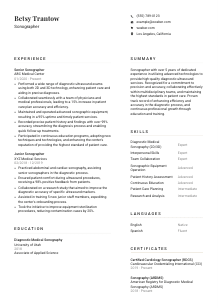
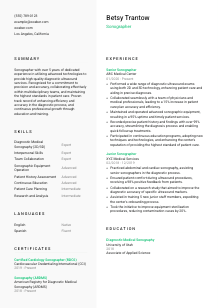
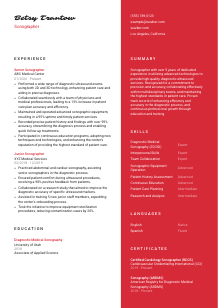
Capturing images, but your resume is fuzzy? Check out this Sonographer resume example, created with Wozber free resume builder. It shows how to showcase your scanning skills in tune with job echoes, rendering your career journey as crystal clear as the images you create!
Sonography work is judged in real clinical moments. You are expected to capture diagnostic images with precision, document findings accurately, keep patients at ease during exams, and support physicians with reliable information that influences care decisions. A Sonographer resume needs to make that clinical judgment visible, not just list ultrasound duties.
Screening gets much easier when your resume clearly connects your modality experience, certifications, and patient care work to the target opening. Wozber's free resume builder helps organize that information in an ATS-friendly resume format, so terms like 2D and 3D ultrasound, ARDMS or CCI credentials, and multidisciplinary collaboration are easy to surface early. That gives the hiring team a faster read on whether you can step into the exam room and contribute right away.
Healthcare hiring starts with practical details. For a Sonographer, that means making it easy to confirm your identity, contact information, professional title, and any location requirement without cluttering the top of the page with unrelated personal data.
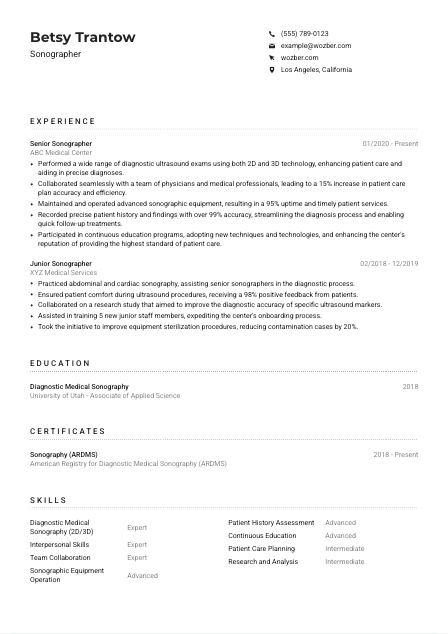
Place your full name at the top, followed by the exact professional title you are pursuing. Using "Sonographer" right under your name immediately matches the role and keeps your resume aligned with how the position is labeled in the posting.
Include a working phone number and a professional email address you check regularly. In clinical hiring, interview scheduling can move quickly, especially when departments need coverage, so even a small typo can cost you a real opportunity.
If a job specifies local availability, show your city and state clearly. In the example, listing Los Angeles, California directly supports the employer's location requirement. Only do this when it is relevant to the posting, rather than treating location as a universal priority for every Sonographer role.
A LinkedIn profile can be useful if it reinforces your certifications, hospital or clinic experience, and professional timeline. If you include a website, make sure it contains relevant professional information such as credentials or continuing education, not generic personal content.
Do not include age, marital status, photo, or other private information unless required by local regulations, which is uncommon. Clinical employers need to see licensure, experience, and patient-facing readiness, not unrelated personal background.
Your header should answer the practical questions first: who you are, how to reach you, what role you hold, and whether you meet any stated location requirement. That keeps attention on your clinical qualifications from the first line.




For Sonographers, experience is where employers look for proof of scan volume, modality range, patient interaction, documentation accuracy, and teamwork with physicians or other care staff. This section should read like clinical contribution, not a generic task list.
Before writing bullets, identify what the employer is emphasizing. Here, the priorities include performing and interpreting diagnostic ultrasound exams, using 2D and 3D technology, recording patient history precisely, maintaining equipment, and working within a multidisciplinary care team. Those points should shape which achievements you feature first.
List positions in reverse chronological order and focus each entry on work that reflects diagnostic skill and patient care contribution. A bullet such as performing a wide range of ultrasound exams with 2D and 3D technology is stronger than simply saying you "conducted scans" because it shows modality scope and clinical relevance. The sample resume does this well by tying imaging work directly to precise diagnoses and patient care.
Numbers carry more weight when they reflect how sonography work is actually measured. Accuracy rates, equipment uptime, patient feedback, onboarding support, reduced contamination cases, or improved care plan efficiency are all credible examples. The sample's 95% equipment uptime and over 99% documentation accuracy give hiring teams a concrete sense of consistency and operational discipline.
If the opening leans toward abdominal, OB/GYN, or cardiac imaging, move that experience higher within your bullets. You do not need to rewrite your whole career around one posting, but you should bring the most relevant scan types and care settings to the surface. For example, mentioning abdominal and cardiac sonography early makes the match easier to see when those specialties appear in the requirements.
Strong Sonographer experience bullets often include more than image acquisition. Mention accurate patient history intake, equipment maintenance, confidentiality, sterilization or safety practices, and collaboration on care plans when those were part of your work. These details show that you understand the full clinical workflow around the exam, not only the machine.
Your experience section should make it clear that you can produce reliable diagnostic studies, document findings carefully, work smoothly with clinical staff, and keep the imaging workflow running safely and efficiently.
Education matters in sonography because employers need to confirm formal clinical preparation, not just general healthcare exposure. Present your training so the accredited program, degree, and field are easy to recognize at a glance.
When a posting asks for graduation from an accredited Diagnostic Medical Sonography program, make that qualification unmistakable. List the degree and field clearly, as in the example's Associate of Applied Science in Diagnostic Medical Sonography. That direct wording helps both ATS parsing and human review.
List degree, field of study, school, and graduation year in a consistent order. This straightforward format works well for ATS optimization and avoids hiding key qualifications inside dense text or decorative layouts.
Some Sonographer openings are broad, while others lean heavily toward cardiac, abdominal, or OB/GYN imaging. If your coursework, clinical rotations, or degree emphasis supports one of those areas, mention it when it helps explain your readiness for the position.
Ongoing learning matters in imaging, especially as protocols, technology, and quality standards evolve. If you have completed relevant workshops, specialty training, or structured continuing education, include those details when they add substance beyond your baseline degree.
Honors, research participation, or notable clinical projects can help if they relate to imaging quality, patient care, or diagnostic accuracy. These details are especially useful early in your career, though experienced Sonographers should still keep the focus on clinical practice and credentials first.
Education should quickly answer one question: do you have the formal sonography training this employer requires. Make that answer obvious, then use supporting details only when they strengthen your clinical story.
For many Sonographer roles, certifications are one of the first screens. If ARDMS or CCI credentials are required, present them clearly so there is no uncertainty about your active status or specialty coverage.
If the posting names ARDMS or CCI, use those exact credential names on your resume. That direct match matters in screening, especially when employers need certified professionals who can step into abdominal, OB/GYN, or cardiac sonography without delay.
Order your certifications by relevance to the role rather than by personal preference. In the example, ARDMS and RDCS credentials are especially useful because they align with the posting's diagnostic and cardiac sonography requirements. Use the same logic for your own specialty mix.
Show the year earned and current validity when applicable. Active credentials tell the employer that your certification is current and maintained, which is particularly important in regulated clinical environments.
If you have added a newer specialty certification or are maintaining continuing education tied to your credential, include it when relevant. That shows you are keeping pace with imaging standards, technology updates, and quality expectations in patient care.
A hiring manager should be able to scan this section and immediately confirm that your credentials match the imaging specialties and certification standards required for the job.
A Sonographer skills section works best when it mirrors real exam-room and clinical workflow demands. Include technical imaging strengths, patient-facing abilities, and operational skills that support safe, accurate diagnostics.
Start with the abilities the employer explicitly names, such as operating sonographic equipment, collaborating with a multidisciplinary team, and communicating clearly in English. If you genuinely have them, use closely matching wording so the connection is obvious in both ATS review and recruiter screening.
Sonography is highly technical, but it is also patient-facing and collaborative. Pair skills like 2D and 3D diagnostic imaging or equipment operation with interpersonal communication, patient history assessment, and team collaboration. The sample resume handles this balance well by combining modality expertise with care-planning and interpersonal strengths.
Do not turn the skills section into a long inventory. Keep the focus on capabilities that support diagnostic accuracy, workflow reliability, patient comfort, documentation quality, and collaboration with physicians or nurses. Every skill listed should help explain how you work as a Sonographer, not just fill space.
Your skills list should give a quick clinical snapshot: what imaging work you can perform, how you support patient care, and how you function within a healthcare team.
Language ability matters in sonography because patients need clear instructions, reassurance, and accurate communication during exams. This section is especially useful when the employer specifies English proficiency or the patient population is multilingual.
When a posting calls for a strong command of English, list English at the top with an honest proficiency level such as Native or Fluent. That makes it easy to confirm you can communicate clearly with patients, physicians, and staff during documentation and care coordination.
Additional languages can be valuable in healthcare settings with diverse patient populations. In the example, Spanish is a useful second language because it may support smoother patient instructions and comfort in a Los Angeles care environment. Treat that as a tailoring advantage, not a universal requirement.
Choose levels that reflect how well you can actually speak, understand, and explain clinical information. Overstating fluency creates risk in patient-facing roles where instructions, consent conversations, and basic reassurance need to be accurate.
A second language matters most when it improves communication during intake, positioning, preparation, or follow-up explanations. If you include multiple languages, keep in mind how they support patient understanding and smoother care delivery rather than listing them as trivia.
Some employers will care deeply about multilingual communication, while others will focus almost entirely on English proficiency and technical capability. Adjust the emphasis based on the patient population and the role's stated requirements, instead of assuming every Sonographer job values language breadth the same way.
Used well, language details show that you can communicate clearly during exams and help patients feel informed and at ease, which is a practical advantage in many imaging settings.
A Sonographer summary should sound like a clinician introducing the scope of their work, not a generic professional statement. In a few lines, show your experience level, imaging strengths, care standards, and the kind of clinical environment you support well.
Start by identifying the few requirements that matter most in the posting. For this one, that includes clinical experience, diagnostic ultrasound work with 2D and 3D technology, certification, accurate patient assessment, and collaboration with care teams. Those themes should shape your opening lines.
Your first sentence should establish who you are professionally. A line like the example's "Sonographer with over 5 years of dedicated experience" works because it immediately gives title, tenure, and credibility. If relevant, add your main imaging specialties or care setting in the same sentence.
Choose points that reflect real clinical strengths, such as precision in documenting findings, experience with advanced ultrasound technology, or collaboration with physicians on patient care plans. The sample summary is effective because it combines technical capability with accuracy, teamwork, and patient care standards rather than repeating job duties word for word.
Aim for a summary of about 3 to 5 sentences. That is enough space to establish your qualifications without crowding out the experience section, where your metrics and clinical examples should do the heavier lifting.
This section should let the employer understand, within a few seconds, your level of sonography experience, your diagnostic strengths, and the quality of patient care you bring into the role.
A Sonographer resume works when it makes your certifications, imaging scope, documentation accuracy, equipment handling, and patient care collaboration easy to find. That is what helps a hiring team decide whether you can contribute in a busy clinical setting from day one.
Use Wozber's free resume builder to shape that content into an ATS-compliant resume, then refine it with the ATS resume scanner so the language in your sections reflects the posting you are targeting. The final result should make your clinical readiness clear before the interview even starts.




