



Use Wozber and land your dream job
Create Resume
No registration required
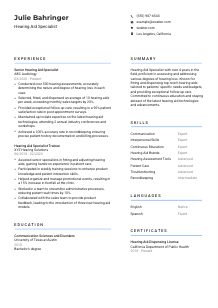
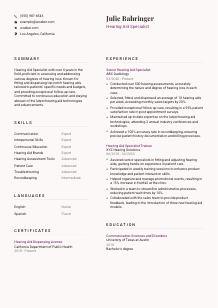
Fine-tuning hearing, but your resume is hard to hear? Check out this Hearing Aid Specialist resume example, created with Wozber free resume builder. Learn how to amplify your audiology skills to match job frequencies, making your career resonance as clear as a well-adjusted sound!
Hearing Aid Specialists work at the point where clinical judgment, patient communication, and device knowledge meet. A hiring team wants to see more than familiarity with hearing loss. Your resume should show that you can assess patient needs, recommend suitable hearing aids, handle fittings and follow-up adjustments, and keep records accurate enough to support continuity of care and billing.
A tailored resume helps separate candidates who have general patient-facing experience from those who can actually manage assessments, fittings, and aftercare in a hearing care setting. Wozber's free resume builder helps you shape that experience into an ATS-compliant resume by aligning your wording with the job description and keeping the structure easy to scan. That makes it much easier for employers to spot hands-on dispensing experience, current credentials, and patient care strengths early.
This section is brief, but it still does important work. For a Hearing Aid Specialist, it should immediately confirm who you are, how to reach you, and whether you meet practical requirements such as location for an on-site clinic role.
Use your full name in a clear, readable format so it stands out at the top of the page. In a healthcare-facing role, clean presentation matters. It should feel as professional and orderly as the patient records and case notes you are trusted to maintain.
Place "Hearing Aid Specialist" directly under your name if that matches your target role. This keeps your resume aligned with the position from the first line and helps ATS systems connect your profile to the job posting quickly.
List a reliable phone number and a professional email address. If a clinic wants to move quickly on interviews, your contact information should not slow them down. Keep it simple, accurate, and free of casual usernames.
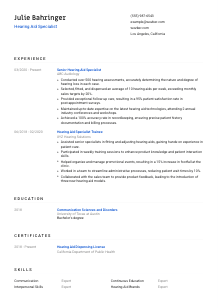
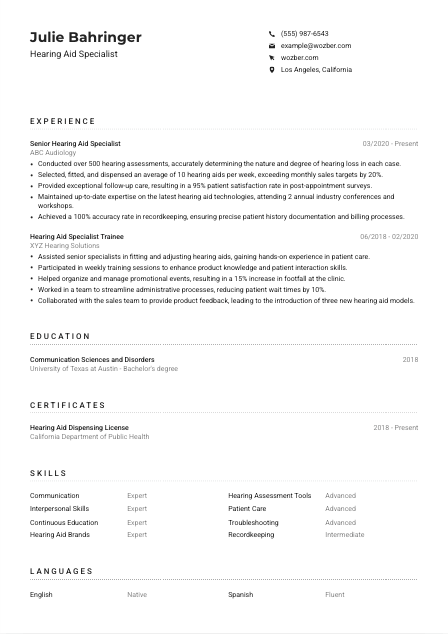
If the employer expects someone based in a specific area, show your city and state clearly. In the provided example, listing Los Angeles, California directly supports the posting's location requirement. Only do this when it is relevant to the role you are targeting.
A LinkedIn profile or professional website can be useful if it supports your clinical or sales-related background, continuing education, or hearing care experience. Make sure any online information matches your resume, especially job titles, dates, and credentials.
Your personal details should confirm the basics without friction. When this section is accurate and role-aligned, employers can move straight to the parts that show your patient care experience and dispensing background.




For Hearing Aid Specialists, experience is usually the section that decides whether the application moves forward. Employers want to see direct work with hearing assessments, device selection, fittings, patient education, follow-up care, and the recordkeeping that supports treatment and service quality.
Before writing bullets, identify the work that appears most often in the job description. For this kind of role, that usually includes hearing assessments, fitting and dispensing hearing aids, follow-up adjustments, patient communication, and documentation. Build your experience section around those functions instead of relying on generic customer service language.
Start with your most recent position and include your title, employer name, and dates. That format helps hiring teams quickly understand your progression, whether you moved from trainee work into independent fitting and dispensing or took on higher patient volume and more responsibility over time.
Each bullet should show what you handled and what came from it. The example resume does this well by moving beyond "performed assessments" to "Conducted over 500 hearing assessments" and by tying dispensing work to monthly sales performance. For this profession, useful outcomes include patient satisfaction, fitting volume, return visits, sales targets, documentation accuracy, and reduced wait times.
Quantify your work where it reflects real hearing care performance. Good metrics include number of assessments completed, devices dispensed per week, satisfaction scores, follow-up adherence, record accuracy, hearing aid returns, or workflow improvements. Numbers such as a 95% patient satisfaction rate or 100% recordkeeping accuracy give your experience more weight because they show how you worked, not just where you worked.
Cut or rewrite points that could belong to any retail or healthcare support role. Prioritize bullets about evaluating hearing loss, matching devices to lifestyle and budget, troubleshooting fit or performance issues, educating patients on use and maintenance, and staying current on hearing aid technology. If you include broader clinic contributions, connect them back to patient service or operational quality.
A hiring manager should be able to tell, from this section alone, whether you can handle patient consultations, device recommendations, fittings, and follow-up care with confidence. Keep the focus on actions and outcomes that belong to real hearing aid practice.
Education matters here because it anchors your knowledge of hearing science, communication disorders, and patient care principles. Even when experience carries the most weight, your degree should still be easy to find and easy to connect to the role.
If you have a Bachelor's degree in Communication Sciences and Disorders or a related discipline, list it clearly. That directly addresses the type of academic background requested in the job description and helps position you as someone with relevant hearing and communication knowledge.
Include degree, field of study, school name, and graduation year in a straightforward order. In healthcare hiring, clean formatting is not just cosmetic. It helps reviewers verify qualifications quickly, especially when they are comparing licensing, experience, and education side by side.
When your degree closely aligns with the opening, there is no reason to bury it. In the example, "Bachelor's degree" in "Communication Sciences and Disorders" tells the employer immediately that the academic background matches the position well.
Most experienced candidates do not need a long course list. Include selected coursework only when it adds something useful, such as audiology, hearing science, anatomy of the auditory system, or patient counseling. This is especially helpful if you are earlier in your career or your degree title is broad.
If you graduated with honors or completed relevant academic projects, include them when they reinforce your seriousness about the field. Keep this concise. Once you have solid experience in hearing aid fitting and dispensing, academic extras should support your profile, not compete with your work history.
Your education section should quickly confirm that your training supports the technical and patient-facing parts of the role. Clear, relevant academic details help employers connect your foundation to your day-to-day practice.
In this profession, certifications and licenses are not optional add-ons. They are often a threshold requirement. Present them clearly so an employer can confirm your legal eligibility to dispense hearing aids and your commitment to staying current in the field.
Lead with your state-issued license or certification in Hearing Aid Dispensing or Audioprosthology if the role requires it. This is one of the first details a clinic or practice will look for because it determines whether you can legally perform core duties.
Prioritize certifications that strengthen your hearing care profile, such as dispensing licenses, audioprosthology credentials, manufacturer training, or continuing education tied to hearing aid technology. Remove items that do not support patient assessment, fitting, product knowledge, or compliance.
Show when the credential was issued and, if relevant, that it is active. The example's "2018 - Present" format works because it communicates ongoing validity at a glance. This is especially helpful for roles where current licensure is a hiring requirement, not a bonus.
Hearing aid technology changes quickly across device features, programming approaches, and product lines. If you complete regular training, workshops, or continuing education, keep those credentials updated on your resume. That tells employers you can work with current devices rather than relying on outdated product knowledge.
Your credentials section should answer a simple question immediately: are you licensed, current, and prepared to work with today's hearing aid technology? When that answer is obvious, the rest of your resume carries more force.
A Hearing Aid Specialist needs a mix of technical, interpersonal, and operational skills. The right list should show that you can work with patients, understand hearing aid technology, and manage the day-to-day demands of assessments, fittings, follow-up service, and documentation.
Pull out the abilities the employer emphasized most. Here, that includes knowledge of current hearing aid technologies and brands, strong communication, interpersonal skill, and personalized patient care. Those are not filler keywords. They describe the actual work of guiding patients through assessment, device selection, and adjustment.
Use skill names that reflect both your real ability and the employer's wording. The example does this by listing items such as Hearing Aid Brands, Hearing Assessment Tools, Patient Care, Troubleshooting, Communication, and Recordkeeping. That combination works because it covers both the clinic side and the patient-facing side of the role.
Choose skills you can support elsewhere in the resume. A shorter list with relevant entries is stronger than a long inventory of vague strengths. For this role, prioritize hearing aid technology, fitting support, patient counseling, follow-up care, troubleshooting, documentation, and communication over broad terms that do not distinguish your work.
Your skills section should reinforce the practical abilities employers expect to see in hearing care. If the list matches the job posting and your experience bullets back it up, this section will feel believable and useful.
Clear communication is central to hearing care. Patients need to understand assessment results, device options, maintenance instructions, and follow-up guidance. Your language section should reflect the communication needs of the practice without overstating your fluency.
If the job requires English, place it at the top of this section and state your proficiency plainly, such as Native or Fluent. For a Hearing Aid Specialist, this is about more than conversation. It affects patient education, case history intake, and accurate explanation of care options.
If you speak additional languages relevant to the community you serve, include them prominently. In the example, Spanish adds value in a large and diverse patient market. That is not a universal requirement, but it can strengthen your ability to support consultations and follow-up communication.
Additional languages can be useful when a clinic serves multilingual households or needs smoother communication around appointments, hearing aid maintenance, and patient questions. Only include languages you could use with confidence in a real patient interaction.
Use honest proficiency levels. Overstating fluency creates risk in a role where misunderstandings can affect patient trust, device use, and care instructions. If you are conversational rather than fluent, label it that way.
When a second language helps you explain hearing aid use, maintenance routines, or follow-up expectations more clearly, it becomes a practical advantage, not just a nice extra. Include it when it adds genuine value to the kind of patient population the employer serves.
This section works best when it supports the patient-facing demands of the job. Clear and honest language details help employers understand how well you can guide, reassure, and educate the people sitting across from you.
Your summary should give a fast, accurate picture of the kind of Hearing Aid Specialist you are. In a few lines, it needs to cover your experience level, your clinical or dispensing strengths, and the kind of patient care or operational value you bring.
Read the posting closely before writing this section. If the role emphasizes hearing assessments, fitting and dispensing, follow-up service, and knowledge of current devices, those points should shape your summary. Avoid broad healthcare statements that could apply to unrelated roles.
Start with your title and years of experience, then anchor that with work that matters in this profession. The example summary works because it quickly establishes more than 4 years in the field and references assessing different degrees of hearing loss.
Mention the capabilities that define your value, such as selecting hearing aids based on patient needs and budget, providing strong follow-up care, or staying current with hearing aid technology. If possible, borrow the direction of your experience metrics so the summary reflects real performance rather than generic claims.
Aim for 3 to 5 lines with direct language. This section should read like a compact professional profile, not a paragraph of soft traits. Give the employer a quick sense of your scope in assessments, fittings, patient care, and product knowledge.
A well-written summary tells the reader, within seconds, whether you have the background they need in hearing aid dispensing and patient care. Keep it specific enough that the rest of the resume feels like proof of the opening claim.
A Hearing Aid Specialist resume works best when it reflects the real balance of the job: assessment skill, product knowledge, patient communication, follow-up care, and accurate documentation. When each section is tailored to those priorities, your background becomes much easier for employers to understand.
Use Wozber's free resume builder to shape your experience into an ATS-compliant resume that matches the language of the role and stays easy to scan. With the right detail in place, your resume should make one thing clear fast: you can guide patients from evaluation to better day-to-day hearing support.