



Use Wozber and land your dream job
Create Resume
No registration required
Dispensing medications, but your resume feels like an expired prescription? Refill your job prospects with this Retail Pharmacist resume example, created with Wozber free resume builder. Learn how to blend your pharmaceutical skills with retail requirements, making your career as effective and in-demand as the medications you provide!
Retail pharmacy work moves fast, but the standard is exact. Hiring teams want to see that you can process prescriptions accurately, catch interactions before they become problems, counsel patients in plain language, and keep daily operations steady at the counter. Your resume should make that clinical judgment and store-level reliability visible within a few lines.
When a resume is tailored well, the first read quickly shows whether your background matches the core retail pharmacy workflow: dispensing, medication review, patient counseling, and inventory control. Wozber's free resume builder helps you shape that experience into an ATS-compliant resume with the right terminology and structure, so both hiring teams and applicant tracking systems can immediately see your readiness for patient-facing pharmacy practice.
Retail pharmacist resumes do not need a long identity section, but they do need a precise one. This is where you confirm the practical basics first: who you are, how to reach you, what role you are targeting, and, when the posting asks for it, whether you are already based in the required market.
Use your full name as the top line of the resume and make it easy to scan. Skip nicknames unless they are how you are known professionally in pharmacy settings. Clean formatting matters here because this header anchors every section that follows, from licensure to patient-care experience.
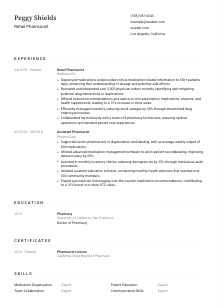
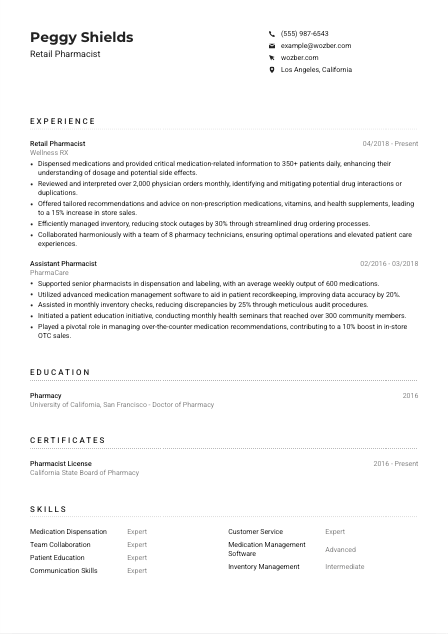
Place the job title directly under your name using the wording from the posting when it reflects your actual background. For this opening, "Retail Pharmacist" works well because it immediately frames your experience around community dispensing, patient counseling, and pharmacy operations rather than hospital or clinical specialty work.
Add a reliable phone number and a professional email address. Double-check every character. Pharmacy hiring often moves quickly when a store needs licensed coverage, and a typo in your contact information can stall an interview request just as easily as a weak bullet point.
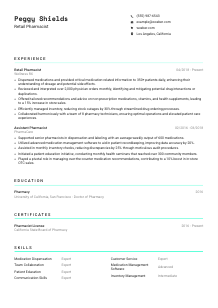
If an employer specifies a city or state, show that detail clearly in this section. Here, listing Los Angeles, California immediately answers a stated requirement. Treat location this way only when it helps remove a practical hiring question, not as filler in every application.
A LinkedIn profile or professional website can be useful if it reinforces your pharmacy background, licenses, certifications, or community health work. Only include it if the content is current and consistent with the resume. For a retail pharmacist, outdated profiles can create confusion about licensure status, role focus, or current location.
This section should confirm the basics without distraction. A hiring manager should be able to see your target role, contact details, and any stated location requirement in seconds, then move straight to your pharmacy credentials and experience.




This section carries the most weight because retail pharmacy is judged in real operating terms. Employers look for evidence that you can fill prescriptions accurately, review profiles for safety concerns, guide OTC decisions, work efficiently with technicians, and keep inventory moving without service breakdowns.
Read the posting and mark the work that defines the role. For retail pharmacists, that usually includes medication dispensing, order review, interaction screening, patient counseling, OTC guidance, technician collaboration, and inventory management. These priorities should shape your bullet points so the employer sees the same workflow on your resume that they need in the store.
List your positions in reverse chronological order with job title, employer, and dates. That format makes it easy to track your progression from support or assistant roles into full pharmacist responsibility. In retail settings, clear chronology also helps hiring teams gauge how long you have worked under the pace, volume, and compliance demands of community pharmacy.
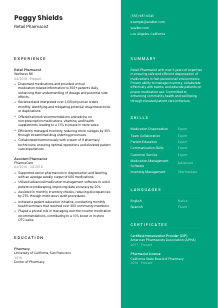
Do not stop at "dispensed medications" or "worked with patients." Show the scale and result. The sample resume does this well by pairing dispensing with 350+ patients daily and physician-order review with more than 2,000 orders monthly. Numbers like these give context to your pace, judgment, and workload management.
Retail pharmacy work produces metrics, so use them when they are real. Good examples include prescription volume, patient count, reduction in stock outages, lower inventory discrepancies, OTC sales lift, immunization counts, or accuracy improvements tied to system use. These measures show how you contributed to both safe care and store performance.
Focus the section on work that translates directly to the target opening. If you have mixed pharmacy experience, give more space to community or retail responsibilities than to unrelated rotations or general healthcare tasks. A bullet about collaborating with eight pharmacy technicians or reducing stock outages by 30 percent is far more useful here than broad statements about being hardworking or detail-oriented.
Your experience section should show that you can operate safely and efficiently in a retail pharmacy, not simply that you have held a pharmacist title. When the bullets reflect prescription volume, patient interaction, inventory control, and team coordination, your readiness becomes much easier to judge.
For pharmacists, education is not background decoration. It confirms that you hold the degree required to practice and gives the employer one of the first formal checks they need before moving deeper into your application.
If the posting asks for a Doctor of Pharmacy degree, make that credential easy to find. List the degree exactly and place it prominently in the education section. In this case, the sample resume meets the requirement cleanly with a Doctor of Pharmacy from the University of California, San Francisco.
Keep the entry simple: degree, field, school, and graduation year. Pharmacy hiring teams do not need decorative formatting here. They need to confirm that the educational requirement is met quickly and without ambiguity.
Use the formal title of your credential rather than abbreviating it in a way that could be missed. "Doctor of Pharmacy" or "PharmD" is clear. Accuracy matters because this section works alongside your license to establish professional eligibility for the role.
Most experienced retail pharmacists can keep this section brief. If you are closer to graduation or moving into a specialized pharmacy environment, relevant coursework in pharmacotherapy, patient counseling, pharmacy law, or community pharmacy practice can add useful context. Otherwise, your work history will carry more value.
Honors, leadership roles, or pharmacy-related activities can support your profile if they connect to practice readiness or community care. Use them sparingly, especially if you already have several years of retail experience. At that stage, employers care more about dispensing accuracy, patient care, and operational judgment than campus involvement.
This section should answer one question immediately: do you hold the pharmacy degree required for the job. Once that is clear, the rest of the resume can focus on how you apply that training in a retail setting.
In pharmacy, certifications are not side notes. Your active license is essential, and additional credentials can strengthen your profile when they reflect services the store provides, such as immunizations, medication therapy support, or patient education.
Start with the credential that determines whether you can practice in the state. If the job asks for an active pharmacist license, list it clearly with the issuing board and current status. For this Los Angeles opening, a California State Board of Pharmacy license directly answers the requirement.
After your license, add certificates that support patient-facing work in community settings. Immunization credentials are a strong example because they connect directly to front-of-store clinical services and seasonal demand. Keep the list focused on qualifications that matter in daily pharmacy operations.
Pharmacy credentials often need renewal, so include dates when they help show that the qualification is current. This saves the hiring team from guessing whether a license or certification is active and usable right now.
Update certifications as you add services or responsibilities. If you train for immunization delivery, medication therapy management, or specialized patient counseling programs, reflect that on the resume. Ongoing professional development is especially relevant in retail pharmacy, where service offerings and regulatory expectations change over time.
Your credentials should show that you are licensed, current, and prepared for the services expected in a community pharmacy. A focused list does that better than a long inventory of unrelated coursework or expired training.
A retail pharmacist skills section should read like the job, not like a generic healthcare list. Hiring teams look for a mix of clinical knowledge, patient communication, and store-level execution, especially in roles that combine prescription accuracy with steady customer-facing service.
Pull out the skills the employer names directly and compare them with your actual strengths. Here, that includes medication knowledge, dosage and side-effect counseling, communication with patients and healthcare professionals, and retail pharmacy experience. Starting from the posting helps you choose skills that support ATS optimization without drifting into vague filler.
List skills that reflect both safe pharmacy practice and the pace of a retail environment. Relevant entries might include medication dispensation, drug interaction review, patient education, inventory management, OTC consultation, medication management software, team collaboration, and customer service. That balance tells a fuller story than a list made up only of soft skills.
Choose the skills most relevant to the role instead of trying to cover every capability you have built over your career. The sample resume keeps the section readable by focusing on skills that connect directly to patient care and store operations. That approach works well because it supports the experience section rather than repeating it word for word.
Your skills should mirror the work you can actually perform at the counter, in the verification queue, and with the pharmacy team. If the list reflects medication expertise, patient communication, and operational reliability, it is doing its job.
Language ability matters in retail pharmacy because patient understanding affects safety. Clear counseling on dosage, side effects, interactions, and OTC use can prevent errors, improve adherence, and strengthen trust at the point of care.
If the posting specifies English fluency, list English first and state your level accurately. In pharmacy practice, this is not a cosmetic detail. It directly affects how well you can interpret questions, explain instructions, and communicate with prescribers and support staff.
If you speak other languages well enough to support patient conversations, include them. In many retail environments, bilingual ability can help with counseling, vaccine outreach, OTC recommendations, and everyday pharmacy questions from a broader community.
A posting may only mention English, but additional languages can still strengthen your application when they are relevant to the population served. For example, Spanish on the sample resume is a practical asset in many community pharmacy settings because it can widen patient communication without changing the core role requirements.
Use honest proficiency labels such as Native, Fluent, Intermediate, or Basic. Avoid overstating your comfort level. In a pharmacy setting, miscommunication around dosage timing, warnings, or administration instructions can create real patient risk.
If you know the store serves multilingual neighborhoods, language skills become even more relevant. Use this section to show added communication range, but keep the emphasis on usable proficiency that supports safer counseling and better patient service.
This section should show whether you can communicate clearly with the patients and teams you are likely to encounter. In retail pharmacy, language ability is valuable when it improves understanding, trust, and medication safety.
The summary sits at the top of the resume, so it should establish your practice level fast. For a retail pharmacist, that usually means showing years of experience, patient-facing scope, and the mix of clinical accuracy and operational consistency you bring to a community pharmacy setting.
Before writing, pull out the two or three priorities that matter most in the job ad. For this role, the strongest themes are safe medication dispensing, patient counseling, and efficient retail pharmacy operations. Let those themes guide the wording instead of trying to summarize your entire career.
Start with a clear professional introduction such as "Retail Pharmacist with 6+ years of experience in community pharmacy settings." That line gives immediate context and helps the reader place the rest of your qualifications quickly.
Use the next lines to highlight strengths that connect directly to the opening. The sample summary does this by referencing efficient medication dispensation, inventory management, team collaboration, and patient education. You can make yours even sharper by tying those strengths to measurable outcomes when space allows, such as prescription volume or reduced stock outages.
Three to five lines is usually enough. Prioritize the details that distinguish you as a retail pharmacist, such as counseling patients on medication use, reviewing profiles for interactions, managing technician workflows, or supporting store performance through OTC and inventory judgment. A tight summary works best when every phrase points toward the target role.
By the time someone finishes this paragraph, they should understand your level, your retail pharmacy focus, and the kind of patient care and operational value you bring. It should set up the rest of the resume, not repeat it.
A retail pharmacist resume works best when it reflects the actual rhythm of the job: dispensing safely, reviewing orders carefully, counseling patients clearly, and keeping pharmacy operations reliable. Each section should help the employer see those capabilities faster.
Wozber supports that process with a free resume builder, AI-assisted tailoring, and an ATS resume scanner that help align your wording, structure, and section content with the role you are targeting. Use that support to build an ATS-friendly resume format that makes your licensure, retail experience, and patient-care judgment easy to recognize.
When your resume is tailored this way, hiring teams can quickly see that you are ready to step into the pharmacy and perform from day one.




