



Use Wozber and land your dream job
Create Resume
No registration required
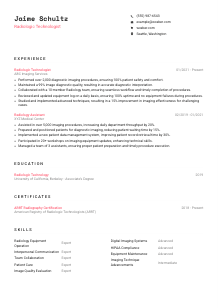
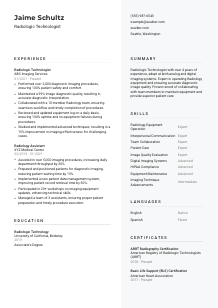
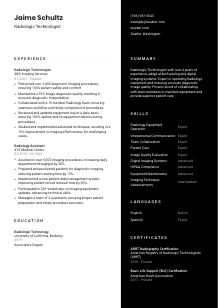
Capturing images with dedication, but your resume seems underexposed? Build your profile with this Radiologic Technologist resume example, created with Wozber free resume builder. Learn how to show your imaging expertise in a way that matches job requirements, setting your career path as clearly as an AP view!
Radiologic Technologists work where technical precision and patient care meet. Hiring teams look for more than familiarity with imaging equipment. They want to see that you can produce diagnostic-quality images, position patients safely, follow physician orders accurately, and keep the department moving without compromising care. Your resume should make that clinical reliability visible right away.
A tailored resume helps separate hands-on imaging experience from broader support work, which matters when employers are filling a role that depends on image quality, workflow discipline, and current credentials. Wozber's free resume builder helps you shape an ATS-compliant resume around the posting's language so ARRT certification, imaging systems knowledge, and patient-facing experience are easy to recognize in both ATS screening and human review.
In healthcare hiring, basic contact information still does real screening work. For a Radiologic Technologist, this section should quickly confirm who you are, where you practice, and how a department can reach you for credential checks, interview scheduling, or shift discussions.
Use your full name in a clear, readable format. Skip nicknames, extra labels, or decorative styling. In clinical hiring, simple presentation works best because it keeps the focus on your credentials, imaging experience, and availability.
Place "Radiologic Technologist" directly under your name if that is the role you are pursuing. This helps frame your background immediately, especially if your recent experience includes adjacent titles such as Radiology Assistant or Imaging Technician. It also supports ATS matching when the employer is screening for that exact title.
List a phone number you answer regularly and a professional email address. Small errors here can delay interviews, credential verification, or follow-up on availability. If your email still looks casual or outdated, switch to a format based on your name.
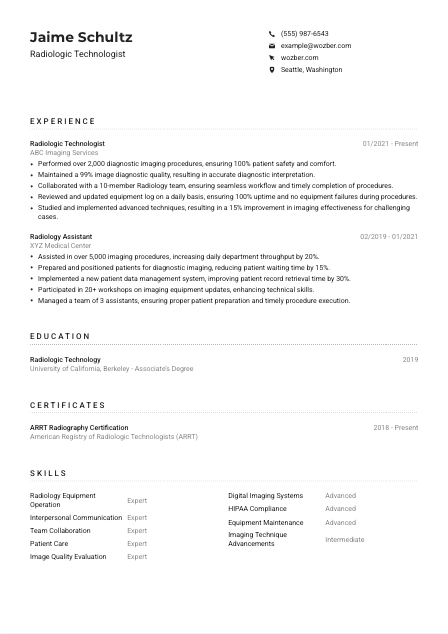
If the posting requires local availability, add your city and state. In the example, listing Seattle, Washington directly supports the employer's location requirement. Use this when it is relevant to the posting, rather than treating location as a universal resume priority for every Radiologic Technologist role.
Include LinkedIn or another professional profile if it supports your application with consistent work history, certifications, or healthcare experience. Make sure the dates, titles, and credentials match your resume. For this profession, consistency matters more than having extra links.
Keep Personal Details clean and practical. It should confirm your target role, your contact route, and any location requirement without forcing the reader to search for basics.




This is the section most likely to decide whether a Radiologic Technologist moves forward. Departments want to know what imaging work you have handled, how independently you performed it, and whether your results supported safe, usable studies and efficient patient flow.
Start by marking the responsibilities that define the role. For this job, that includes performing diagnostic imaging procedures, reviewing image quality, maintaining patient records under HIPAA standards, supporting equipment upkeep, and working closely with the radiology team. Once those duties are clear, rewrite your bullets so they mirror that real clinical work instead of staying broad.
List your most recent role first, then work backward. For each position, include job title, employer, and dates. That structure helps hiring teams quickly separate current imaging experience from earlier support roles, which is especially important if your background includes both direct radiography work and assistant-level experience.
Your bullet points should show the kind of imaging work you performed and how well you handled it. The example does this effectively with details such as "performed over 2,000 diagnostic imaging procedures" and "maintained a 99% image diagnostic quality." Those statements work because they connect volume with clinical quality, which is exactly what a radiology department needs to see.
Metrics make your experience easier to trust when they reflect real department performance. Procedure counts, image quality rates, patient wait time reduction, workflow throughput, equipment uptime, and improvement in difficult studies all fit naturally here. The sample's 20% throughput gain and daily equipment log tracking are good models because they show operational impact, not just effort.
Keep the section centered on diagnostic imaging, patient positioning, record accuracy, equipment handling, safety, collaboration, and technical growth. If an accomplishment does not strengthen that picture, leave it out. A hiring manager reviewing radiography resumes is usually deciding whether you can step into patient-facing imaging work with minimal ramp-up.
Your experience section should make one point unmistakable: you can produce high-quality studies, work safely with patients, and contribute to a dependable radiology workflow from day one.
For Radiologic Technologists, education is a qualification checkpoint, not a background detail. Employers usually need to see accredited training that supports licensure, certification eligibility, and safe clinical practice with imaging equipment and patient positioning.
List the degree or diploma that directly supports your radiologic practice. If you graduated from an accredited Radiologic Technology program, make that easy to find. In this case, an Associate's Degree in Radiologic Technology clearly aligns with the requirement.
Include degree, field of study, school, and graduation year or date. That is usually enough for a Radiologic Technologist resume unless you are early in your career. Clear structure helps recruiters and credentialing staff confirm your training without digging through extra text.
Do not assume the school name tells the whole story. Spell out "Radiologic Technology" or the exact training field so the connection to radiography is obvious. This matters when ATS filters are looking for education that matches certification and clinical scope.
If you are early in your career, selected coursework can help fill in technical context. Subjects tied to imaging techniques, radiation safety, anatomy, patient care, or digital imaging systems are useful because they reflect the work itself. If you already have substantial clinical experience, this level of detail is usually unnecessary.
Short courses, workshops, or continuing education can support your education section or be referenced elsewhere if they relate to newer imaging systems, patient safety, or updated radiology practices. The sample mentions workshops on equipment updates, which is a practical way to show continued development without overstating it.
This section should quickly confirm that your training supports clinical radiography work and aligns with the credential path expected for the role.
In radiology hiring, certifications are often screened before experience is read in depth. Current credentials tell the employer that you meet core professional standards and can work in a patient-care environment that depends on regulated practice and emergency readiness.
Lead with the certifications the posting specifically asks for. Here, ARRT certification in Radiography and BLS certification belong at the top because they are direct requirements, not optional extras. Make them impossible to miss.
Choose certifications that strengthen your ability to perform in a radiology department. For most Radiologic Technologist roles, ARRT and BLS will carry more weight than unrelated healthcare coursework because they connect directly to imaging practice and patient safety.
Include dates or validity periods where appropriate so employers can tell your credentials are active. The example's "2018 - Present" and "2017 - Present" format works well because it reassures the reader that the certifications are current and maintained.
Update certifications promptly as you renew them or add new ones relevant to your modality, equipment knowledge, or patient care responsibilities. In a field shaped by regulation, documentation standards, and evolving imaging techniques, outdated credentials can weaken an otherwise solid resume.
This section should leave no doubt that you meet the credential requirements for safe, current radiologic practice and are ready to step into a clinical setting without administrative uncertainty.
The best Radiologic Technologist skills sections balance technical capability with clinical judgment. Employers need to see that you can operate imaging equipment and evaluate image quality, while also communicating clearly with patients, physicians, and the radiology team.
Start with the language used in the posting. Here, that includes radiology equipment operation, analog and digital imaging systems, communication, teamwork, and image quality evaluation. These terms are worth using because they reflect the role's day-to-day work and help ATS systems connect your resume to the job.
Choose skills that support diagnostic imaging, patient care, compliance, and department operations. The sample's mix of Radiology Equipment Operation, Patient Care, Image Quality Evaluation, HIPAA Compliance, and Equipment Maintenance is effective because it covers both the technical and clinical side of the job.
Present your skills in a format that is easy to scan. You can group them mentally or visually into technical, patient-facing, and operational categories, even if your template keeps them in one list. Hiring teams should be able to spot imaging systems knowledge, safety awareness, and collaboration skills in seconds.
Your skills should support the same message as your experience: you know how to operate in a radiology department, produce reliable studies, and work well with patients and colleagues.
Language ability can matter in imaging settings because patient instructions must be understood the first time. Radiologic Technologists often need to explain positioning, prep expectations, or what happens during a procedure in calm, direct terms.
If the posting calls for English fluency, list it directly with an honest proficiency level. In this case, "English: Native" or "English: Fluent" makes the requirement easy to confirm and supports your ability to communicate with patients, physicians, and staff.
Extra languages can be valuable in healthcare, especially in patient-facing imaging roles. The sample includes Spanish, which can be useful when helping patients understand positioning instructions or easing anxiety before a procedure. Include additional languages when you can genuinely use them in a clinical setting.
Additional languages strengthen your profile, but they do not replace core radiography qualifications. Keep this section accurate and concise so it complements your technical background rather than distracting from it.
Choose ratings such as Native, Fluent, Advanced, or Intermediate based on what you can actually do in conversation and patient interaction. In healthcare environments, overstating language ability can create real communication problems.
Language skills matter most when they improve patient understanding, comfort, and coordination of care. If you include them, make sure they support the patient-facing nature of imaging work rather than reading like filler.
Handled well, the languages section shows that you can communicate clearly in the setting where radiology work actually happens: with patients, providers, and a busy clinical team.
The summary sits at the top of the resume, so it needs to frame your background in a few lines that match radiology hiring priorities. For a Radiologic Technologist, that usually means years of experience, imaging scope, credential strength, and the quality of care you bring to each study.
Start with a direct line that identifies you as a Radiologic Technologist and states your experience level. The example's "over 4 years of experience" works because it immediately places the candidate above the posting's minimum of 2 years and establishes professional maturity.
Use the next sentence or phrase to mention the strengths that match the posting most closely. For this role, both analog and digital imaging systems, radiology equipment operation, diagnostic image quality, and patient care are strong choices because they reflect the core work described in the job ad.
Aim for 3 to 5 lines with no filler. This is not the place for generic traits or broad career statements. A concise summary that names your experience, imaging environment, and strongest clinical value gives the reader a faster, clearer picture of what you can handle.
A well-written summary should position you as a clinically ready Radiologic Technologist whose experience, credentials, and imaging strengths match the work ahead.
Once each section is tailored, your resume should read like a radiology department could trust you with patients, equipment, and diagnostic image quality from the start. That means the right credentials are easy to find, your imaging experience is specific, and your bullets show the pace, standards, and teamwork expected in clinical practice.
Use Wozber's free resume builder to refine wording, keep an ATS-friendly resume template clean, and check alignment with an ATS resume scanner. The finished resume should make one decision easier for the employer: whether you are ready to step into Radiologic Technologist duties with confidence and consistency.




