



Use Wozber and land your dream job
Create Resume
No registration required
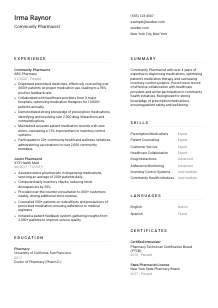
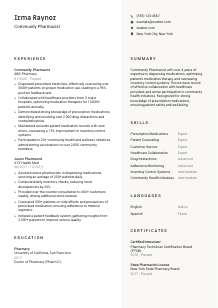
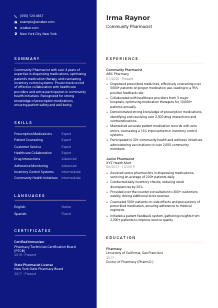
Dispensing healthcare, but your resume feels like a pill to swallow? Check out this Community Pharmacist resume example, created with Wozber free resume builder. It shows how to combine your clinical and people skills to match job specifics, ensuring your career script has no side effects on your prospects!
Community pharmacy work sits at the intersection of clinical judgment and daily patient contact. Hiring teams look quickly for proof that you can dispense accurately, catch interactions, counsel clearly, and keep the pharmacy running safely when prescription volume is high. Your resume needs to make that operational reliability visible from the start.
A tailored resume changes how quickly reviewers can connect your background to medication safety, patient counseling, and front-line pharmacy workflow. Wozber's free resume builder helps you align your language with the posting, keep the layout ATS-friendly, and surface requirements such as licensure, retail pharmacy experience, and immunization work so your application reads like a direct match for community practice.
Community pharmacy hiring starts with practical checks. Before anyone reads your experience, they need to see that you are reachable, licensed in the right market, and applying for the exact pharmacist role they need to fill. Keep this section clean, complete, and easy to scan.
Use your full name in a clear, readable style at the top of the page. In pharmacy hiring, professionalism and precision matter, and your header should reflect the same standard you would apply to medication records or patient documentation.
Place "Community Pharmacist" directly below your name when that is the role you are pursuing. This immediately tells the reader where you fit, and it helps ATS matching when the posting uses that exact title rather than a broader term such as staff pharmacist or retail pharmacist.
Your phone number and email should be current and error-free. A pharmacist is trusted with controlled substances, patient counseling, and record accuracy, so even basic details should show care and consistency. Use a professional email format, ideally based on your name.
Some community pharmacy roles are tied to a specific city or state because of scheduling, licensure, or store coverage needs. Here, the employer asks for someone located in New York City, New York, so listing that location directly helps remove an early screening barrier.
A LinkedIn profile or professional website can support your application if it reinforces pharmacy experience, immunization work, licenses, or continuing education. Include it only if the information is polished and consistent with the resume, not as filler.
This section should confirm the essentials fast: who you are, which pharmacist role you want, how to reach you, and whether you meet location expectations. That allows the hiring team to move straight into your patient care and dispensing background.




For a Community Pharmacist, experience is where employers look for real-world judgment. They want to see how you handled prescription volume, patient counseling, provider communication, adherence questions, vaccination support, and inventory accuracy in a live retail setting.
Read the job description and mark the responsibilities that define day-to-day pharmacy work. In this case, that includes dispensing prescribed medicines, counseling patients, monitoring for drug interactions and contraindications, maintaining medication records, overseeing inventory control, and joining community health initiatives. Those points should shape the language of your experience section.
Use reverse chronological order and include your title, employer, and dates for every relevant role. For pharmacy positions, the title matters because "Community Pharmacist" and "Junior Pharmacist" suggest different levels of autonomy, patient counseling responsibility, and verification authority.
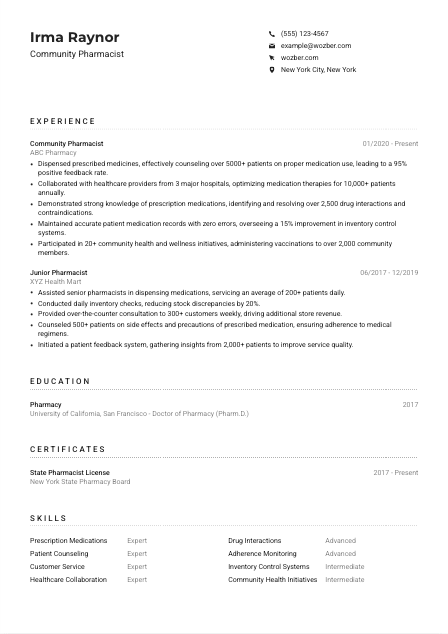
Under each role, focus on what you handled and what changed because of your work. Good bullets in this field often show prescription volume, counseling load, immunization activity, collaboration with prescribers, adherence support, or inventory accuracy. The sample resume does this well by tying pharmacist work to outcomes such as counseling 5,000+ patients and maintaining records with zero errors.
Numbers carry weight when they reflect actual pharmacy performance. Include measures such as patients served per day, interventions made on drug interactions, adherence improvements, vaccination totals, refill or inventory accuracy, or provider partnerships. Metrics like these tell the reader whether you can manage both patient safety and store-level workflow.
Keep older or unrelated jobs only if they add something useful, such as customer service in a healthcare setting or regulated recordkeeping. Community pharmacy resumes are strongest when most of the space is devoted to dispensing, consultation, medication therapy support, inventory systems, and patient-facing care.
Your experience section should leave no doubt that you can operate safely in a community or retail pharmacy. When your bullets show patient volume, clinical judgment, and reliable execution, hiring managers can picture you behind the counter, not just on paper.
Education is a required credential in pharmacy, so this section needs to be direct and complete. Employers are checking for the degree that qualifies you for practice, and they should be able to confirm it in seconds.
List your Bachelor's in Pharmacy or Pharm.D. clearly, using the full degree name. This posting accepts either, and the example resume highlights a Doctor of Pharmacy degree right away, which makes the applicant's academic qualification immediately clear.
Include degree, field of study, school, and graduation year or date. Pharmacy is a regulated profession, so there is no advantage in making this section creative. Straightforward formatting supports fast verification.
If you hold a Pharm.D., make sure it is easy to spot because many employers view it as strong preparation for medication therapy management, patient counseling, and broader clinical responsibility in practice.
Most licensed pharmacists do not need to list coursework unless they are early in their career or applying for a role with a specific clinical emphasis. If you do include it, focus on subjects that support community practice, such as pharmacotherapy, patient counseling, or immunization training.
Academic honors, pharmacy associations, or leadership roles can strengthen this section if they show commitment to the profession. Keep them concise and relevant, especially if you already have solid pharmacy experience.
A hiring manager should be able to confirm your academic qualification at a glance. Clear degree information keeps the focus where it belongs, on whether you are prepared and credentialed for licensed pharmacy practice.
In pharmacy, certifications are more than add-ons. Licensure is a core hiring requirement, and additional credentials can show that you are ready for patient-facing services that matter in retail settings, especially vaccinations and public health support.
If the posting calls for a state pharmacist license in good standing, place that credential first. It is the non-negotiable qualification that allows you to practice, and it should never be buried below optional certifications.
After your pharmacist license, list certifications that strengthen your value in community practice, such as immunization authorization, medication therapy management training, or CPR if the role involves clinical services. In the example, the Certified Immunizer credential directly supports the employer's interest in vaccinations and wellness initiatives.
Include issue dates, renewal periods, or "Present" when appropriate. Employers need to know whether a license or certification is current, especially in regulated healthcare roles where lapsed credentials can halt hiring immediately.
Retail and community pharmacists are often involved in expanding patient services, from vaccines to screenings and medication reviews. Updated certifications show that you can contribute beyond dispensing and support newer care models in the pharmacy setting.
This section should quickly answer two questions: are you licensed, and do you bring any additional qualifications that expand your value in community care. Put the essentials first and keep the status of every credential clear.
The best skills section for a Community Pharmacist reads like a concise map of safe pharmacy practice. It should balance medication knowledge with patient communication, because the role depends on both clinical accuracy and clear counseling at the counter.
Start with the posting and note the abilities tied to actual pharmacy tasks. Here, the clearest priorities are prescription medication knowledge, dosage forms, drug interactions, patient counseling, communication, customer service, adherence monitoring, provider collaboration, and inventory control.
Only list skills that show up in your experience, certifications, or summary. If you claim expertise in drug interactions or healthcare collaboration, your work history should include interventions, prescriber communication, or therapy optimization that backs it up. The sample resume handles this by pairing skills such as Patient Counseling and Drug Interactions with quantified pharmacy accomplishments.
Organize your skills so both ATS systems and human reviewers can read them quickly. A clean mix of clinical and service-oriented skills works well for community pharmacy, because employers are hiring for medication safety, patient education, and steady day-to-day store performance, not just product knowledge.
When this section is aligned with your experience, it gives a quick read on the kind of pharmacist you are. The right mix shows that you can manage prescriptions accurately, communicate with patients clearly, and support the operational pace of a community setting.
Language ability matters in community pharmacy because understanding instructions, side effects, and adherence concerns can directly affect patient safety. If you serve a diverse population, an additional language can improve counseling quality and trust at the counter.
This role specifically requires effective communication in English, so English should be listed clearly with your proficiency level. In healthcare, language is not a decorative detail. It affects counseling accuracy, question handling, and patient understanding of medication use.
If you speak another language commonly used in your community, include it when you can use it in real patient interactions. The example resume lists Spanish, which can be valuable in many urban pharmacy settings, though that kind of additional language should be framed as an advantage rather than a universal requirement.
Additional language skills can strengthen your profile, especially in neighborhoods with multilingual patient populations or stores that serve a broad customer base. Add them if they are relevant and if you can communicate accurately about healthcare topics.
Terms such as "Native," "Fluent," "Intermediate," and "Basic" are enough. Avoid vague wording. Pharmacists often explain dosage, side effects, storage instructions, and interactions, so accuracy about your own communication level matters.
List languages with the same mindset you bring to counseling. The point is not to appear cosmopolitan. It is to show that you can support clearer communication, better medication understanding, and more accessible service in the communities you serve.
When presented clearly, your language section can strengthen your case for a community-facing pharmacy role. It shows that you can do more than dispense correctly. You can also help patients understand what safe medication use looks like.
Your summary should give a quick, credible picture of how you practice as a pharmacist. In a few lines, it should cover your level of experience, your strongest community pharmacy capabilities, and the kind of patient care or operational impact you bring.
Before writing, identify the few requirements that matter most for early screening. For this role, those are community or retail pharmacy experience, strong medication knowledge, patient counseling, communication, and monitoring for interactions or contraindications. Use those as the backbone of your opening lines.
Start with a direct description such as Community Pharmacist with 4+ years of experience in retail and patient-facing pharmacy settings. This gives immediate context and helps distinguish you from hospital, industry, or non-practicing pharmacy profiles.
Bring in two or three role-matched strengths, such as medication therapy optimization, high-volume patient counseling, prescriber collaboration, vaccination support, or inventory oversight. The sample summary works because it connects years of experience with concrete areas of practice instead of relying on broad claims alone.
Aim for a short paragraph that sounds grounded and specific. Avoid generic adjectives and focus on practical pharmacy value. After reading the summary, a hiring manager should already understand your setting, your core strengths, and why you belong in a community pharmacy environment.
A well-built summary gives immediate context for the rest of the resume. When it reflects real community pharmacy work, it frames your experience, skills, and licensure in a way that makes your application easier to shortlist.
A Community Pharmacist resume should make three things easy to see: you are qualified to practice, you can manage day-to-day dispensing and counseling safely, and you can support the pace and patient needs of a retail pharmacy. When your experience, skills, and credentials are aligned around those points, the document reads with the same clarity and reliability the job demands.
Use Wozber to tighten that alignment with an ATS-friendly resume format, targeted phrasing, and practical ATS optimization support. Wozber's ATS resume scanner can help you spot missing requirements, strengthen role-specific language, and organize your content so both screening systems and hiring teams can quickly recognize your pharmacy readiness.
That is the standard your resume should now meet.




