



Use Wozber and land your dream job
Create Resume
No registration required
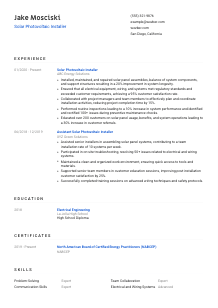
Positioning panels, but your resume isn't shining? Energize your credentials with this Solar Photovoltaic Installer resume example, created with Wozber free resume builder. Learn how to present your renewable expertise to match job currents, powering up a career that's as bright as a sunlit day!
Solar installation work is judged in the field long before a hiring manager ever sees you. Teams need installers who can mount and wire systems safely, read site conditions, work cleanly around code requirements, and keep projects moving without creating callbacks. Your resume should make that practical range clear, from panel assemblies and balance-of-system components to inspections, maintenance, and customer handoff.
When that experience is tailored to the posting, the resume is easier to sort in both an ATS and a human review. Wozber's free resume builder helps you align your wording with the job description, keep an ATS-friendly resume format, and surface the right mix of electrical knowledge, installation history, and certification detail so the hiring team can quickly see whether you can step onto a crew and contribute.
For an installer role, the header does more than identify you. It confirms basic logistics fast, including who you are, what role you do, and whether location or language requirements are already covered before anyone reads your project history.
Use your full name in a larger, clean font so it is easy to find on both screen and print. Keep it simple and professional. For a field role like Solar Photovoltaic Installer, the header should look dependable and organized, much like the rest of your resume.
Place "Solar Photovoltaic Installer" directly under your name if that is the role you are targeting. This helps frame your background immediately, especially when your recent work already includes panel installation, wiring, troubleshooting, or preventive maintenance.
List a current phone number and a professional email address that you check regularly. Hiring for installation crews often moves quickly, so missed calls and outdated contact details can cost you an interview. Skip casual email handles and use something straightforward, ideally based on your name.
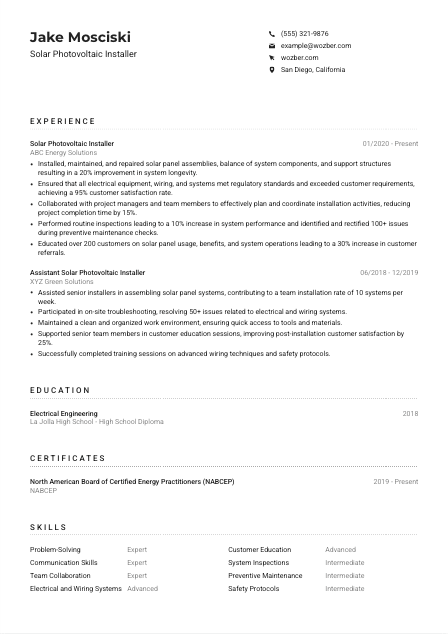
If the employer specifies a city or region, show it clearly in your personal details. Here, listing "San Diego, California" directly addresses a stated requirement. For other applications, only mirror location when it is relevant to the posting or commute expectations.
A LinkedIn profile can help if it reinforces your hands-on solar background, certifications, safety training, or related electrical work. Make sure dates, titles, and credentials match your resume. If your profile is thin or outdated, leave it off until it reflects your actual field experience.
This section should answer the first practical questions fast: who you are, what job you do, and whether you meet key logistical requirements. Keep it clean, accurate, and easy for both recruiters and ATS tools to read.




This is the section hiring managers will study most closely. For solar installer roles, they want to see direct installation work, electrical competence, safety awareness, crew coordination, and signs that your work held up after commissioning.
Before editing your experience, identify the work the employer keeps returning to. In this case, that includes installing and repairing solar assemblies, working with electrical and wiring systems, coordinating with project managers, performing inspections, and educating customers. Use those duties as your filter when choosing which bullets stay and which need rewriting.
Start with your most recent role and include title, employer, and dates for each position. This format lets hiring teams track how quickly you moved from assisting on installations to owning more of the job, whether that means wiring, maintenance checks, troubleshooting, or customer-facing responsibilities.
Each bullet should connect a real task to an outcome. Instead of saying you were responsible for installations, describe what you installed, maintained, repaired, tested, or corrected. The sample resume does this well with details like improving system longevity, reducing project completion time, and identifying issues during preventive maintenance.
Good metrics for this profession include systems installed, completion speed, defect reduction, maintenance findings, customer satisfaction, referral lift, or performance improvements after inspections. Figures such as "95% customer satisfaction," "100+ issues identified and corrected," or "15% faster project completion" give the employer a much clearer read than generic claims about being hardworking.
If older jobs do not relate to solar, electrical work, construction-site discipline, customer education, or equipment handling, reduce them or remove them. Use the space for more relevant details such as racking, wiring, code compliance, troubleshooting, or maintenance routines. The goal is to show that your background translates directly to active solar installation work.
By the end of this section, the reader should understand the scale of your installation experience, the technical tasks you can handle, and the results your crews delivered. Focus on field execution, electrical accuracy, and outcomes that suggest fewer delays, fewer issues, and better-performing systems.
Education usually plays a supporting role for Solar Photovoltaic Installers, but it still matters because employers often use it as a quick qualification check. Present it clearly, then let your hands-on work and certifications carry the stronger weight.
If the posting asks for a high school diploma or equivalent, make sure that appears exactly and clearly in your education section. Do not assume it is obvious. For this opening, that simple line satisfies a stated requirement and keeps your application from being filtered out early.
List the school, diploma or degree, field if relevant, and graduation year or date. Keep the structure consistent with the rest of the resume. For trade-adjacent roles like solar installation, clarity matters more than decorative detail.
If your coursework, concentration, or school program had an electrical, renewable energy, or technical focus, include it when it genuinely strengthens your fit. The sample resume references Electrical Engineering alongside a high school diploma, which works as an example of tailoring because it supports the role's wiring and systems focus. Do not force a specialization you did not actually complete.
Short courses in electrical safety, OSHA practices, fall protection, solar design basics, or equipment handling can be useful here if they are not listed elsewhere. These details show familiarity with jobsite standards and the realities of rooftop or ground-mount installation work.
If you are new to the trade, school projects, technical coursework, and relevant activities can help fill out the section. If you already have several years of installation experience, keep education brief and let your work history and certifications do more of the talking.
This section does not need much space unless you are early in your career. Confirm the required diploma, include any genuinely relevant technical study, and move the reader toward the stronger proof in your field experience and certifications.
Certifications carry real weight in solar hiring because they signal up-to-date knowledge, technical discipline, and commitment to safe, compliant installation work. They are especially useful when the employer explicitly mentions NABCEP or state-specific licensing.
When a posting names certifications, move those to the top of the section. Here, NABCEP and state-specific licenses are directly relevant, so they deserve immediate visibility. If you hold one of them, do not bury it under less important training.
List certifications that support photovoltaic installation, code compliance, safety, electrical systems, or inspection-related work. The sample resume uses NABCEP and a Solar PV Installation Professional credential, which is a solid example of how to keep this section closely aligned with the job.
Include the credential name, issuing body, and the date earned or validity period when appropriate. For certifications that must stay current, this helps employers confirm they are active without extra follow-up. That matters in regulated work where expired credentials can delay hiring.
Solar installation changes with code updates, equipment changes, and local requirements. Refresh this section whenever you renew a certification or add new training. An up-to-date list tells employers you are maintaining the knowledge needed for safe installs and compliant electrical work.
A focused certifications section tells the employer you take technical standards seriously. Lead with the credentials that matter most for solar installation, keep the details current, and make it easy to see that you can work within industry and regulatory expectations.
For Solar Photovoltaic Installers, the best skills section mirrors the day-to-day demands of the job. It should support your experience, not repeat generic traits with no context.
Read the posting closely and mark both explicit and implied skills. Here, the obvious ones include electrical and wiring knowledge, problem-solving, communication, and collaboration. The responsibilities also point to practical strengths such as inspections, preventive maintenance, regulatory compliance, and customer education.
Choose skills that map directly to work you have actually done. For this role, that might include electrical wiring systems, solar panel assembly, balance-of-system installation, troubleshooting, preventive maintenance, safety protocols, team coordination, and customer instruction. The sample resume balances technical and interpersonal skills well by combining wiring knowledge with communication and collaboration.
Do not overload the section with every skill you have ever used. Prioritize the capabilities most likely to matter on a solar crew and in the ATS scan. A shorter, targeted list is usually stronger than a crowded one, especially when the same strengths are already backed up by measurable bullets in your experience section.
The best skill lists feel credible because the same abilities appear elsewhere in the resume through tasks, tools, and results. Keep the emphasis on technical competence, safe execution, and the communication skills needed on-site and with customers.
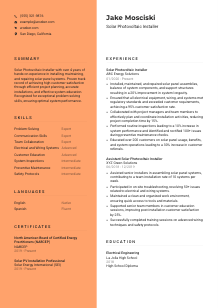
Language ability matters in installation work because crews need clear coordination on-site and customers need understandable system handoff. List languages in a way that reflects actual working proficiency, especially when the posting makes one mandatory.
If the employer states that English is mandatory, list English clearly and give an honest proficiency level. For this job, that requirement should be visible without the reader having to search for it.
Lead with the language you use most confidently in technical discussion, safety communication, and customer interaction. If English is your primary language, showing it first helps confirm that you can follow installation instructions, explain system basics, and coordinate with supervisors or project managers.
Additional languages can be valuable when crews or customers are multilingual. In the sample resume, Spanish is listed alongside English, which can be a practical advantage for customer education and smoother communication on diverse job sites. Treat that as a bonus, not a universal requirement.
Use clear labels such as Native, Fluent, Conversational, or Basic. Avoid overstating ability. On a job site, inaccurate language claims can create confusion around safety instructions, troubleshooting steps, or customer explanations.
Only include languages that you can realistically use in work settings. For Solar Photovoltaic Installers, that usually means site communication, customer walkthroughs, and support during maintenance or service visits rather than broad claims about global business value.
This section should quickly confirm mandatory communication requirements and highlight any extra language ability that helps on-site coordination or customer support. Keep it honest and directly relevant to how you work.
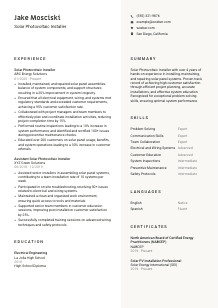
Your summary should sound like someone who has already done the work, not someone describing the profession from a distance. In a few lines, show installation experience, technical strengths, and the kind of results or responsibilities that match the target job.
Look at the opening and identify what matters most in the first read. Here, that includes at least 2 years of solar installation experience, strong electrical knowledge, problem-solving ability, communication, and relevant certifications. Those are the points your summary should bring forward first.
Start with a direct line such as "Solar Photovoltaic Installer with 4+ years of hands-on experience." That immediately places you in the right hiring category and distinguishes you from candidates coming from general labor or broader construction backgrounds.
Follow the opener with specific strengths tied to the work, such as installing and maintaining photovoltaic systems, working with electrical and wiring components, improving system performance, or educating customers after installation. The sample summary does this effectively by combining hands-on experience with customer satisfaction and performance outcomes.
Aim for 3 to 5 lines. That is enough space to establish your installation background, technical focus, and one or two concrete results without repeating the entire experience section. Save the fuller detail for your bullets below.
A good summary makes it clear, early, and without hype that you have installed systems, handled the technical side responsibly, and contributed to reliable project outcomes. It should leave no doubt about the kind of installer you are.
A Solar Photovoltaic Installer resume works best when it reflects how the job is actually evaluated: safe installation work, electrical competence, dependable coordination, and systems that perform well after the crew leaves the site. When each section reinforces those points, your application becomes much easier to trust.
Use Wozber's free resume builder to shape your content into an ATS-compliant resume, refine role-specific wording with AI support, and check alignment with the posting through its ATS resume scanner. The final result should make one thing clear fast: you can install, maintain, and explain solar systems with the technical accuracy the role demands.




