



Use Wozber and land your dream job
Create Resume
No registration required
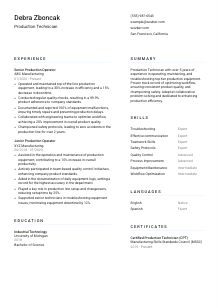
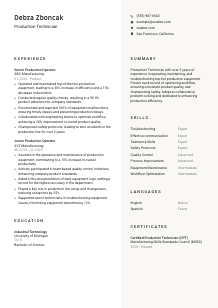
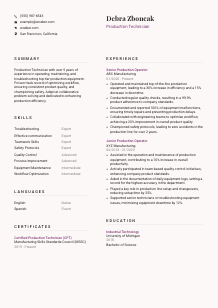
Fine-tuning assembly, but your resume seems out of sync? Check out this Production Technician resume example, created with Wozber free resume builder. It shows how to bring your technical know-how in line with job tune-ups, ensuring your career's productivity hits all the high notes!

Production technician hiring moves quickly when a resume shows what happened on the line under your watch. Employers want to see that you can keep equipment running, catch quality issues before they spread through a batch, document breakdowns clearly, and work safely around output targets, changeovers, and standard operating procedures.
Resume tailoring matters here because production resumes often blur together unless the operational details are explicit. Wozber's free resume builder helps you line up your wording with the posting, keep an ATS-friendly resume format, and surface the exact mix of equipment handling, quality control, and shop-floor collaboration the employer needs to see first.
On a production resume, the header should settle the basics fast so the reviewer can move straight to your plant-floor experience. Keep this section clean, accurate, and aligned with the posting, especially when the employer has practical filters such as location or role title.
Use your full name in a clear, readable font so it stands out immediately at the top of the page. This is simple, but it matters. A clean header sets the tone for the rest of a resume built around precision, safety, and controlled execution.
Place "Production Technician" directly beneath your name when that is the role you are pursuing. Matching the posted title helps hiring teams and ATS software connect your resume to the opening without guessing whether your background as an operator, technician, or line specialist fits the same lane.
Your contact information should be easy to scan and impossible to misread. Production hiring can move fast, especially for shift-based roles, so accuracy matters here as much as it does in an equipment log.
If the posting asks for a local candidate or someone willing to relocate, make that easy to see. In this example, listing "San Francisco, California" immediately removes a common point of uncertainty and shows you meet the geographic requirement without needing extra explanation.
Include LinkedIn or a professional website only if it supports your application. For production work, that could mean a profile that reflects your manufacturing experience, certifications, safety record, or process improvement work and matches the dates and titles on your resume.
Your Personal Details section does not need flair. It needs accuracy, a clear job title, and any key logistical detail that affects eligibility. Once that is in place, the rest of the resume can focus on throughput, quality, maintenance, and safety.




For production technicians, the Experience section carries most of the decision weight. This is where employers look for proof that you can run equipment reliably, reduce downtime, follow quality procedures, and work with maintenance, engineering, or QA when the line needs attention.
Start by marking the verbs and operating standards in the job description. Phrases such as "operate and maintain production equipment," "perform regular quality checks," and "document equipment malfunctions" should shape how you describe your work, as long as they reflect what you have actually done.
List your jobs in reverse chronological order and make the most relevant manufacturing work easiest to read. If you have been a production operator, line technician, assembler, or machine operator, focus bullets on the parts of those roles that connect to equipment operation, preventive care, troubleshooting, quality checks, and workflow support.
Production hiring responds well to numbers because they show what your work changed on the floor. Use metrics tied to efficiency, scrap reduction, downtime, defect rates, setup time, output, safety, or documentation accuracy. The example resume does this well with results like a 30% efficiency increase, 15% less downtime, 99.9% adherence to standards, and zero accidents over two years.
Do not spend space on generic duties that could belong to any job. Prioritize experience that shows you can keep a line moving, spot irregularities, escalate issues properly, support changeovers, and work within quality and safety procedures. Even if your past title was not exactly "Production Technician," the work itself can still align strongly when framed around these outcomes.
Lead bullets with verbs that show direct contribution, such as "operated," "maintained," "troubleshot," "documented," "inspected," "calibrated," "collaborated," or "reduced." In the sample, verbs like "operated," "conducted," "documented," and "championed" make each accomplishment sound active and accountable instead of routine.
The best experience sections connect your actions to line performance, product quality, and safe execution. When a hiring manager can quickly see what equipment you handled, how you worked, and what results followed, your resume starts reading like someone ready to contribute on day one.
Production technician roles are often won on hands-on manufacturing experience, but education still adds useful context. It can show technical grounding, familiarity with industrial systems, and the kind of training that supports process discipline, quality work, and equipment awareness.
If you have education in industrial technology, manufacturing, mechanical systems, electronics, or a related field, place that information clearly. A degree like the Industrial Technology example supports the technical side of production work, even when the job itself is more operations-focused.
List the degree, field of study, school, and graduation year in a clean sequence. Hiring teams reviewing many manufacturing resumes do not need extra decoration here. They need to find your training quickly and move back to your production record.
When your field of study connects to production environments, make that relevance obvious. Coursework or training in manufacturing systems, quality assurance, industrial safety, maintenance, operations, or process improvement can strengthen your fit when your experience is still growing.
If a class project involved process flow analysis, equipment systems, lean manufacturing, or quality inspection methods, include it only when it helps explain your preparation for the target job. This is most useful for early-career candidates who need another way to show technical exposure.
If your certification is a meaningful part of your qualifications, connect it naturally to your education and technical preparation. For example, a Certified Production Technician credential reinforces formal knowledge of production processes, safety, and quality standards.
Education will not replace hands-on manufacturing results, but it can strengthen the picture. When it is relevant and clearly presented, it shows that your shop-floor experience is backed by structured technical learning.
Certifications can make a production resume more credible, especially when they relate to safety, manufacturing standards, equipment work, or quality procedures. They are particularly useful when the employer lists them as preferred rather than required, because they help separate candidates with similar line experience.
Feature certifications that support the actual demands of the role, such as operating discipline, quality awareness, safety knowledge, or manufacturing process familiarity. In this posting, the Certified Production Technician credential is a clear match because it aligns directly with plant-floor responsibilities.
Include the certificates that strengthen your case for this specific kind of work. A short list of relevant credentials is more persuasive than a long list that drifts away from manufacturing, maintenance, or production quality.
Show the issuing organization and whether the credential is current. If a certificate needs renewal, display the dates in a way that is easy to understand. That saves the reviewer from guessing whether the qualification is active.
Production environments change with new equipment, revised quality systems, and updated safety expectations. Continuing to add role-relevant training shows that you stay current with how the work is actually done, whether through formal certifications or focused technical programs.
Certificates work best when they reinforce the kind of production work you want to do next. A well-chosen credential can strengthen your resume by showing verified knowledge in the same areas the employer needs on the floor.
The skills section should read like a production technician's working toolkit, not a generic list of strengths. Focus on the abilities that affect uptime, quality, safety, and teamwork, because those are the areas most employers are staffing for when they hire into manufacturing operations.
Start with the capabilities named in the job description, then match them to your actual background. Here, that means equipment operation, maintenance, troubleshooting, quality control procedures, communication, teamwork, and safety. Using the employer's wording where it is accurate helps both ATS matching and human review.
Production technicians are rarely hired on machine skills alone. Include hard skills like troubleshooting, equipment maintenance, quality control, process improvement, or changeover support alongside soft skills that matter on the line, such as communication, shift handoff clarity, and teamwork across operations, maintenance, and QA.
Keep the section tight and relevant. The example resume lists troubleshooting, safety protocols, quality control, workflow optimization, and communication, which aligns well with the posting without turning into a keyword dump. Aim for that same level of focus so the list supports your experience instead of repeating it blindly.
A good skills section makes your operational strengths easy to find at a glance. When the list reflects real equipment work, quality discipline, and reliable teamwork, it supports the rest of your resume instead of padding it.
Language ability is usually a supporting section for production technicians, but it can still matter. Manufacturing settings rely on clear written instructions, shift communication, safety signage, and accurate documentation, so language proficiency should be listed in a practical way.
If the posting specifies English reading ability, list English clearly with an honest proficiency level. In this case, the requirement to read complex texts in English likely connects to work instructions, safety procedures, maintenance notes, and quality documentation.
Additional languages can be valuable in multilingual production environments where teamwork, training, and handoffs happen across diverse crews. They are not always decisive, but they can support smoother communication.
Choose simple levels such as Native, Fluent, Advanced, or Conversational and be accurate. If your language skills come up during onboarding, training, or cross-shift coordination, your listed level should hold up in practice.
Language matters more when the job involves reading technical instructions, recording issues, or coordinating with teams during setup, maintenance, or quality investigations. Add extra languages when they genuinely support that type of work environment.
Only list languages you can use in a work setting. The example includes English and Spanish, which can be helpful in many manufacturing teams, but the priority remains the language required for safe, accurate execution of the job.
For this kind of role, language ability matters most when it improves understanding, documentation, and coordination. Keep the section honest and practical, with English proficiency clearly visible when the posting calls for it.
Your summary should quickly tell the employer what kind of production technician you are. In a few lines, connect your experience level with the operational strengths that matter most, such as equipment reliability, quality discipline, troubleshooting, safety performance, or process improvement.
Read the posting closely and decide which themes belong in your opening lines. For this role, the main priorities are equipment operation and maintenance, quality checks, troubleshooting, teamwork, and safety. Those should shape the summary more than broad statements about being hardworking or motivated.
Open with your title or closest equivalent and your years in manufacturing. The sample summary does this effectively by leading with more than 5 years of experience operating, maintaining, and troubleshooting production equipment. That instantly places the candidate in the right experience bracket.
Choose the abilities that best match the opening and connect them to outcomes when possible. Useful themes include reducing downtime, maintaining consistent product quality, improving workflow, supporting safe operations, or collaborating across teams to resolve line issues.
Aim for 3 to 5 sentences with no wasted space. A production supervisor or recruiter should be able to read your summary in seconds and understand your experience level, technical focus, and the kind of value you bring to a manufacturing team.
A focused summary gives the reader a quick operational snapshot before they reach your work history. If it clearly states your manufacturing background, equipment expertise, and quality and safety discipline, it sets the right expectation for everything that follows.
A production technician resume works best when every section supports the same message: you can help a manufacturing team run equipment safely, maintain quality standards, and keep downtime under control. That means tailoring your wording to the posting, using metrics that belong in production environments, and keeping the structure clean enough for both hiring managers and ATS systems to read quickly.
Wozber helps you do that with an AI resume builder built for targeted revision, ATS optimization, and clear section structure. Use it to sharpen the language, surface missing requirements, and produce an ATS-compliant resume that makes your equipment experience, quality discipline, and shop-floor reliability easy to judge.




