



Use Wozber and land your dream job
Create Resume
No registration required
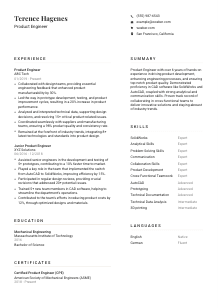
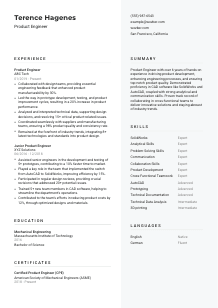
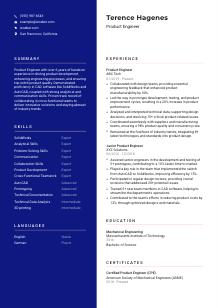
Blending innovation, but your resume doesn't make the cut? Check out this Product Engineer resume example, created with Wozber free resume builder. It shows how to present your engineering prowess to fit the contours of a job, ensuring your career prospects rise as high as your prototypes!
Product engineering work gets judged in the real world by what happens after the concept phase. Can you turn design intent into something manufacturable, testable, and reliable at production quality. A Product Engineer resume needs to make that practical contribution visible, especially around prototype cycles, engineering tradeoffs, and collaboration with design and manufacturing teams.
Resume tailoring changes how quickly a hiring team can place you on the product development spectrum, from CAD-heavy support work to full ownership of prototyping, testing, and supplier coordination. Using Wozber's free resume builder to match the posting's language and keep an ATS-compliant resume structure helps surface the right terms, from manufacturability to technical data analysis, so your experience reads clearly as hands-on product engineering.
This section is brief, but it still does real screening work. For Product Engineer roles, it should confirm who you are, how to reach you, and whether you already meet any practical hiring condition such as location for on-site prototype work or factory coordination.
Use your full name at the top in a clean, readable style. Product engineering hiring usually moves fast once a profile matches the technical need, so your resume should make identification immediate and professional.
Place "Product Engineer" under your name if that is the role you are applying for. This helps frame the rest of the resume around product development, CAD work, testing, and manufacturability instead of leaving room for your background to be read as generic mechanical engineering or design support.
Make this section easy to scan and error-free. A missed digit or an unprofessional email address creates friction before anyone reaches your engineering experience.
If a role requires local presence for prototype reviews, supplier visits, or in-person collaboration, include your city and state clearly. Here, listing San Francisco, California directly addresses the stated location requirement and removes a common point of hesitation early.
A LinkedIn profile, portfolio, or personal site can help when it shows project context, product launches, CAD-heavy work, or cross-functional achievements. Keep it current and consistent with your resume, especially if it includes engineering projects, design-for-manufacture examples, or prototype outcomes.
Your personal details should confirm that you are reachable, professionally presented, and aligned with any practical requirement attached to the role. For a Product Engineer, that means removing avoidable doubts before the reader gets to your product development record.




This is the section hiring teams study most closely. For Product Engineer roles, they want to see where you influenced design decisions, how you handled prototype and testing cycles, and whether your work held up when it reached suppliers, manufacturing, or quality review.
Read the posting for the actual engineering work, not just the title. In this case, the priorities include manufacturability feedback, prototype development, technical data analysis, supplier coordination, and product improvement. Those phrases tell you which parts of your background deserve the most space and the most precise wording.
Use reverse chronological order so the hiring team sees your current level first. For each position, include company, title, and dates. That structure lets them quickly map your progression from junior support work to broader product ownership or faster iteration cycles.
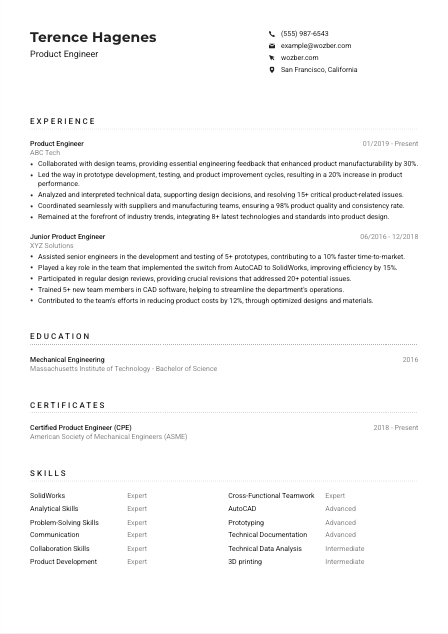
Focus each bullet on an engineering action and a product result. Good Product Engineer bullets often show how you improved manufacturability, resolved technical issues, supported testing, reduced cost, or increased performance. The example resume does this well with lines like improving manufacturability by 30% and resolving 15+ product-related issues, both of which translate daily engineering work into outcomes a team can trust.
Metrics carry weight here because product work is measured through performance gains, defect reduction, cycle speed, yield, cost, and quality consistency. Use percentages, counts, tolerances, throughput, or time-to-market improvements when they are real. A bullet about coordinating with suppliers to maintain a 98% quality rate says far more than a generic claim about teamwork.
Keep the section centered on product development and engineering execution. If a bullet does not connect to design reviews, CAD-driven changes, testing, problem solving, manufacturing coordination, or product improvement, it probably belongs elsewhere or should be rewritten. Relevance matters more than volume.
Your experience section should show that you can move a product from concept support into tested, manufacturable reality. When the bullets clearly connect your engineering decisions to performance, quality, or delivery outcomes, your resume starts reading like someone who can contribute on day one.
For Product Engineer positions, education is usually a baseline requirement rather than the main selling point. Still, it needs to confirm the technical foundation behind your CAD work, prototyping judgment, and understanding of materials, mechanics, and design constraints.
When the posting asks for a bachelor's degree in Mechanical Engineering, Product Design, or a related field, make that qualification easy to verify. If your degree aligns cleanly, state it plainly. If it is related but not identical, use the field wording that best reflects your engineering foundation.
List degree, field of study, school, and graduation year in a consistent format. Hiring teams do not need decoration here. They need to confirm the academic background behind your product engineering work without hunting for details.
If your education directly supports the role, let that clarity work for you. In the example, a Bachelor of Science in Mechanical Engineering lines up neatly with the requirement and reinforces the candidate's fit for prototyping, product analysis, and manufacturability discussions.
For early-career applicants, coursework in CAD, product design, materials, manufacturing processes, or testing methods can help. The same goes for capstone projects involving prototypes, design iterations, or validation work. Once your professional experience is established, these details become optional unless they are unusually relevant.
Honors, project awards, engineering competition results, or research work are worth adding when they connect to product development or technical problem solving. Skip generic student activities unless they support the role in a concrete way.
This section should quickly confirm that you have the technical foundation the role expects. For an experienced Product Engineer, education supports the story. It does not need to carry it.
Certifications are rarely the core requirement for Product Engineer hiring, but the right one can strengthen your profile, especially when it supports product development practice, quality discipline, or continued technical learning.
List credentials that relate to product engineering, manufacturing quality, CAD tools, materials, testing, or design processes. A certification such as Certified Product Engineer fits because it supports the same areas the role touches, from development cycles to product improvement.
Add the year earned or the active date range. That tells the reader whether the certification is current and whether it reflects recent professional development rather than something outdated.
A short list of relevant credentials reads better than a long catalog of loosely related courses. Prioritize certifications that support your actual resume story, whether that story leans more toward CAD execution, prototype testing, product quality, or supplier-facing engineering work.
Product engineering changes with materials, manufacturing methods, design tools, and industry standards. Ongoing certification or structured training can reinforce that you stay current and can bring updated practices into development and production conversations.
The best certifications add useful technical context around your experience. Keep them current, relevant, and clearly tied to the kind of product engineering work you want to do next.
A Product Engineer skills section should look like it belongs to someone who can contribute in design reviews, prototype builds, technical analysis, and production handoff. That usually means a balanced mix of CAD capability, engineering judgment, and cross-functional communication.
Start with the posting. Here, the clearest skill areas are CAD software, analytical problem solving, attention to detail, communication, and collaboration across design and manufacturing teams. Those are not filler keywords. They describe how the work gets done.
Use the same terminology when it matches your real experience. If you have worked in SolidWorks, AutoCAD, prototyping, technical documentation, or product development, name those skills directly. The example resume handles this well by pairing tool skills with broader engineering capabilities such as cross-functional teamwork and technical data analysis.
Order matters. Lead with skills that are central to the job, such as SolidWorks, product development, prototyping, technical analysis, and collaboration with design or manufacturing teams. Secondary skills can follow. This helps both the reader and ATS parsing pick up the core engineering profile quickly.
Your skills list should read like the toolkit behind your experience bullets, not a disconnected inventory. If the top items match the actual work of building, testing, and improving products, this section will support the rest of the resume well.
Language skills matter when the role depends on clear communication across design, manufacturing, suppliers, or global teams. For Product Engineers, that often means making sure the required working language is easy to spot and rated honestly.
If the job asks for English proficiency, list English clearly and give it an accurate level. That is especially important in roles involving technical documentation, design feedback, test reporting, and cross-functional meetings.
Lead with the language the role depends on most. In this case, English belongs at the top because it is tied directly to collaboration and communication requirements, not because it is merely nice to have.
Additional languages can be useful when suppliers, manufacturing partners, or global product teams are involved. They are not usually the deciding factor for a Product Engineer role, but they can support broader collaboration.
Choose straightforward levels such as Native, Fluent, Intermediate, or Basic. Product engineering roles involve precise communication, so it is better to be accurate than aspirational about your language ability.
If the company works across regions or coordinates with overseas vendors, extra language capability can add practical value. Keep the emphasis proportional, though. For most Product Engineer resumes, languages support the profile rather than lead it.
This section should quickly show that you can handle the language demands of the job, especially for technical discussion and teamwork. Anything beyond that is a useful bonus when it supports the company's operating footprint.
The summary needs to position you quickly within product development. For Product Engineer roles, that usually means showing your years of experience, your technical scope, and the kind of product outcomes you influence, all in a few focused lines.
Before writing, decide what your background most strongly supports. Are you strongest in CAD-led design support, prototype development, manufacturability improvement, supplier coordination, or product performance analysis. Your summary should lead with the pattern that best matches the role.
Start with your title, years of experience, and core engineering territory. A line such as "Product Engineer with 6+ years of experience in product development and prototype-driven improvement" is more useful than a vague self-description because it immediately places you in the product lifecycle.
Mention one or two relevant tools or capabilities, then connect them to results. In this case, CAD proficiency, technical analysis, manufacturability, and cross-functional product work all fit naturally. The example summary works because it combines SolidWorks and AutoCAD with engineering process improvement and product quality.
Aim for 3 to 5 lines with no filler. Every phrase should either define your scope, name a key tool, or point to an outcome such as improved performance, quality consistency, or stronger collaboration across design and manufacturing.
When this section is doing its job, a reader can tell within a few seconds what kind of Product Engineer you are and where you create value in the development cycle. That gives the rest of your resume a clear frame.
Before you send the resume, review it the same way you would review a product release. Check whether the core requirements are covered, whether the terminology matches the job description, and whether your strongest engineering outcomes are easy to find. Wozber's free resume builder, ATS-friendly resume templates, and ATS resume scanner can help you tighten structure, improve ATS optimization, and align your wording with the role's actual development and manufacturing priorities.
When the resume is finished, it should make one thing clear right away: you know how to turn design work into products that can be built, tested, improved, and delivered.




