



Use Wozber and land your dream job
Create Resume
No registration required
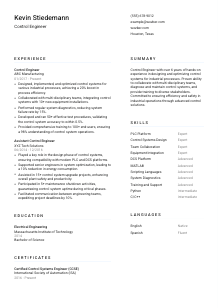
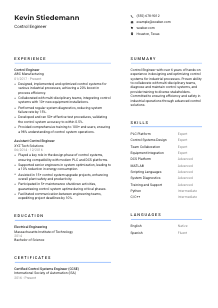
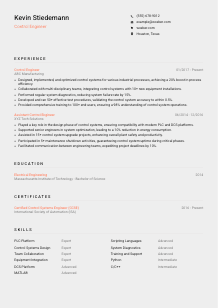
Crafting automation, but your resume feels manual? Check out this Control Engineer resume example, created with Wozber free resume builder. Learn how to map out your system savvy to match job requisites, keeping your control career cruising on autopilot!

Control engineering work is judged in production results long before anyone discusses style. Hiring teams want to see whether you can design stable control logic, commission systems safely, troubleshoot faults under plant constraints, and improve process performance without creating downtime or risk. Your resume should make that engineering judgment easy by showing where you have worked, what platforms you used, and what changed because of your work.
For this kind of role, the first screening question is often whether your background actually maps to the control environment in the posting, from PLC or DCS exposure to commissioning and diagnostics. Using Wozber's free resume builder helps you shape that experience into an ATS-compliant resume with the right technical language, so reviewers can quickly connect your projects to the control systems, testing work, and cross-functional support the job requires.
In control engineering, small input errors create larger downstream problems. The same applies to the top of your resume. Your personal details should confirm who you are, how to reach you, and whether you meet practical requirements such as location without distracting from the technical content that follows.
Place your name at the top in a clean, readable format. Hiring managers reviewing engineering resumes often move quickly from header to title to recent experience, so your name should be immediately visible without decorative styling or crowded formatting.
If you are applying for a Control Engineer position, use "Control Engineer" directly under your name when that reflects your background. This keeps your resume aligned with the posting and helps both recruiters and ATS tools categorize you correctly against control systems, commissioning, and process automation roles.
List a phone number you actually answer and a professional email address built around your name. If you include a website or portfolio, make sure it supports the application with relevant project work, automation documentation, or engineering credentials rather than generic links.
Some control engineering jobs are tied to plants, field sites, or local commissioning support, so location can affect whether your resume moves forward. In this example, Houston, Texas is part of the requirement, so showing Houston in the header immediately removes doubt. If you are relocating, state that plainly instead of leaving the employer to guess.
A LinkedIn profile can help if it matches your resume title, dates, and technical scope. For a Control Engineer, that means consistent references to industrial processes, PLC or DCS work, testing, troubleshooting, and collaboration with operations or maintenance teams. If the profile is outdated, leave it off until it is aligned.
This section should answer practical questions in seconds and then get out of the way. When your header is accurate and complete, reviewers can focus on your control design, commissioning work, and process results.




Experience carries the most weight in control engineering because the role sits close to live equipment, production targets, and safety expectations. Employers are looking for more than job titles. They want a clear record of design work, implementation, diagnostics, testing, optimization, and collaboration across engineering and operations.
Before you rewrite bullets, isolate the work themes in the job description. Here, the priorities include control system design, implementation, commissioning, diagnostics, maintenance, troubleshooting, testing, and end-user support. Those themes should shape which projects and outcomes you place highest in each role, especially if your background spans broader automation or process engineering work.
Use reverse chronological order and include company name, title, and dates for every role. In engineering hiring, a clean timeline helps reviewers understand your progression from supporting design and upgrades to owning control logic, system optimization, and commissioning responsibilities. Do not bury that progression in dense paragraphs.
Focus each bullet on a control engineering action and its result. Good bullets show what system you worked on, what you changed, and what improved, whether that was process efficiency, reliability, safety, startup performance, or operator usability. The sample resume handles this well with bullets about optimizing industrial control systems, integrating new equipment, and validating accuracy through test procedures.
Numbers matter when they reflect how the work is actually measured. For Control Engineers, that may include efficiency gains, failure-rate reduction, uptime, test coverage, accuracy, shutdown support, energy use, or number of installations commissioned. The example's "20% boost in process efficiency," "15% reduction in system failure rate," and "50+ test procedures" work because they tie engineering activity to operational outcomes.
If a bullet does not support your fit for the target role, trim it or rewrite it. General engineering tasks are less persuasive than specifics about PLC or DCS compatibility, troubleshooting during maintenance windows, control upgrades, or training operators on system behavior. Every bullet should help the employer picture you working on their equipment, process, and control environment.
A hiring manager should be able to scan this section and quickly understand the scale of your systems work, the platforms you touched, and the operational results you delivered. That is what turns experience into a credible Control Engineer profile.
For Control Engineers, education is usually a threshold check before the deeper review starts. The degree confirms your grounding in electrical, mechanical, chemical, or closely related engineering principles, which matters when the role involves control theory, instrumentation, system dynamics, and industrial process behavior.
If the posting asks for a bachelor's degree in Electrical, Mechanical, or Chemical Engineering, present your degree in those exact terms when applicable. In the example, "Bachelor of Science in Electrical Engineering" lines up cleanly with the requirement and supports the candidate's background in control systems and industrial automation.
List degree, field of study, school, and graduation year in a simple structure. This keeps the section easy to scan for both recruiters and ATS parsing. Academic detail matters, but the format should stay clean and quick to verify.
When your academic background directly supports the role, do not hide it behind abbreviations or overcomplicated formatting. Electrical engineering, for example, naturally connects to control logic, instrumentation, automation hardware, and systems design. That direct alignment is useful context, especially when a posting calls out technical degree requirements explicitly.
If you are still building experience, include selected coursework, lab projects, capstones, or thesis work related to process control, embedded systems, modeling, MATLAB, Python, or industrial automation. Keep it relevant and tied to actual engineering application rather than listing every class you completed.
Honors, engineering societies, or automation-related student work can strengthen this section for junior candidates. Membership in groups connected to controls, process engineering, or instrumentation can reinforce your interest in the field, though once your plant or project experience grows, those details become secondary.
This section does not need to be long. It needs to show that your engineering foundation matches the role and supports the control systems work described elsewhere on the resume.
Certifications matter most in control engineering when they reinforce practical system knowledge, professional standards, or continued development in automation and industrial controls. They are especially useful when they support the kind of platform, process, or regulatory environment the employer works in.
Lead with certifications that strengthen your relevance to control system design, automation, instrumentation, or process safety. A credential such as "Certified Control Systems Engineer (CCSE)" fits naturally because it supports the same kind of systems thinking and applied controls knowledge the job description emphasizes.
A shorter list of relevant certifications is stronger than a long list of unrelated training. If a credential does not help explain your ability to design, implement, troubleshoot, or support industrial control systems, it probably does not need space on the resume.
Show issue dates, renewal ranges, or active status for certifications that are current or time-sensitive. The example's "2016 - Present" format works because it shows continuity and maintenance rather than leaving the reader unsure whether the credential is still active.
Control environments change with new platforms, updated standards, and evolving plant requirements. Keeping this section current shows that you continue to build capability in areas that affect system reliability, commissioning quality, and operational support, not just that you once completed a course.
Certifications should reinforce the technical story already established in your experience and skills. When chosen well, they add confidence that your control engineering knowledge is current and applied.
A Control Engineer skills section should read like a condensed map of your technical toolkit. Hiring teams want to see the platforms, programming languages, and working strengths that support real design, commissioning, diagnostics, and optimization work. Generic soft-skill lists do not carry much weight unless they connect to how you work with operators, maintenance, and multidisciplinary engineering teams.
Start with the exact capabilities the posting asks for, then match them to skills you genuinely use. In this case, that includes control system design, PLC and DCS platforms, MATLAB, Python, C/C++, diagnostics, troubleshooting, and collaboration across disciplines. This helps your resume align with ATS filters and gives the reviewer the terminology they expect to see.
Do not turn the section into a master inventory of everything you have touched. Prioritize the skills that support the target work, such as process control, equipment integration, test procedure development, system maintenance, and operator training. The sample resume stays close to the role by centering control systems design, PLC, DCS, diagnostics, and scripting tools.
Put the most important technical skills first, followed by supporting tools and collaboration strengths. For many Control Engineer roles, core systems knowledge and platform familiarity should appear before broader traits. A recruiter should be able to scan the first few entries and immediately understand your controls stack and application range.
This section should quickly confirm that you speak the language of industrial controls and can operate in the systems environment the employer uses. Clear prioritization does that better than a long, unfocused list.
Language ability matters in control engineering when it affects documentation, training, troubleshooting, or coordination across shifts, vendors, and engineering teams. It is rarely the centerpiece of the resume, but when a posting specifies language proficiency, the section should answer that requirement clearly and without exaggeration.
If the job requires strong English, list English first and state your level plainly. In this posting, high English proficiency is explicitly required, so the sample resume's "English - Native" gives a direct answer and removes uncertainty around documentation, team communication, and end-user training.
Additional languages can be useful when plants have multilingual operator teams, international vendors, or cross-border engineering support. Include them if they are real working skills, as they can strengthen your profile for training, technical support, and project coordination.
Terms such as Native, Fluent, Advanced, Intermediate, or Basic are easier to interpret than vague descriptions. Keep the scale consistent so hiring teams can quickly understand whether you can handle meetings, technical instructions, or written documentation in that language.
Not every Control Engineer role needs multiple languages, but some do. If the company operates across regions or works with global equipment suppliers, an additional language can become a practical advantage. Include it when it helps explain how you work in real engineering settings, not just to fill space.
Do not overstate proficiency. In control engineering, poor communication during troubleshooting, testing, or operator handoff can create costly misunderstandings. List only the languages you can use confidently in the level of interaction your claimed proficiency suggests.
If language matters for the role, state it clearly and honestly. Once that requirement is covered, the rest of the resume can return to the technical and operational strengths that define your value as a Control Engineer.
The summary should quickly tell the reader what kind of Control Engineer you are and where your value shows up. In a few lines, connect your years of experience to the control environments you have worked in and the outcomes you have delivered, whether that is process efficiency, system reliability, commissioning support, or operator training.
Start with a direct description of your background, such as years of experience and the type of control work you handle. The example summary does this effectively by establishing more than 6 years in designing and optimizing control systems for industrial processes, which immediately places the candidate in the right technical lane.
Use the summary to mention the most relevant parts of your profile, such as PLC or DCS exposure, programming tools like MATLAB or Python, diagnostics, commissioning, or cross-functional equipment integration. Keep the selection tight and tied to the employer's stated priorities rather than trying to summarize your entire career.
A summary should sound like an engineer describing capability, not a personal statement. Choose concise phrases with technical weight and practical outcomes. References to process efficiency, control reliability, test execution, or end-user support do far more than broad claims about being motivated or detail-oriented.
A controls role in batch processing, manufacturing, utilities, or energy may emphasize different systems, tools, and performance measures. Tailor the summary so the first lines reflect the environment in the posting. Wozber's AI resume builder can help surface the relevant phrasing and keywords for that specific role, making your summary stronger and your ATS optimization more precise.
When this section is done well, the rest of the resume feels consistent from the first line onward. It should immediately frame you as someone who can design, troubleshoot, and improve control systems in the kind of industrial setting the employer runs.
A tailored Control Engineer resume should now show the essentials without forcing a reviewer to search for them: the right engineering degree, relevant control platforms, programming capability, commissioning and diagnostics work, and measurable process results. That combination is what helps hiring teams distinguish real controls experience from broader engineering backgrounds.
Use Wozber to refine the language, strengthen ATS optimization, and organize your content into an ATS-friendly resume format that keeps your technical profile clear from header to summary. The finished document should make one thing easy to judge: you can step into the control environment, work across disciplines, and improve system performance with confidence.




