



Use Wozber and land your dream job
Create Resume
No registration required
Marinating production lines, but your resume feels like it's stuck in a queue? Streamline your credentials with this Process Engineer resume example, created with Wozber free resume builder. Learn how to detail your optimizations to match job standards, serving up a career as efficient as a well-oiled assembly line!

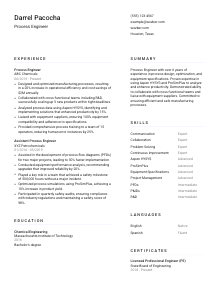
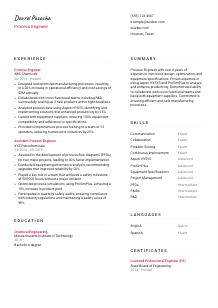
Process engineering work is judged in results that show up on the plant floor and in the data: safer operations, steadier throughput, better yield, lower cost, and fewer process bottlenecks. A Process Engineer resume needs to make that practical impact visible. Hiring teams want to see how you improve manufacturing performance, work through technical constraints, and translate analysis into changes that operations can actually run.
A tailored resume quickly separates process improvement experience from adjacent engineering work by surfacing the right technical language early, including process simulation tools, PFD and P&ID work, equipment knowledge, and measurable operating outcomes. Wozber's free resume builder helps structure that information into an ATS-compliant resume, so the screening process picks up the same strengths a plant manager or engineering lead would want to see first.
For engineering roles tied to plant operations, the header section should remove friction immediately. Keep it clean, accurate, and aligned with the practical requirements of the position so the reader can move straight to your process design and optimization experience.
Use your full name as the most visible text on the page. Keep formatting straightforward and professional so the document reads like an engineering resume, not a personal branding exercise. Clear presentation matters when your resume may be reviewed quickly by HR, an engineering manager, and operations leadership.
Place the role title directly beneath your name and match it to the opening when it reflects your background. "Process Engineer" works well here because it aligns with both ATS searches and the hiring team's expectation. If your previous title was slightly different, your experience bullets can provide the needed context.
List a reliable phone number and a professional email address with no formatting errors. These details seem basic, but process engineering hiring often moves through several interview stages involving HR, technical reviewers, and plant stakeholders, so missed calls or bounced emails create avoidable delays.
If the role specifies a location requirement, reflect that clearly in your header. In this example, Houston, Texas is stated outright, which helps confirm local availability for a plant-based or site-connected role. Only include location details that are accurate and relevant to the job you are targeting.
Include a LinkedIn profile or personal site only if it supports your candidacy with consistent information. For a Process Engineer, this might reinforce project scope, certifications, or industry background. Make sure dates, titles, and technical details match the resume exactly.
This section should answer the basic logistical questions in seconds and leave no distractions. Once that is handled, the reader can focus on what matters most for this profession: your process knowledge, plant impact, and engineering judgment.




This is the section where Process Engineers separate themselves. Hiring teams are looking for proof that you have improved process performance, supported safe operations, and worked across engineering, production, maintenance, and supplier relationships to move a process forward.
Start by marking the responsibilities and tools that define the opening. For this role, that includes process design, optimization, manufacturing efficiency, scale-up work, supplier coordination, technical support, and simulation tools such as Aspen HYSYS or ProSimPlus. Those points should guide which projects and accomplishments you foreground in your experience section.
List positions in reverse chronological order and give each one enough context to show the type of operation, process, or manufacturing environment you supported. Process engineering experience becomes much easier to assess when the reader can connect your title to the scale of the plant, the type of production, or the kind of process improvement work you handled.
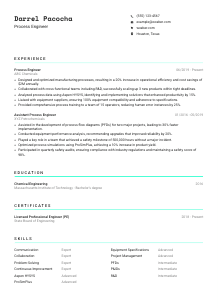
Focus each bullet on what changed because of your work. Strong Process Engineer bullets often combine the technical action, the operating context, and the outcome. The sample resume does this well with statements such as improving operational efficiency by 20%, scaling up three new products, and reducing human error through operator training. That kind of writing shows more than participation. It shows execution.
Use metrics that matter in process environments: throughput, yield, downtime, cost savings, incident reduction, implementation speed, equipment reliability, or audit performance. A number like "$2M annually" or a 15% productivity gain gives hiring teams a concrete way to understand your contribution. Choose measures that fit the work you actually performed and the operating goals of the employer.
Keep the section centered on process design, optimization, plant support, simulation, documentation, and cross-functional implementation work. Older or less relevant experience can stay brief if it does not strengthen your case. Every bullet should help explain why you can improve a manufacturing process, communicate with operations, and handle technical detail from analysis through implementation.
A hiring manager should be able to scan this section and understand what processes you improved, what tools you used, and what business or operating results followed. That is the clearest route from resume review to technical interview.
For Process Engineer roles, education is usually straightforward, but it still carries weight. It confirms the engineering foundation behind your process calculations, equipment decisions, simulation work, and understanding of manufacturing systems.
When a posting asks for a Bachelor's degree in Chemical Engineering or a related field, make that qualification easy to find. Use the exact degree and field wording from your academic record. In this case, a Bachelor's degree in Chemical Engineering aligns directly with the requirement and should appear without unnecessary extra wording.
List school, degree, field of study, and graduation year in a consistent format. Engineering resumes benefit from order and clarity, and this section should be readable at a glance by both ATS systems and technical reviewers moving quickly through candidate files.
If your degree is directly tied to the role, let that do the work for you. Chemical Engineering is an immediate match for process design and optimization roles because it connects naturally to mass and energy balances, unit operations, reaction systems, and scale-up work. There is no need to bury that relevance.
If you are early in your career, selected coursework, capstone design work, pilot plant projects, or simulation-heavy academic assignments can help bridge limited experience. For candidates with several years in industry, those details usually matter less than recent plant, process, or production results.
Honors, scholarships, or engineering leadership activities are worth listing when they add useful context, especially for newer candidates. Keep the emphasis on achievements that reinforce technical discipline, problem-solving, or teamwork rather than general campus involvement.
This section does not need much space, but it should remove any doubt about your engineering background. Once the degree requirement is clear, the rest of the resume can focus on process performance and practical application.
Certifications are not always mandatory for Process Engineer roles, but the right ones can strengthen your profile, especially when they point to professional standing, regulated environments, or deeper technical responsibility.
Prioritize credentials that connect naturally to engineering practice, safety, compliance, or professional licensure. A PE license, for example, can add weight because it suggests recognized technical competence and accountability, even when the posting does not require it outright.
Choose certifications that support the kind of work you want to do, such as process safety, quality systems, lean manufacturing, or industry-specific operations. Avoid filling this section with credentials that do not help explain your value in process design, optimization, or plant support.
Include issue dates or active date ranges when the certification is current, renewable, or tied to present eligibility. The sample PE entry uses an active date range, which is useful because it immediately shows the credential is still in force.
Process engineering evolves with new process controls, simulation methods, regulatory expectations, and production technologies. Updating this section as you earn relevant credentials shows that your technical knowledge is staying current with the environments you work in.
A focused certification section can reinforce your engineering credibility without taking over the resume. List what directly supports the role and leave the reader with a clearer sense of your professional standing.
The skills section should read like a compact view of how you operate as a Process Engineer. That means showing the technical tools, process documentation knowledge, and collaboration strengths that support real manufacturing improvement.
Pull the most important skills from the job description and use your own experience to decide which belong in the final list. Here, process simulation software, PFDs, P&IDs, equipment specifications, communication, collaboration, and problem-solving all deserve attention because they connect directly to the posted responsibilities.
A Process Engineer is rarely hired on software knowledge alone. Include simulation platforms such as Aspen HYSYS or ProSimPlus alongside plant-facing abilities like cross-functional collaboration, technical support, continuous improvement, or project coordination. The sample skill list handles this balance well by mixing software, documentation knowledge, and team-facing strengths.
Do not overload the section with every tool or trait you have ever used. Keep the strongest and most relevant items, especially those that support process analysis, optimization, equipment work, and implementation. A shorter list with real relevance is more useful than a long list of loosely related terms.
This section should make it obvious that you can analyze a process, work with technical documentation, and collaborate with the people who run and maintain the system. That combination is central to the role.
Language ability matters in engineering when it affects documentation, plant communication, vendor coordination, or technical training. Keep this section practical and tied to the communication demands of the role.
If the posting specifies a language requirement, list it clearly and use an honest proficiency level. This role asks for advanced English, so English should appear first and be described in a way that reflects your real speaking, writing, and technical communication ability.
Put the required language at the top so the reader does not have to search for it. In engineering roles, strong English may affect report writing, process documentation, safety communication, and coordination with suppliers or cross-functional teams, so visibility matters.
Additional languages can be useful when working with global suppliers, multilingual operations teams, or international manufacturing environments. The sample resume includes Spanish, which can be a practical plus, but it should remain secondary to the stated English requirement unless the employer says otherwise.
Describe proficiency honestly with terms such as Native, Fluent, Advanced, or Intermediate. Avoid overstating ability, especially in roles where language may affect technical training, audit communication, or written process instructions.
For most Process Engineer positions, languages support the application rather than define it. Include them when they add real value, but let your process results, engineering tools, and manufacturing knowledge carry the main case for your candidacy.
Handled well, this section confirms you can communicate in the language the job requires and adds any extra capability that may help in plant, vendor, or cross-border settings. Keep it useful and factual.
The summary should give a hiring manager a fast, accurate read on your process engineering background. In a few lines, it should establish your level, your technical focus, and the kind of operational results you tend to deliver.
Start with your title and years of relevant experience, then anchor that experience in the parts of process engineering you actually handle. A line such as "Process Engineer with 6+ years of experience in process design, optimization, and equipment specifications" works because it sets both seniority and technical scope right away.
Use one or two key tools, domains, or achievements that match the opening. In this example, Aspen HYSYS, ProSimPlus, productivity improvement, and cross-functional scale-up work all reinforce the target role well. Choose details that reflect your strongest overlap with the job rather than trying to summarize your entire career.
Aim for a short paragraph that can be read in seconds. Skip generic traits unless they are tied to the work. Process Engineer summaries are strongest when they connect technical capability with plant outcomes, such as efficiency gains, safe operations, cost reduction, or successful implementation support.
When this section is tailored well, the rest of the resume feels easier to read because the reviewer already knows your engineering focus and likely value. It should point clearly toward the process problems you are equipped to solve.
A Process Engineer resume should leave little ambiguity about your technical toolkit, the manufacturing environments you have supported, and the operating improvements you have delivered. Before sending it out, check that your experience reflects the language of the target posting, your metrics are concrete, and your process work is described in terms an engineering manager would recognize immediately.
Wozber's free resume builder can help you tighten that alignment with ATS optimization, role-specific phrasing, and an ATS-friendly resume format that keeps your process engineering experience easy to parse. With the right revisions in place, your resume should make it clear that you can step into process design, optimization, and plant support work with confidence.




