



Use Wozber and land your dream job
Create Resume
No registration required
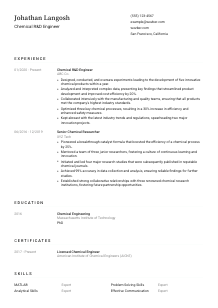
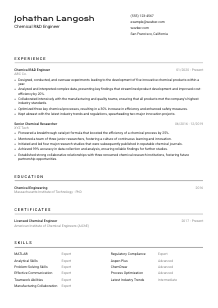
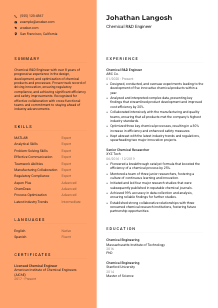
Cooking up chemical breakthroughs, but your resume experiments could use some refinement? Check out this Chemical R&D Engineer resume example, created with Wozber free resume builder. It shows how to condense your innovative mixtures to match job compounds, crafting a career formula as powerful as your reactions!
Chemical R&D work is judged in the lab and at the plant floor. Hiring teams want to see whether you can design experiments, interpret data that actually informs decisions, and move a product or process closer to better yield, lower cost, tighter safety controls, or smoother scale-up. Your resume should make that progression visible, not bury it under generic engineering language.
For this kind of role, the first screen often separates candidates who have real research depth from those who only list broad engineering duties. Wozber's free resume builder helps you line up your resume with the posting in an ATS-friendly resume format, so tools, process knowledge, and measurable R&D outcomes are easier to spot early. That matters when the employer is scanning for experiment ownership, software fluency, and collaboration with manufacturing, quality, or regulatory teams.
For a Chemical R&D Engineer, the header should immediately establish professional credibility and remove any friction around contact, title, or location. Keep it clean and practical so the hiring team can move straight to your technical background and lab results.
Set your name at the top in a clear, readable format. It should stand out without distracting from the technical content that follows. In engineering hiring, this is simple administration, but it still matters because your resume may be reviewed across HR, R&D leadership, and cross-functional stakeholders.
Place "Chemical R&D Engineer" directly under your name when that is the role you are pursuing. Matching the target title helps frame the rest of the document around research, experimentation, process development, and technical problem-solving instead of looking like a broader operations or production resume.
Include a reliable phone number and a professional email address. These details seem basic, but they support quick scheduling for technical interviews, panel conversations, or follow-up discussions about lab work, process modeling, or published research.
If the employer names a location requirement, show that clearly in your header. Here, San Francisco, California is specifically requested, so including it removes an immediate screening question. For other Chemical R&D roles, location only needs this level of prominence when the job posting makes it relevant.
A LinkedIn profile, publications page, patent list, or professional site can add useful depth, especially if your work includes research studies, technical papers, process innovation, or industry presentations. Only include links that reinforce your experience in chemical development or applied research.
Skip details such as age, marital status, or other personal identifiers that do not help explain your engineering background. Keep the space for information that supports the role, such as your title, location, and ways to reach you.
This section should answer the administrative questions immediately and then get out of the way. When your header is precise and job-aligned, the reader can focus on what matters most for Chemical R&D hiring: experiments run, processes improved, tools used, and results delivered.




In Chemical R&D hiring, experience carries the most weight when it shows ownership. Employers look for evidence that you designed experiments, analyzed results, improved formulations or processes, and worked across technical and operational teams to move ideas toward production and compliance.
Read the posting closely and map your past work to its core demands. For this role, that means experiment design, data interpretation, process optimization, software use, and collaboration with manufacturing, quality, and regulatory teams. If you have done similar work, mirror that language naturally so the connection is obvious in both ATS screening and human review.
List positions in reverse chronological order with job title, company, and dates. That structure lets the reader quickly trace your progression from research support to independent project leadership, scale-up responsibility, or senior technical contributions. Clear chronology matters when a role asks for 5+ years of R&D experience.
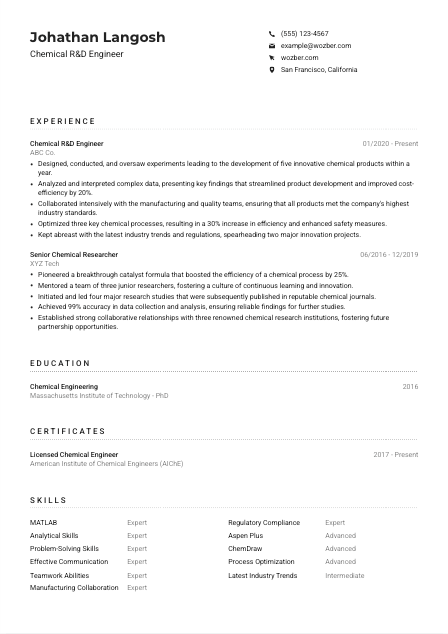
Your best bullets should show what you investigated, what you improved, and what the outcome was. Strong examples in this field include developing new formulations, improving reaction efficiency, reducing cost, tightening safety performance, or making a process easier to scale. The sample resume does this well by tying experiments to five new products and linking process work to a 30% efficiency gain.
Quantified results make your work more credible. Use metrics that belong to Chemical R&D, such as yield improvement, cost reduction, cycle time, accuracy, safety performance, number of products developed, or efficiency gains. The example's 20% cost-efficiency improvement and 25% process boost work because they show technical work turning into business value.
Prioritize bullets that show experimental ownership, chemical process understanding, analytical depth, software use, and cross-functional execution. General statements about being hardworking or detail-oriented add little if they are not tied to real deliverables such as studies completed, findings presented, or process changes implemented.
A Chemical R&D Engineer resume should read like a record of technical contribution, not a list of duties. When each role shows experiments, analysis, optimization, and measurable outcomes, hiring teams can see how you would contribute to their development pipeline.
Chemical R&D roles often ask for a strong academic base because the work depends on chemical engineering principles, experimental design, and data-driven analysis. Your education section should quickly confirm that foundation and, when relevant, show advanced study that supports deeper research work.
When the employer requires a Bachelor's degree in Chemical Engineering or a related field, make that visible right away. If you also hold a Master's or PhD, include it prominently because advanced study often strengthens your case for research-heavy, formulation, or process development roles. In the example, the graduate degrees reinforce depth without needing extra explanation.
Present each entry with degree, field of study, institution, and graduation year if appropriate for your level. The section should be easy to verify in seconds. For experienced engineers, straightforward formatting usually matters more than adding extra academic detail.
If your degree is in a related area such as materials science, chemistry, or biochemical engineering, use the field wording accurately and let your experience section bridge the connection to chemical R&D work. When your education directly matches the posting, as it does in the sample, the section can remain concise.
Most mid-career and senior Chemical R&D candidates do not need a course list. Include selected coursework only if it helps connect your background to a target area such as reaction engineering, transport phenomena, catalysis, process modeling, or safety engineering and that connection is not already clear from your experience.
Thesis work, published research, major lab projects, or academic honors can strengthen this section when they relate to the target role. This is most useful if the position values innovation, advanced experimentation, or specialized technical knowledge that is easier to show through graduate research than through early-career work history.
Your education section should confirm that you have the technical grounding for chemical research and process work. Once that is clear, let your experience and skills carry the heavier proof of what you can deliver in an R&D environment.
Certifications can strengthen a Chemical R&D resume when they support regulated work, professional licensure, safety awareness, or specialized technical credibility. They are rarely the center of the application, but they can reinforce seriousness and current professional standing.
Start with the posting. Some Chemical R&D roles care more about degrees and lab experience than certificates, while others may value licensure, safety training, quality systems knowledge, or industry-specific qualifications. Tailor this section to what the employer is likely to recognize as relevant to the work.
List only certifications that strengthen your profile for research, development, process engineering, or regulated chemical work. A credential such as Licensed Chemical Engineer can add weight because it reflects formal professional standing. The example uses that certificate well because it supports the engineering identity of the candidate.
Add issue dates or active periods when the timing helps the reader understand that the credential is current. This is especially useful for certifications tied to ongoing standards, safety expectations, or professional membership standing.
Chemical R&D changes with new regulations, materials, modeling approaches, and safety expectations. If you complete relevant training or earn a new credential, update the section so it reflects your current technical environment rather than an outdated version of your background.
Certificates should support the technical story already established by your education and experience. When they are current and relevant, they add another layer of confidence around your professional discipline and development.
The skills section should work like a compact technical index. For Chemical R&D roles, that usually means software, analytical methods, process knowledge, and a few collaboration skills that matter in cross-functional development work.
Pull out the tools, technical capabilities, and working behaviors the employer actually asked for. Here, that includes MATLAB, Aspen Plus, ChemDraw, analytical problem-solving, and collaboration across manufacturing, quality, and regulatory functions. That mix tells you the employer wants both lab depth and practical development execution.
List hard skills first or near the top when they are central to the role. Software such as Aspen Plus and MATLAB should sit alongside process optimization, data analysis, experimental design, or regulatory compliance if those reflect your real experience. Soft skills belong here too, but keep them grounded in the work, for example "cross-functional collaboration" rather than vague terms with no technical context.
Do not turn this into an inventory of every platform or trait you have ever used. Choose the skills that support the target Chemical R&D role and that also appear in your experience bullets. The sample resume stays effective because its skills list echoes the posting and reinforces the candidate's research, process, and collaboration strengths.
A focused skills section helps the reader confirm the tools and capabilities behind your project work. When your listed skills match the posting and are backed up elsewhere in the resume, the section becomes a quick technical summary rather than filler.
Language ability matters in Chemical R&D when the role involves technical documentation, lab reporting, presentations, and coordination across teams. Keep this section brief, but make sure it supports the communication demands of the job.
If the posting states that oral and written English communication is required, list English clearly with an honest proficiency level. That is especially important in roles involving experiment reports, technical presentations, SOPs, and discussions with cross-functional partners.
Order your languages by relevance to the job, not personal preference. For this role, English belongs first because it supports the day-to-day work of documenting findings, explaining process changes, and collaborating with technical and non-technical audiences.
Additional languages can be useful if the company works with international suppliers, research partners, or global manufacturing teams. They are a plus, not a substitute for the technical communication needed in the core role. In the sample, Spanish adds breadth without distracting from the required English proficiency.
Stick to standard levels such as Native, Fluent, Intermediate, or Basic. That gives the employer a practical sense of how you can contribute in meetings, documentation, and technical discussions.
Most Chemical R&D resumes only need a short language section unless multilingual communication is central to the position. Include enough to clarify your working capability, then let your research, analysis, and process work stay in focus.
For this profession, languages matter most when they help you explain technical findings clearly and work effectively with others. A concise, accurate language section does that without taking attention away from your engineering credentials.
Your summary should quickly tell the reader what kind of Chemical R&D Engineer you are, how much experience you bring, and what kind of technical results follow your work. In a few lines, it should connect your background to product development, process improvement, research depth, or cross-functional execution.
Read the posting before writing the summary so you can reflect its main priorities. If the role centers on experiment design, process optimization, software modeling, and collaboration with manufacturing or regulatory teams, your opening lines should sound anchored in that environment.
State your title and years of experience in a direct way. For example, "Chemical R&D Engineer with 8+ years of experience in product and process development" gives immediate context and suits the expectations of a role asking for at least 5 years in chemical research and development.
Add two or three details that reflect your value, such as lab-based research experience, process modeling tools, product development outcomes, regulatory awareness, or cross-functional collaboration. The sample summary works because it combines years of experience with innovation, compliance, and efficiency improvements instead of repeating generic strengths.
Aim for a short paragraph that earns every line. Mention one or two meaningful outcomes such as efficiency gains, successful product launches, or safety improvements, then move on. A summary that is concise and specific sets up the rest of the resume well for both ATS parsing and human review.
A useful summary gives the reader a fast, accurate picture of your R&D range and likely contribution. By the time they reach your experience section, they should already expect to see experiment leadership, process insight, and measurable engineering results.
You now have a clear framework for presenting yourself as a Chemical R&D Engineer whose work improves products, processes, and research outcomes. Use Wozber's free resume builder to organize that experience in an ATS-compliant resume that keeps your technical strengths, software fluency, and cross-functional contributions easy to read.
From there, refine the language against the target posting, check alignment with Wozber's ATS resume scanner, and make sure every section supports the same story. The final result should make one thing clear fast: you can run disciplined research, interpret data well, and turn chemical insight into practical development progress.




