



Use Wozber and land your dream job
Create Resume
No registration required
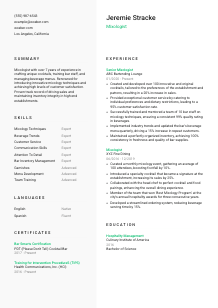
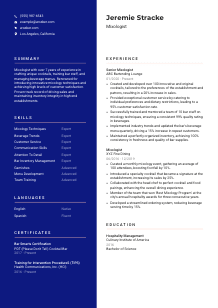
Shaking and stirring, but your resume's flavor isn't coming through? Blend harmoniously with this Mixologist resume example, created with Wozber free resume builder. Learn how to infuse your bar brilliance with the job's perfect pour, making your mixology journey as enticing as your cocktails!
Mixology gets judged in the glass and at the guest's table. Hiring teams want to see whether you can build drinks people come back for, keep service moving during a rush, and maintain quality when preferences, dietary needs, and menu changes all hit at once. Your resume should make that operational range visible, not just list bars where you worked.
For mixologists, the first screening question is often whether your background clearly matches the bar program's style and service demands. Wozber's free resume builder helps you shape that story in an ATS-friendly resume format, so cocktail development, guest-facing service, inventory control, and staff training show up in the language employers actually search for. That makes it easier to tell whether you can step into their service flow and raise the standard behind the bar.
The personal details section should identify you quickly and remove basic friction from the hiring process. In hospitality hiring, that means your name, role, contact information, and location need to be easy to scan before anyone gets to your cocktail list or service metrics.
Use your full name as the most prominent line on the page. Keep the formatting clean and professional so the reader can find it at a glance, especially when reviewing multiple hospitality resumes in one sitting.
Place "Mixologist" directly under your name if that is the role you are targeting. This helps frame the rest of your resume around beverage creation, service standards, and bar operations instead of leaving you looking like a more general bartender candidate.
List a current phone number and a professional email address that you check regularly. Bar and restaurant hiring can move fast, especially for trial shifts and interviews, so make it easy for a manager to reach you without guessing which contact method is current.
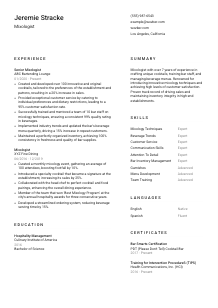
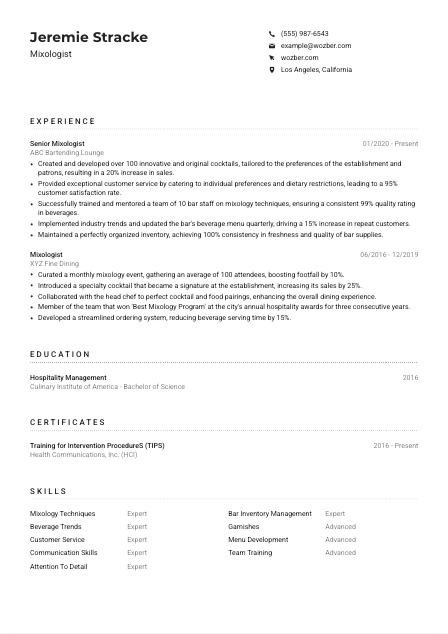
If a job requires you to be based in a specific city, include that clearly. In the provided example, listing Los Angeles, California immediately supports a stated requirement rather than forcing the employer to hunt for it later in the resume.
A LinkedIn profile, portfolio, or professional site can help if it shows hospitality experience, menu work, event features, or industry recognition. If you include one, make sure it matches your resume and presents the same level of professionalism you would bring to guest service.
This section should answer the basic logistics in seconds. When your role, contact details, and location are clear, the hiring manager can move straight to your cocktail program experience and service results.




Experience carries the most weight on a mixologist resume because it shows how you perform in live service. Hiring managers look for proof that you can create drinks people order again, handle pace without slippage in quality, and contribute to menu performance, training, and stock control.
Read the posting closely and pull out the work that matters most: original cocktails, customer recommendations, dietary accommodations, inventory freshness, trend awareness, and team training. Then choose accomplishments from your history that speak directly to those points instead of describing every shift duty you have ever handled.
List your most recent bar or hospitality position first, followed by earlier roles. Include the venue name, your title, and dates so the reader can quickly understand your progression from service work into higher-responsibility mixology, menu, or mentoring roles.
Each bullet should show what changed because of your work. Good mixologist metrics include cocktail sales, repeat customer rates, guest satisfaction, service speed, event attendance, menu uptake, or consistency across the bar team. The sample resume does this well by tying cocktail creation to a 20% sales increase and menu updates to more repeat customers.
Mixologist roles rarely hinge on one skill alone. Use bullet points that cover product creativity, guest interaction, operational discipline, and leadership. A strong set might include one menu development win, one customer-service result, one inventory or efficiency improvement, and one training example so the employer sees how you support the full beverage program.
If you have led menu development, mentored junior staff, partnered with chefs on pairings, or introduced trend-driven drinks, say so plainly. Those details show you can shape the bar experience, not just execute tickets. In the example, training 10 staff members and maintaining a high quality rating gives a clear picture of leadership in service.
Your experience section should show how you operate when service is busy and standards stay high. By the end of it, a hiring manager should understand the kind of bar program you have supported, the results you produced, and the level of responsibility you can handle from day one.
Education usually plays a supporting role on a mixologist resume, but it still adds context. Hospitality, culinary, or beverage-related study can reinforce your understanding of service, operations, guest experience, and the commercial side of running a successful bar.
Many mixologist roles focus far more on service record and beverage expertise than on degrees. If the job does not require specific education, include your highest relevant credential without over-expanding the section.
List the school, degree, field of study, and graduation year. This format works well for hospitality hiring because it is quick to scan and leaves the spotlight on your bar experience.
If your degree connects to hospitality management, culinary arts, food and beverage operations, or event service, that link is worth making clear. The example's Hospitality Management degree supports a resume centered on guest experience and venue performance.
Competitions, hospitality societies, beverage coursework, or event leadership can add value if they relate to mixology, service, or venue operations. Leave them out if they distract from stronger professional experience.
If you already have several years behind the bar, your education should stay concise. Early-career candidates can afford a little more detail, especially if coursework or activities helped build beverage knowledge or hospitality discipline before full-time roles.
Use education to reinforce your foundation, not to compete with your bar record. For most mixologists, the main story still lives in service, menu work, and measurable results on the floor.
Certifications matter in mixology because they connect your creativity to responsible service and professional standards. They can also answer a hiring requirement immediately, especially when a bar or restaurant needs someone cleared to work within alcohol service rules from the start.
If the job asks for TIPS or equivalent alcohol service training, list that first. In this posting, that certification is a stated requirement, so placing it prominently helps your resume clear an early screen.
Put the credentials most useful for the role at the top, then follow with training that deepens your beverage knowledge. Responsible alcohol service, spirits education, and recognized bar programs generally matter more here than broad unrelated certificates.
Many certifications need renewal or periodic verification. Add the year earned and, where relevant, the active date range so employers can see your training is current enough for service compliance and day-to-day operations.
Bars change with consumer tastes, ingredient trends, and service expectations. Additional certifications or advanced beverage programs can show that you keep developing your palate, technique, and product knowledge beyond the minimum required license.
A focused certificates section tells employers you can pair creativity with compliance and professional discipline. That is especially valuable when the role combines menu innovation with direct responsibility for guest safety and service standards.
The skills section should read like the working toolkit behind your bar station. It needs to cover technical drink knowledge, guest interaction, and the operational habits that keep service accurate, fast, and consistent across a full shift.
Start with the skills the employer named, then match them to your real experience. For this role, that includes mixology techniques, garnishes, beverage trends, communication, multitasking, attention to detail, and customer-facing service.
A mixologist is hired for more than recipe knowledge. Pair technical strengths such as menu development, inventory management, or spirits knowledge with customer-facing abilities like recommendation skills, rapport-building, and handling dietary requests with confidence.
Avoid filling this section with generic traits that could belong to any hospitality role. Choose skills that connect to actual bar work, such as cocktail development, POS familiarity, stock rotation, garnish execution, staff training, or trend-led menu planning.
This section should give a quick, credible picture of how you work behind the bar and with guests. When the right skills are selected, employers can immediately see whether your strengths match their beverage program and service style.
Language skills can matter in front-of-house hospitality because service is built through conversation. For mixologists, the value is practical: clearer recommendations, smoother guest interactions, and better rapport in busy environments where tone and timing shape the experience.
If the posting specifies English proficiency, place English first and state your level clearly. In this case, strong verbal and written English is required, so that should be easy to find on the resume.
List the languages most relevant to guest service and team communication first. In a diverse hospitality market, a second language can strengthen your ability to explain ingredients, make recommendations, and build comfort with a wider range of patrons.
If you speak more than one language, add them as long as you can genuinely use them in conversation. The sample resume's Spanish is a useful example because it can support guest interaction in many service settings, though it is not a universal requirement for every mixologist role.
Choose clear ratings such as Native, Fluent, Conversational, or Basic. Accuracy matters here because language skill shows up immediately in interviews, trial shifts, and guest-facing work.
Where relevant, think about how language supports your work. Being able to describe flavor profiles, explain substitutions, or guide a guest through a menu in another language can improve service quality in high-volume or international-facing venues.
List languages when they add real service value. For a mixologist, they can support guest trust, clearer recommendations, and a smoother experience at the bar.
Your summary should quickly establish the level of bar program experience you bring. In a few lines, it should tell the reader whether you are strongest in cocktail creation, guest service, menu development, training, or high-volume execution, and give enough proof to make the rest of the resume worth close attention.
Start with your title, years of experience, and the kind of mixology work you do best. That might be craft cocktail development, upscale dining service, volume-driven bar work, menu innovation, or staff leadership.
Pull in two or three strengths that line up with the job description. For this role, that could include original cocktail creation, customer recommendations, inventory control, beverage trend knowledge, or mentoring bar staff.
A short metric or specific achievement gives the summary weight. The sample resume uses strong material for this, including sales growth, customer satisfaction, and proven menu impact.
Aim for a short paragraph that reads cleanly in one pass. Save the full detail for your experience section and use the summary to frame the kind of mixologist the employer is about to read about.
A good summary should make your value behind the bar clear within seconds. It should point to the mix of creativity, service judgment, and operational consistency that defines your work.
A mixologist resume needs to show more than drink knowledge. It should connect cocktail development, guest experience, inventory discipline, and team contribution in language that fits the role you are pursuing.
Use Wozber to tighten that alignment with an ATS-compliant resume, role-matched phrasing, and practical ATS optimization support. When the resume is tailored well, hiring teams can quickly tell whether you can elevate the menu, handle service pressure, and contribute behind the bar from your first shift.