



Use Wozber and land your dream job
Create Resume
No registration required
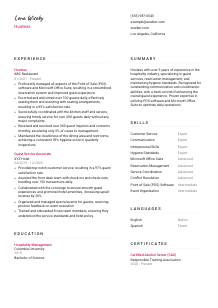
Mastering the art of hospitality, but your resume feels like a solo table? Get a seat at the front with this Hostess resume example, created with Wozber free resume builder. Learn how to present your graciousness and organizational skills to match job requirements, setting a career table always bustling with opportunity.
A hostess sets the pace before the first order is ever taken. Hiring teams look for someone who can manage the front of house calmly, keep seating moving, handle guest questions with polish, and stay coordinated with servers and the kitchen when the dining room gets busy. Your resume should make that front-of-house control visible from the start.
When a hostess resume is tailored well, the reader can quickly see whether you have handled reservations, guest flow, POS tasks, and service coordination in a real dining environment. Wozber's free resume builder helps turn that experience into an ATS-compliant resume that mirrors the language of the posting without sounding forced, so your application reads like someone who can keep service smooth from the door onward.
At the top of a hostess resume, basic details do more than identify you. They show whether you are easy to contact, local when required, and already presenting yourself with the professionalism expected at the front of house.
Use your full name as the most prominent text on the page. Keep the styling clean and easy to read, the same way a hostess stand needs to look organized and immediately understandable during a rush. Avoid nicknames unless they are the name you actually use at work.
Place "Hostess" directly under your name if that is the role you are applying for. This makes your direction clear at a glance and keeps your resume aligned with the posting title, which also helps with ATS matching when employers search by role name.
Include a current phone number and a professional email address that you check regularly. Front-of-house hiring often moves quickly, especially for restaurants and hotels filling shift coverage, so missed calls or a casual email address can work against you. Double-check every character before sending.
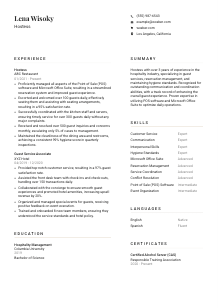
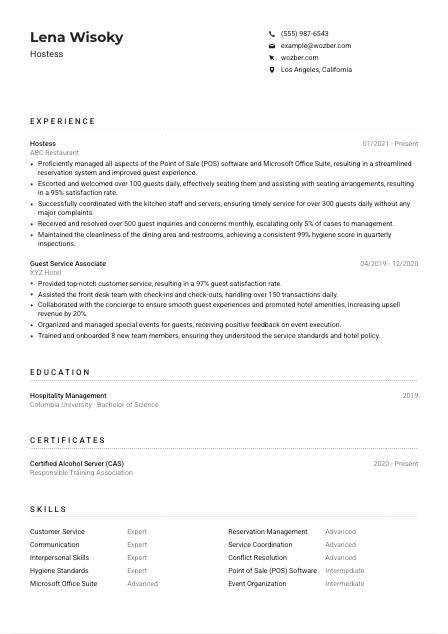
If the employer asks for candidates in a specific city, include it in your contact line. In this example, listing "Los Angeles, California" answers a stated requirement right away and removes doubt about commute or local availability. Only do this when it is relevant to the job you are targeting.
A LinkedIn profile or personal site can help if it reflects hospitality work, customer service experience, event support, or a steady employment history. Leave it off if it is outdated or unrelated. For a hostess position, a polished and current profile matters more than having an extra link for its own sake.
This section should answer the practical basics in seconds: who you are, how to reach you, and whether you match any stated location requirement. That kind of clarity suits a role built around smooth guest handling and dependable front-of-house presence.




For hostess hiring, experience is where employers look for proof that you can manage guest flow, communicate under pressure, and support service without creating bottlenecks. Titles matter, but the real value sits in the details of volume, pace, guest handling, and coordination with the dining room team.
Start with your most recent job and work backward. For each position, include your job title, employer name, and dates. That straightforward structure helps employers trace your front-of-house progression quickly, whether your background comes from restaurants, hotels, lounges, or other guest-facing service settings.
Do not stop at generic statements like "greeted guests" or "handled reservations." Show how you managed the flow of service. Strong hostess bullets often cover seating efficiency, waitlist coordination, reservation accuracy, guest issue handling, and communication with servers or kitchen staff. In the sample resume, phrases such as welcoming over 100 guests daily and resolving more than 500 guest concerns monthly give the work real operating context.
Hospitality work is highly measurable, even in customer-facing roles. Add numbers that show guest count, reservations managed, satisfaction scores, inspection results, or complaint reduction. Metrics like serving 300 guests daily, achieving a 95% satisfaction rate, or maintaining a 99% hygiene score tell a hiring manager you can perform consistently in a live service environment.
If some of your past roles were not hostess positions, pull forward the parts that still matter here. Front desk work, guest service, event support, check-ins, conflict resolution, and team coordination all translate well when framed correctly. The sample's hotel experience works because it highlights guest transactions, service support, and onboarding, all of which reinforce composure and customer care.
Use wording that reflects the employer's needs, especially around reservations, seating arrangements, guest inquiries, POS software, cleanliness checks, and coordination with servers or kitchen teams. This improves ATS optimization and makes your experience feel immediately relevant. The key is to use terms you can genuinely support with your past work, not to force keywords into every bullet.
By the end of this section, an employer should understand how you handle volume, guests, and front-of-house coordination during a real shift. That is what separates vague hospitality experience from experience that looks ready for a hostess opening.
Education is usually a supporting section for a hostess resume, but it still matters. Many openings ask for a high school diploma or equivalent, and any additional hospitality-related study can reinforce that you understand service standards, guest experience, and restaurant operations.
List your highest finished credential first, whether that is a high school diploma, GED, associate degree, or bachelor's degree. Include the school name, credential, field of study if applicable, and graduation year or date. For this role, meeting the minimum education requirement clearly is usually more important than adding extra academic detail.
A hostess resume does not need a long academic section unless you are early in your career. One well-formatted entry is often enough. Save space for experience and skills, since those sections usually carry more hiring weight for front-of-house positions.
If your coursework or field of study connects directly to guest services, hospitality management, event operations, or customer experience, include it. In the example, a degree in Hospitality Management adds useful context because it supports the candidate's restaurant-facing and guest-service background. If your degree is unrelated, the credential alone is fine.
Student leadership, event planning, campus hospitality roles, or volunteer positions involving customer interaction can strengthen this section for less experienced candidates. Choose examples that show poise, organization, and people-facing responsibility rather than listing unrelated clubs.
If you have more than a year or two of solid hospitality experience, keep education brief. If you are applying with limited work history, use this section to add relevant coursework, leadership, or service-based involvement. The amount of detail should match how much support your resume needs outside of your job history.
Education should confirm the baseline qualification and, when relevant, add a bit more context about your hospitality background. Keep it clean, credible, and proportionate to your actual experience on the floor.
Certifications can carry real weight in hospitality when they connect directly to guest safety, alcohol service, food handling, or customer-facing operations. For a hostess role, they are especially useful when the posting names one specifically or when the venue serves alcohol and expects front-of-house staff to understand compliance basics.
If the employer asks for Responsible Alcohol Service or a similar credential, list it clearly and use the exact terminology that appears in the job ad when appropriate. In this example, a Responsible Alcohol Service-related certificate directly supports the application because it answers a stated requirement.
Choose certificates tied to hospitality work, such as alcohol service, food safety, customer service training, or conflict de-escalation. These show that you understand the operating standards of a guest-facing environment, not just the social side of the role.
List the issue date and, if relevant, the renewal period. Restaurants and hospitality groups often need current credentials for compliance reasons, so dating your certificate helps employers see that it is active and usable. The sample's "2020 - Present" format works well for an ongoing credential.
If you plan to stay in hospitality, continue adding certifications that improve your value on the floor. A hostess who also understands responsible service, hygiene standards, or guest conflict handling can support the team more effectively during busy or sensitive service situations.
The best certificates on a hostess resume do not sit there as decoration. They show you are prepared for the venue's service environment, compliance expectations, and guest-facing responsibilities.
A hostess skills section should read like the toolkit behind a smooth shift. Employers want to see the mix of guest-facing ability, operational awareness, and system comfort that keeps seating organized and service moving without friction.
Start with the language in the job description, then match it to your real experience. For hostess roles, that often includes customer service, verbal communication, interpersonal skills, reservation management, POS software, Microsoft Office, cleanliness standards, and handling guest concerns. Use the posting as a guide for what to prioritize, not as a script to copy word for word.
Hostess work is both interpersonal and procedural, so your skills section should reflect both sides. Pair soft skills like communication and conflict resolution with practical abilities such as seating coordination, reservation systems, POS use, and hygiene awareness. The sample does this well by combining customer service and interpersonal strengths with tools and service coordination.
Keep only the skills that help an employer picture you handling the front of house. Ten focused skills usually do more work than a long, scattered list. If a skill does not connect to guest management, dining room flow, service support, or required tools, it probably does not belong here.
This section should sound like someone who can greet guests, manage the book, coordinate with the team, and stay composed when the room fills up. That is the mix a hostess resume needs to make obvious.
Language ability can be a practical advantage in hospitality, especially in busy dining rooms, tourist areas, and restaurants serving a diverse guest base. For a hostess, it matters most when it improves greeting, seating, reservation handling, and clear communication with guests and staff.
If the posting specifies English ability, list English prominently and label your level clearly. This job asks for strong verbal and written English, so the language section should confirm that requirement without making the employer search for it.
Additional languages can strengthen a hostess resume when they are relevant to the venue's customer base. Spanish, for example, can be a real advantage in many hospitality settings because it supports smoother guest communication and broader service coverage. Include extra languages only if you can use them comfortably in real interactions.
Use clear proficiency labels such as Native, Fluent, Intermediate, or Basic. Avoid overstating your ability, especially in a role where spoken communication affects guest comfort, reservation accuracy, and issue handling at the host stand.
Some restaurants need only strong English. Others value multilingual staff because of neighborhood demographics, tourism, or brand positioning. Tailor this section to the setting when you can, and let your listed languages reflect the kind of guest interaction you are likely to handle.
For a hostess, language skills matter when they help service run more smoothly and guests feel understood from the first interaction. Keep the section honest and relevant to the dining environment you want to work in.
The summary sits near the top of the resume, so it should quickly establish your hospitality background and the kind of service environment you can handle. For a hostess, that means combining guest-facing warmth with proof of organization, pace, and coordination.
Start with a direct description of your background, such as how many years you have worked in hospitality, guest service, or front-of-house support. This immediately places you in the right lane for the reader. The sample summary works because it leads with more than 3 years in hospitality and names hostess-relevant strengths right away.
Use the next sentence or two to highlight the parts of the role you perform confidently, such as reservation management, guest seating, POS use, issue resolution, service coordination, or maintaining dining area standards. Choose points that match the posting closely and are backed up in your experience section.
Aim for a short paragraph of three to five lines. Skip broad claims about being passionate or hardworking unless they are attached to actual work, tools, or results. A concise summary that mentions guest volume, front-of-house coordination, or operational strengths will land better than a generic introduction.
Your summary should make it easy to picture you at the host stand, managing arrivals, communicating with the team, and keeping the guest experience steady from the first greeting. When that picture is clear, the rest of the resume has momentum.
A well-tailored hostess resume makes your value visible in the ways restaurants actually hire for this role: guest handling, reservation control, service coordination, POS comfort, and steady communication under pressure. If those strengths are clear in your experience, skills, and summary, employers can picture you contributing on shift, not just applying on paper.
Use Wozber's free resume builder and ATS resume scanner to align your wording with the posting, surface missing requirements, and shape an ATS-friendly resume format that still sounds natural. The finished resume should make one thing easy to judge: you can keep the front of house organized, welcoming, and service-ready.