



Use Wozber and land your dream job
Create Resume
No registration required
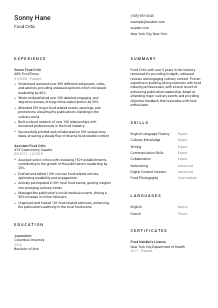
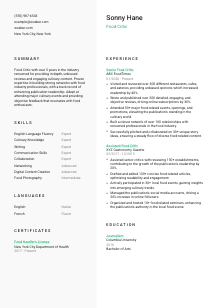
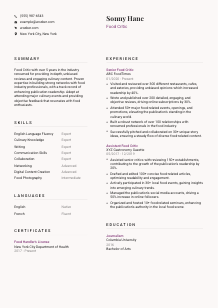
Sampling flavors, but your resume feels bland? Savor this Food Critic resume example, created with Wozber free resume builder. Learn how to present your gastronomic expertise to meet editorial expectations, making sure your career path is always as tasteful and enticing as the dishes you describe!

Food criticism sits at the intersection of reporting, culinary knowledge, and judgment. Hiring teams want to see that you can evaluate food with range and discipline, then turn that evaluation into clean, engaging copy that holds up in print or digital publication. Your resume should make that editorial standard visible, not just list restaurants visited or a general love of food.
When a food critic resume is tailored well, the first scan quickly shows whether your background leans toward published criticism, food journalism, or broader culinary work, and whether your language matches the role closely enough for ATS screening. Wozber's free resume builder helps organize that alignment in an ATS-friendly resume format, so your reviews, audience impact, and industry fluency come through clearly.
This section is simple, but it still carries useful hiring information. For a Food Critic, it should immediately confirm who you are, how to reach you, and whether you meet practical location or portfolio expectations.
Use your full name at the top in a larger, readable font. For writers and critics, your name often functions as a byline, so it should be easy to spot and consistent with how your work appears on articles, review pages, or professional profiles.
Place "Food Critic" under your name when that matches the role you are pursuing. That small line helps frame the rest of the resume around restaurant reviews, food writing, and editorial contribution instead of leaving your background open to broader journalism or hospitality interpretation.
List a reliable phone number, a professional email address, and your city and state. In this example, New York City, New York matters because the posting names that location specifically. If a role mentions local dining coverage, regional familiarity, or relocation, address that here rather than making the reader search for it.
A website, digital portfolio, or well-kept LinkedIn profile can do real work for a Food Critic. Link to published reviews, feature pieces, event coverage, or multimedia food content so editors can see your voice, range, and publication history in one click.
Skip personal data such as age, marital status, or a photo unless a specific market requires it. Use the space for information that supports editorial hiring, such as contact details, location, and links to review samples or writing clips.
Your personal details should confirm availability, professional identity, and access to your published work without distraction. For a Food Critic, that means making the byline, location, and portfolio easy to find.




This is the section that carries the most weight for Food Critic roles. Employers want to see what you reviewed, what you published, how often you delivered, and whether your work moved readership, subscriptions, or editorial reach.
Start by isolating the recurring demands in the posting. For Food Critic roles, that usually includes reviewing restaurants, writing objective long-form or short-form pieces, tracking food trends, attending openings and events, collaborating with editors, and maintaining deadlines. Your experience bullets should answer those points directly with work you have already done.
List roles in reverse chronological order and make the titles clear. If your path includes positions such as Food Critic, Assistant Food Critic, Food Writer, Restaurant Reviewer, or culinary journalism roles, let the progression show how your judgment, publication responsibility, and industry exposure expanded over time.
Generic lines like "reviewed restaurants" or "wrote articles" do not say enough. Replace them with what you produced and what changed because of it. The sample resume does this well with bullets such as reviewing 300+ establishments and publishing 200+ reviews that increased readership and subscriptions, which tells both editorial volume and audience effect.
Numbers help when they reflect how this profession is actually measured. Prioritize review count, article volume, readership growth, subscription lift, event coverage, social reach, editorial cadence, or network scale. A line about pitching 30+ story ideas is stronger than a vague claim about creativity because it shows contribution to the content pipeline.
You do not need every past job on the page. Keep roles that support your authority in food, writing, criticism, publishing, or audience development. If an older hospitality or kitchen role gives you useful culinary depth, include it briefly and connect it to tasting knowledge, service understanding, or cuisine familiarity.
Your experience should show that you can observe carefully, write on deadline, and produce criticism that readers trust. Make the volume of your work, the quality of your output, and the reach of your contribution easy to read.
Education matters here because the role often sits between journalism and culinary expertise. Hiring teams usually want to confirm that your training supports either strong reporting and writing, strong food knowledge, or both.
If the posting asks for a bachelor's degree in Journalism, Culinary Arts, or a related field, list that degree exactly and make it easy to find. In the example, a Bachelor of Arts in Journalism aligns directly with the editorial side of the role.
Include degree, field of study, school, and graduation year or date. This section does not need elaborate formatting. Clear structure helps an editor or recruiter confirm your academic background quickly and move back to the work samples and experience that matter most.
Your degree can help explain the lens you bring to food criticism. Journalism signals reporting, interviewing, and written analysis. Culinary Arts points to technique, ingredients, preparation, and kitchen literacy. Related programs can work too if the connection is obvious.
If you are early in your career or your program included standout classes, a short mention of subjects like feature writing, media ethics, food studies, sensory analysis, or culinary history can strengthen the section. Skip course lists if your professional work already carries the story.
Honors, editorial leadership, student publications, or food media projects can help if they connect to criticism or writing. Choose details that support your current direction rather than filling space with unrelated campus activity.
This section should quickly confirm that your background supports the kind of criticism the role requires. Keep it concise, relevant, and connected to either editorial craft, culinary understanding, or both.
Certifications are usually secondary for Food Critic roles, but the right one can still matter. They are most useful when a posting names a license, food safety requirement, or another credential tied to the local market or reporting environment.
If a posting mentions a Food Handler's license or similar certification, list it clearly. That is especially useful when the role involves frequent restaurant visits, event attendance, or local regulations. In the example, the Food Handler's License directly answers a stated requirement.
Choose certifications that strengthen your food credibility or access, such as food safety, sensory training, wine credentials, or similar industry-recognized learning. Do not overload the section with unrelated courses that add little to restaurant criticism or food journalism.
Some credentials carry active dates, renewals, or current status. Add those details so the reader can see at a glance that the certification is valid and maintained, especially for compliance-related items such as food handling.
A well-chosen certificate can complement your experience by showing that you keep up with food standards, tasting knowledge, or industry practice. That can be especially helpful if your main background is on the journalism side and you want to show deeper technical familiarity with the food world.
Certifications should strengthen your profile, not distract from it. For a Food Critic, the most useful ones either meet a stated requirement or add practical authority to your culinary coverage.
A Food Critic's skills section should balance craft and judgment. Editors look for evidence that you can analyze food accurately, write with control, and navigate the relationships and deadlines that shape publication work.
Start with the skills stated in the posting, then add the ones that naturally support the job. Here that includes knowledge of cuisines and cooking techniques, strong writing, objective feedback, communication, collaboration with editors, and awareness of food trends. Avoid generic lists that could belong to any media role.
Food Critic resumes need both sides of the profile. Pair writing, editing, interviewing, and communication with culinary knowledge, tasting vocabulary, cuisine familiarity, event coverage, or digital content skills. The sample list works because it combines writing and communication with culinary knowledge and content creation.
Do not turn this section into a catalogue. Prioritize the abilities most likely to influence hiring for criticism work, and present them in a clean order. If you use proficiency labels, keep them believable and consistent with the experience section.
Every skill listed here should connect back to real work. The section should help the reader picture you reviewing, writing, pitching, and contributing to a publication with confidence.
Language skills can strengthen a Food Critic resume when they support reporting, cultural literacy, travel, sourcing, or coverage of cuisine-specific contexts. They matter most when the job explicitly asks for English proficiency or when multilingual ability broadens the kind of food writing you can do.
If the posting requires strong English, list it clearly with the right proficiency level. For a Food Critic, this is not a formality. It connects directly to review quality, editorial collaboration, interviewing, and clean copy under deadline.
Additional languages can support restaurant research, chef interviews, menu interpretation, and cross-cultural understanding. In the example, French is worth including because it complements food-world vocabulary and international culinary coverage, though it is an advantage rather than a universal requirement.
Terms like Native, Fluent, Advanced, or Conversational are usually enough. Keep them honest. If a language helps with reading menus or conducting interviews but not full written publication, represent that accurately.
Multilingual ability is strongest when it supports actual reporting or culinary context. If you have used another language during restaurant reviews, event coverage, travel assignments, or source interviews, that connection can be reinforced elsewhere in the resume.
Only list languages you could use professionally in some part of the job. The point is not to appear worldly in the abstract. It is to show added range in research, communication, and cultural understanding around food.
Handled well, this section shows more than fluency. It suggests how broadly and accurately you can engage with cuisines, sources, and dining contexts that shape strong food criticism.
The summary should quickly establish your editorial identity and your angle on food criticism. In a few lines, it needs to connect experience, subject-matter knowledge, and the kind of publication value you bring.
Read the description for repeated priorities, then echo those themes in your own language. Here, the recurring signals are objective restaurant reviews, strong writing, culinary knowledge, trend awareness, and collaboration with editors. Build your summary around the mix that best matches your background.
Start with your title and years of experience, such as a Food Critic with 5+ years in food journalism or culinary media. That immediately frames your level and stops the summary from sounding generic.
Choose details that show how you work and what you have delivered. That might include review volume, readership growth, publication output, event coverage, or a clear strength in unbiased critique. The example summary works because it combines years of experience with objective reviews, relationship-building, and publication impact.
Aim for 3 to 5 lines with no filler. This section should read like an editor could trust your writing. If you are tailoring with Wozber's free resume builder, use that process to align wording with the job description and support ATS optimization while keeping the summary natural and specific to your actual work.
Your summary should sound like someone who can enter the dining room, assess the plate, and file a strong review on deadline. Once that tone is set, the rest of the resume can back it up with detail.
A Food Critic resume works best when it makes three things easy to judge right away: the quality of your published writing, the depth of your culinary knowledge, and the scale of your contribution to a publication or audience. Keep every section pointed toward those outcomes.
Use Wozber's free resume builder to tighten structure, refine role-specific language, and create an ATS-compliant resume that reflects how food criticism is actually hired. The final version should make it easy to picture you reviewing restaurants, shaping stories with editors, and delivering criticism readers trust.




