



Use Wozber and land your dream job
Create Resume
No registration required
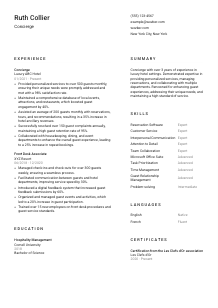
Creating memorable guest experiences, but your resume feels unnoticed? Step forward with this Concierge resume example, created with Wozber free resume builder. Learn how to tailor your hospitality flair to meet job expectations, orchestrating a career that's always in the service of excellence!
Concierge hiring turns on one practical question fast: can you handle guest requests with polish when the pace spikes and expectations stay high? A resume for this work needs to show more than friendliness. It should make clear that you can manage reservations, local recommendations, complaint resolution, and cross-department coordination without letting service quality slip.
The first screening pass often separates candidates with front-of-house exposure from those who have actually delivered personalized concierge service in a demanding property. Using Wozber's free resume builder to tailor your wording and keep an ATS-friendly resume format helps surface the right details early, especially experience with guest requests, reservation systems, and luxury-level service standards. That makes it easier for a hiring team to see whether you can step into guest-facing operations with confidence.
Concierge work starts with polished communication, and your header should reflect that same standard. Keep this section clean, accurate, and aligned with any practical requirement the employer has already made explicit.
Your name should be the most visible item on the page, set in a simple, readable style. Right below it, use the exact target title, "Concierge," when that is the job you are pursuing. It immediately anchors your profile in guest service rather than broader hotel operations.
If your recent title was something adjacent, such as Front Desk Associate or Guest Services Agent, you can still position yourself for concierge work by using "Concierge" as the target title in your header when your experience supports it. This also helps ATS matching when the employer is filtering specifically for concierge candidates.
List a phone number you answer reliably and a professional email address in a standard format. In hospitality, missed calls and messy contact information read badly because the job itself depends on responsiveness, accuracy, and polished communication with guests, vendors, and internal teams.
Some postings include a firm location requirement, as this one does for New York City, New York. If that applies, state your city and state clearly in the header. That removes an avoidable question before the employer gets to your guest service experience.
A LinkedIn profile can strengthen your application if it reflects hospitality experience, service awards, language skills, or luxury property exposure. If you include it, make sure the roles, dates, and accomplishments match your resume exactly. Any mismatch weakens credibility fast.
Your personal details should confirm that you are reachable, professionally presented, and ready for the property's practical requirements before the reader moves into your concierge experience.




This section carries the most weight for concierge hiring. Hotels and luxury residences want to see how you handled guest volume, service recovery, reservations, recommendations, and internal coordination when real requests were coming in, not just that you worked in hospitality.
Read the posting with an eye for the actual work rhythm. Here, the important signals are personalized service, multitasking under pressure, local knowledge, complaint handling, and collaboration with other departments. Those are the themes your bullets should reflect, because they map directly to how concierge performance is judged on the floor.
List your most recent hospitality role first, then work backward with job title, employer, and dates. Keep the structure consistent so the reader can quickly track your progression from front desk or guest services into more specialized concierge responsibilities.
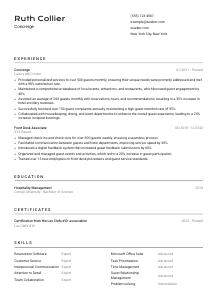
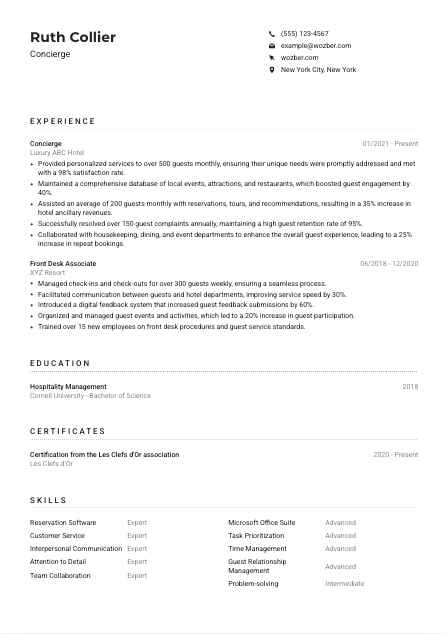
Avoid generic lines like "assisted guests with requests." Show what kind of requests, how many, and what result followed. The sample resume does this well with points such as serving more than 500 guests monthly at a 98% satisfaction rate and assisting 200 guests monthly with reservations and recommendations. Those bullets show scale, service quality, and commercial value in one line.
Metrics make concierge work tangible. Good examples include guest satisfaction scores, complaint resolution volume, repeat bookings, ancillary revenue, guest engagement, or service speed. If you improved booking uptake through restaurant and tour recommendations or helped raise retention after resolving issues, say so with real figures.
Prioritize bullets that show personalized attention, local expertise, problem-solving, and coordination across housekeeping, dining, events, transportation, or front office teams. Even if part of your background comes from a front desk role, select accomplishments that translate clearly into concierge value, such as facilitating guest requests across departments or improving service turnaround.
Your experience section should show that you can run concierge responsibilities in a live guest environment, handle pressure without losing composure, and contribute to satisfaction, revenue, and repeat business.
Education usually supports a concierge application rather than driving it. Still, the right degree or training can reinforce your understanding of hospitality operations, service standards, and guest-facing professionalism, especially earlier in your career.
If you have a degree in Hospitality Management, Tourism, Business, or a related field, include it clearly. While many concierge roles are hired primarily on experience, hospitality education can reinforce your grounding in service operations, guest relations, and property workflows. The example's Cornell hospitality degree is a strong illustration, not a universal requirement.
List degree, field of study, school, and graduation year in a straightforward structure. Hiring managers reviewing front-of-house candidates often move quickly, so clarity matters more than detail unless your coursework or training directly supports the role.
When your degree is not directly in hospitality, emphasize elements that still transfer well, such as communications, business administration, cultural studies, or event management. The key is to connect your education to guest interaction, coordination, and service delivery rather than listing a degree without context.
Student leadership, event planning, tourism clubs, language-focused activities, or customer-facing campus roles can strengthen this section if they show poise, organization, or public-facing communication. Skip unrelated activities that do not help explain your readiness for hospitality work.
Honors, scholarships, or notable projects are worth listing when they reinforce discipline, service orientation, or hospitality relevance. Keep them brief. This section should support your professional story, not compete with your guest-service experience.
Use education to reinforce your foundation in hospitality or transferable service skills, especially if it adds context to the guest-facing strengths shown in your work history.
Certifications can add useful weight in concierge hiring, especially when they point to recognized service standards, luxury hospitality exposure, or specialist guest-service knowledge. They are most valuable when they match what the employer already cares about.
When a posting names a preferred certification, give it priority. Here, Les Clefs d'Or is specifically mentioned, so it belongs near the top if you hold it. That credential carries real recognition in concierge circles and can distinguish you from candidates with general hotel experience only.
List credentials tied to hospitality, guest relations, luxury service, tourism knowledge, or customer care systems. The certificate should deepen your case for handling high-touch guest requests, not just add a line for volume.
Add the certification date, and if it is active or ongoing, make that clear. Recent or current credentials suggest that your service standards and professional knowledge are up to date, which matters in guest-facing roles where expectations change with the market.
Concierges who keep learning tend to bring sharper local knowledge, stronger service judgment, and better operational awareness. If you are pursuing additional hospitality training, destination expertise, or luxury service programs, relevant current learning can support your profile.
This section should reinforce recognized hospitality standards and show that your concierge practice is backed by training, not just experience alone.
Concierge skills need to read like tools you actually use during a shift. Hiring managers are looking for a blend of guest-facing judgment and operational competence, from communication and service recovery to reservation systems and prioritization.
Start with the abilities named in the job description, then keep only the ones you genuinely use. For this role, that includes interpersonal communication, customer service, multitasking, prioritization, reservation software, and Microsoft Office. Matching the employer's language improves both ATS optimization and human review.
A concierge role sits at the intersection of relationship management and execution. Pair soft skills such as guest communication, discretion, and problem-solving with hard skills such as reservation software, CRM or PMS familiarity, itinerary coordination, and Microsoft Office reporting or scheduling tasks.
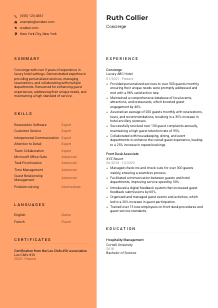
Do not crowd this section with every skill you have learned in hospitality. Put the strongest concierge-relevant skills first, especially those that connect to guest requests, local recommendations, complaint resolution, and fast coordination across departments. The sample list works because it balances service strengths with tools and workflow skills instead of reading like a generic personality inventory.
Your skills list should show that you can manage guests, systems, and shifting priorities in the same shift without losing service quality.
Language skills can be especially valuable in concierge work because guest trust often starts with smooth communication. In international hotels, luxury residences, and major travel markets, an additional language can make service feel more personal and far more efficient.
If the job states English is required, list English prominently with an honest proficiency level. For this posting, effective English communication is non-negotiable because the role depends on fast guest interaction, precise recommendations, and calm complaint handling.
Additional languages can strengthen your profile when they are relevant to the property's guest mix or market. In a city with international travelers, fluent French, Spanish, Mandarin, Arabic, or similar language skills may support more personalized service and smoother reservation or itinerary conversations.
Stick to simple levels such as Native, Fluent, Intermediate, or Basic. Hiring teams need a practical sense of how comfortably you can greet, guide, explain, and resolve guest issues in each language.
Languages matter most when they improve the guest experience. If a second language helps you give restaurant recommendations, coordinate transport, explain local events, or resolve concerns with less friction, it is worth including. The example's English and French combination works well for exactly that reason.
Do not overstate fluency. A concierge may be called on to handle urgent requests or complaints in real time, so exaggerated language claims are easy to uncover. List the languages you can use confidently in guest-facing situations.
This section should show whether you can serve the property's guest population smoothly and add a more personal layer to the concierge experience.
Your summary should sound like someone who already knows how a guest-facing operation runs. In a few lines, it needs to frame your level, your setting, and the kinds of concierge outcomes you deliver most consistently.
Review the posting and identify the few qualities that define success in the job. Here, that means personalized guest service, calm prioritization under pressure, local knowledge, and smooth coordination with other departments. Build your summary around those realities rather than broad statements about being passionate or hardworking.
Your first line should quickly establish who you are. A direct opener such as "Concierge with 3+ years in luxury hotel environments" gives the reader level, setting, and specialization right away. If your background is partly from front desk or guest services, frame it in a way that still points toward concierge readiness.
Mention the capabilities that matter most for the target role, such as handling reservations, resolving guest concerns, curating local recommendations, or coordinating across departments. If you can, anchor the summary in outcomes already proven in your experience, like high satisfaction scores, repeat bookings, or increased ancillary revenue.
Aim for 3 to 5 lines with no filler. The sample summary works because it stays close to concierge work, mentions luxury hotel experience, and highlights personalized service and cross-department collaboration. Use that approach to create a summary that sounds specific to your background and the property you are targeting.
After reading this section, the employer should already understand your level of hospitality experience, the type of guest environment you know, and the service strengths you would bring on day one.
A concierge resume works when every section supports the same message: you can deliver polished, prompt, personalized service in a demanding guest environment. That means aligning your experience with real hospitality outcomes, keeping your skills close to daily concierge work, and using your summary to establish the level of service setting you know best.
Wozber's free resume builder can help you shape that story into an ATS-compliant resume, refine wording with role-specific language, and present it in an ATS-friendly resume template that keeps the focus on your guest service record. The finished resume should make one thing easy to judge: whether you can represent the property well and handle concierge responsibilities with confidence.




