



Use Wozber and land your dream job
Create Resume
No registration required
Mastering operations, but your resume seems to be having technical difficulties? Connect the dots with this Operations Manager resume example, created with Wozber free resume builder. Learn how to lay out your management strengths to match job specs, making your career trajectory as smooth as an efficiently run supply chain!

Operations managers are hired to keep moving parts under control while improving how the business runs. A resume for this role needs to show that you can lead frontline teams, tighten workflows, manage inventory or supply flow, and turn operational data into better cost, service, and productivity outcomes.
When that story is tailored well, hiring teams can quickly distinguish broad management experience from hands-on operational leadership. Wozber's free resume builder helps you shape an ATS-compliant resume around the language of the role, so strengths like process improvement, ERP use, reporting discipline, and team oversight are easier to recognize early.
For an Operations Manager, the header should be clean and practical. It needs to confirm who you are, how to reach you, and whether you meet straightforward filters such as title alignment and location, without wasting space better used for operational results.
Use your full name in the largest text on the page so it is immediately identifiable. Keep the presentation professional and simple. This role is about control, structure, and sound judgment, and your header should reflect that from the first line.
Place "Operations Manager" under your name when that is the role you are pursuing. It helps frame the rest of the resume around operations leadership rather than general administration, warehouse support, or office management. If your recent title was slightly different, such as Assistant Operations Manager, your summary and experience can show the progression.
List a reliable phone number and a professional email address, then check both carefully. This sounds basic, but operations hiring often moves quickly when employers need someone who can step into staffing, inventory, reporting, or process issues without delay.
If the employer specifies a location, show it clearly in your header. Here, Chicago, Illinois is part of the stated requirement, so including it removes avoidable questions about availability. For roles without a location filter, city and state are usually enough unless relocation is part of your pitch.
A LinkedIn profile or personal site can reinforce the resume if it is current and consistent. For operations candidates, that might mean matching job titles, timeline accuracy, and visible achievements in process improvement, supply chain work, ERP projects, or team leadership. Only include links that strengthen the application.
This section does not need personality flourishes. It should confirm your identity, the role you are targeting, and any obvious requirement such as location, so the reader can move straight to your operational track record.




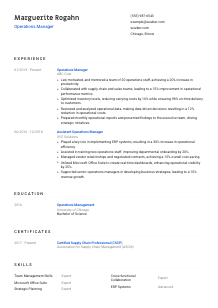
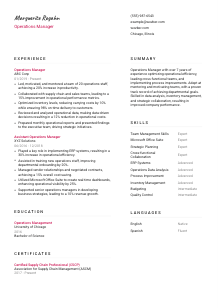
This is the section that carries the most weight for Operations Manager hiring. Employers want to see how you improved throughput, reduced costs, managed staff, supported service levels, and made decisions from operational reporting, not just that you were present in an operations environment.
Start by matching your experience bullets to the core demands of the job. For operations leadership, that usually means team supervision, process improvement, inventory or supply coordination, resource allocation, and reporting to senior leadership. In the example, bullets about mentoring a team, improving productivity, and collaborating with supply chain and sales teams line up closely with the posting's responsibilities.
List your roles from most recent to oldest, and make sure each entry includes employer, title, and dates. Operations careers are often judged by progression in scope, such as moving from support or analyst work into direct people management, cost control, or cross-functional ownership. A clean timeline helps the reader see that growth quickly.
Each bullet should show what you owned and what changed because of your work. "Led a team of 20 operations staff, achieving a 20% increase in productivity" is far stronger than simply saying you supervised staff. Operations resumes benefit from this format because results like service performance, efficiency gains, and cost reductions are central to the job.
Use numbers wherever they reflect normal business measures. Productivity gains, carrying cost reduction, on-time delivery, operational cost savings, revenue contribution, dashboard visibility, or onboarding improvement all make sense here. The sample resume does this well with metrics such as 98% on-time delivery and a 12% reduction in operational costs, which are exactly the kind of measures hiring teams expect to see.
Do not overload this section with every responsibility from your career. Prioritize bullets that show process improvement, ERP implementation, inventory control, vendor management, forecasting support, reporting cadence, and leadership over work that does not support the target role. If a past achievement demonstrates transferable value, frame it in operational terms.
Your experience section should make it easy to picture you managing staff, improving workflows, and keeping performance on target. If the reader can see stronger productivity, better inventory decisions, cleaner reporting, or lower costs in your bullets, the section is doing its job.
Education matters most here as a qualification check and a supporting credential. For Operations Manager roles, the key is to present your degree clearly, especially when the posting asks for business, operations management, or a related field.
Read the posting carefully and reflect the degree category it requests when you genuinely hold it. In this case, a Bachelor's degree in Business, Operations Management, or a related field is requested, so a Bachelor of Science in Operations Management is a direct match and should be stated exactly.
Use a standard format with school, degree, field, and graduation year or date. Hiring teams usually review this section quickly unless the role is early-career or unusually specialized. Clear formatting helps them confirm the requirement without slowing down the read.
If your degree directly relates to operations, supply chain, business, industrial engineering, or logistics, do not hide that in abbreviated wording. Spell it out. A precise field can reinforce your grounding in process design, systems thinking, forecasting, and operational analysis.
Include coursework, capstone projects, or honors only when they strengthen your case. For example, coursework in supply chain analytics, process improvement, inventory systems, or business operations may be worth mentioning if you are earlier in your career or your experience is still developing.
Leadership roles in student organizations, operations case competitions, or academic distinctions can help if they point toward planning, coordination, or analytical discipline. For experienced candidates, these details should stay brief and secondary to your work results.
For most Operations Manager candidates, education should confirm the required academic foundation and then give space back to experience. State the degree clearly, show the relevant field, and let your operational record carry the larger argument.
Certifications are not always mandatory for Operations Manager roles, but the right ones can strengthen your profile, especially if they connect to supply chain, process improvement, quality, or systems work. They are most useful when they reinforce the kind of operational scope the employer needs.
If the posting does not require a certification, use this section to deepen your operations profile rather than to fill space. Credentials such as CSCP, Lean Six Sigma, APICS-related certifications, or quality-focused training can back up experience in inventory planning, process improvement, and cross-functional execution. The sample's CSCP works well because it supports the supply chain and efficiency side of operations leadership.
A shorter list is usually stronger. Include certifications that connect to process design, ERP-enabled operations, supply chain management, continuous improvement, quality control, or people leadership. Leave out unrelated training that does not help explain your suitability for running operations.
Add the year earned and, if applicable, the active date range. This matters when the certification is current, ongoing, or tied to a professional body. Dates can also show that your knowledge in areas like supply chain strategy or continuous improvement is recent enough to matter.
Operations practices evolve with new planning tools, reporting expectations, and process methodologies. Recent certification work can show that you stay current on efficiency methods, inventory strategy, and operational problem-solving rather than relying only on older experience.
This section works best when it supports the story told in your experience. If your resume already shows cost control, inventory optimization, ERP work, or process improvement, the right certification adds another layer of credibility.
The best Operations Manager skills sections are specific and prioritized. Employers look for a combination of leadership capability, systems fluency, process discipline, and analytical judgment, so your list should reflect the work you can actually manage and improve.
Review the job description for both stated and implied requirements. For this role, that includes team management, process improvement, ERP systems, Microsoft Office Suite, inventory optimization, data analysis, and cross-functional collaboration. These are not filler terms. They describe how operations performance is planned, tracked, and improved day to day.
Put the highest-value, most relevant skills near the top of the section. Leadership and process improvement usually belong early for an Operations Manager, followed by ERP systems, operational analysis, inventory management, planning, and reporting tools. The sample resume gets this mostly right by foregrounding team management, strategic planning, collaboration, ERP systems, and operations data analysis.
Do not turn this into a keyword dump. A tight list of capabilities that can be supported by your experience bullets is more convincing than a long inventory of vague strengths. If you include ratings, make sure they match the depth shown elsewhere on the resume.
A hiring team should be able to scan this section and immediately see whether you can lead people, work in the systems they use, and improve the metrics they care about. Keep the emphasis on operational capability, not generic management language.
Language requirements in operations roles tend to be practical. The employer wants to know whether you can manage staff, communicate expectations, present reports, and work across departments without friction, especially when English proficiency is listed explicitly.
If English is required, include it directly and use an honest proficiency level. For an Operations Manager, this matters because the role often involves reporting to leadership, coaching staff, writing updates, and coordinating with functions such as supply chain, sales, finance, or customer service.
Additional languages can strengthen your resume when the environment includes multilingual teams, vendor coordination, regional operations, or customer-facing logistics. Spanish, for example, may be helpful in some operations settings, but it should be presented as an added capability rather than a universal requirement.
Use clear labels such as Native, Fluent, Professional, or Conversational, and do not overstate your level. In operations, language ability shows up quickly in meetings, shift communication, escalation handling, and written reporting, so accuracy matters.
If the company works across multiple regions, plants, suppliers, or distribution markets, extra languages can support coordination and relationship management. If the role is fully local, the section may simply confirm required English proficiency and move on.
Language skills are useful, but they should not take attention away from your core value in operations. Give this section the right amount of space based on the role's communication demands and your actual working environment.
For this kind of role, language proficiency should reinforce your ability to lead teams, present operational findings, and coordinate across functions. State it clearly, keep it truthful, and let it support the broader management story.
The summary should quickly establish the scale and direction of your operations background. Hiring teams want to know whether you lead people, improve processes, work comfortably with data and systems, and drive measurable business performance.
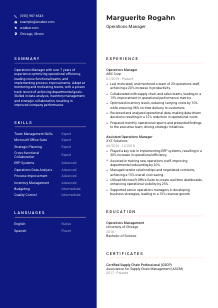
Build the summary around the hiring priorities in the posting. For an Operations Manager, that often includes years of experience, process improvement, team leadership, operational efficiency, ERP familiarity, and cross-functional execution. The sample summary does this well by pairing years of experience with operational optimization and leadership rather than using broad management claims.
Start with your title or professional identity, then add the depth of experience you bring. Phrases like "Operations Manager with 7+ years of experience" work well when the rest of the sentence specifies the environment or value, such as improving efficiency, managing teams, or supporting supply chain operations.
Use the next lines to highlight the areas that matter most for the job. Mention capabilities like mentoring staff, analyzing operational data, improving inventory decisions, implementing ERP systems, or partnering with other departments. If possible, anchor those strengths in outcomes such as cost reduction, service improvement, or productivity gains.
Aim for a short paragraph of 3 to 5 sentences. Avoid filler about passion or ambition. This section works best when it reads like an executive snapshot of your operating range, your management scope, and the business results you tend to produce.
A strong summary should position you as someone who can manage execution, improve performance, and communicate upward with confidence. If those points are clear in the first few lines, the rest of the resume has a strong foundation.
An effective Operations Manager resume shows how you lead teams, improve processes, manage systems, and move business metrics in the right direction. When each section supports that story, your background reads as operational ownership rather than general management experience.
Use Wozber's free resume builder to organize that experience in an ATS-friendly resume format, and refine it with Wozber's ATS resume scanner so the language of process improvement, ERP systems, reporting, and team leadership is clearly aligned with the job. The finished resume should make it easy to judge your readiness to run operations with control and measurable impact.




