



Use Wozber and land your dream job
Create Resume
No registration required
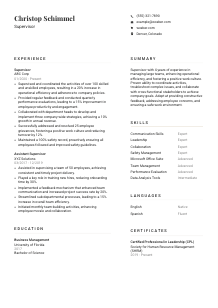
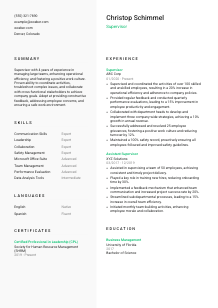
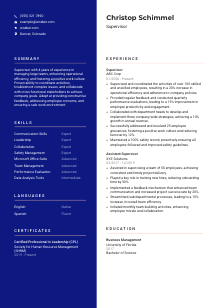
Leading teams, but your resume feels like a solo act? Step onto the podium with this Supervisor resume example, created with Wozber free resume builder. Learn how to match your leadership prowess to job criteria, ensuring your career takes center stage!
Supervisors are hired to keep day-to-day operations steady while people, output, and workplace standards all move at once. That makes the resume less about broad leadership claims and more about showing where you directed teams, handled employee issues, improved execution, and kept policies and safety procedures on track.
Screening often narrows quickly when a resume leaves those details vague. Wozber's free resume builder helps you shape an ATS-compliant resume around the language employers use for supervision, performance management, operations, and safety, so the hiring team can quickly see whether you've already managed the kind of workforce and accountability the job requires.
For supervisor hiring, the top of the resume should confirm practical basics fast: who you are, the role you are targeting, and whether location or contact details create any friction. Keep this section clean and direct so the reader can move straight into your team leadership and operational background.
Use your full name in a clear, readable format at the top of the page. This is a simple detail, but it matters when hiring teams are reviewing multiple candidates for frontline or mid-level leadership roles and need to identify you quickly across resumes, interview notes, and internal discussions.
Place the role title directly under your name and mirror the posting when it fits your background. If you are applying for a "Supervisor" opening, use that wording instead of a looser alternative. It immediately ties your experience to the level of responsibility the employer is filling.
List a working phone number and a professional email address with no errors. Supervisor roles often move quickly from screening to interview because the need is operational, so recruiters should not have to hunt for a number or question whether the contact information is current.
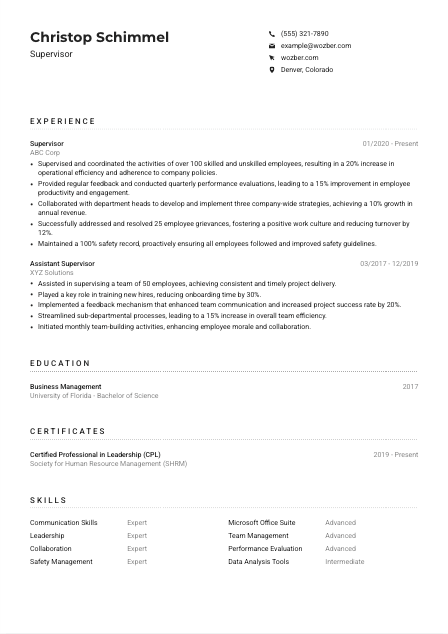
If the employer asks for a specific location or relocation readiness, show it plainly in your personal details. In the example here, "Denver, Colorado" helps remove doubt because the posting requires candidates to be located in or willing to relocate to Denver. Use the same approach whenever geography affects scheduling, site presence, or start-date feasibility.
A LinkedIn profile or professional website can help if it supports your supervisory record with consistent job titles, dates, and leadership achievements. Before adding it, make sure it reflects the same team size, operational scope, and career progression shown on your resume.
Your header should answer the practical questions first: your identity, target role, how to reach you, and whether location requirements are covered. Once those basics are clear, the hiring team can focus on the substance of your supervision experience.




This is the section most likely to decide whether a supervisor candidate moves forward. Employers want to see how many people you led, what kind of operations you coordinated, how you handled performance and employee relations, and whether your oversight improved output, compliance, or safety.
Prioritize roles where you managed teams, coordinated daily work, enforced procedures, or supported operational targets. Titles such as Supervisor, Assistant Supervisor, Team Lead, Shift Lead, or Operations Coordinator can all work if the bullet points clearly show staff oversight and accountability.
List each position in reverse chronological order with title, company, and dates. Then make the first one or two bullets establish your scale of responsibility, such as team size, employee mix, shift coverage, department scope, or production and service environment. In the sample resume, supervising more than 100 skilled and unskilled employees gives immediate context for the level of coordination involved.
Do not stop at "supervised staff" or "conducted evaluations." Show what happened because of your oversight. Strong bullets connect supervision to outcomes like higher efficiency, better productivity, fewer grievances, lower turnover, stronger policy compliance, or improved delivery timelines. The example bullet on quarterly performance evaluations works because it links feedback practices to a 15% improvement in productivity and engagement.
Numbers help hiring teams gauge scale and effectiveness quickly. Use metrics that make sense for supervisor work, such as headcount, productivity gains, efficiency improvements, turnover reduction, safety performance, on-time completion, or grievance volume resolved. A line such as "maintained a 100% safety record" carries more weight than a generic statement about caring about safety.
Choose examples that show decision-making, coordination, coaching, and accountability. That includes corrective action, conflict resolution, cross-functional planning, process improvement, staffing support, and policy enforcement. If a bullet does not help the reader understand how you led people or improved operations, cut it and use the space for a stronger supervisory example.
After reading your experience section, a hiring manager should understand the size of teams you have led, the operating environment you worked in, and the business results that followed your supervision. That is what makes your background feel ready for the next supervisor role, not just adjacent to it.
Education usually is not the most persuasive section for an experienced supervisor, but it still matters when the posting calls for a specific degree. Present it cleanly so the employer can confirm you meet the stated requirement and move back to your operational and people-management experience.
Read the posting carefully and match the level and field wherever you can. For this opening, a bachelor's degree in Business Management, Operations, or a related field is part of the requirement, so that information should be easy to find on the page.
Use a simple format that includes degree, field of study, school name, and graduation year or date. Supervisor resumes do not need elaborate academic descriptions unless you are early in your career or the program directly supports the role's operational focus.
If your degree directly matches the posting, let that alignment be obvious. The example resume lists a Bachelor of Science in Business Management, which fits the employer's request neatly. If your degree is in a related area, keep the wording clear enough that the connection is easy to understand.
Relevant coursework can help if you have limited supervisory experience or if classes in operations, organizational behavior, analytics, or safety management support the role. For most established candidates, the degree itself is enough and space is better used in experience.
Honors, leadership activities, or projects belong here only if they add something useful to your candidacy, such as process improvement work, team leadership, or business analysis. Keep the emphasis on details that still matter for a supervisor hiring decision.
This section only needs to confirm that your academic background supports the role. When the degree requirement is clear and relevant, education does its job and lets the rest of the resume carry the heavier proof of leadership and operational performance.
Certifications can sharpen a supervisor resume when they reflect the kind of oversight the job demands. Leadership credentials, process improvement training, and safety-related certifications often help because they connect directly to managing teams, improving workflows, and enforcing standards.
When the employer calls out preferred credentials, list matching ones prominently if you have them. Here, Certified Professional in Leadership and Six Sigma are specifically mentioned, so either would be worth highlighting near the top of this section.
Prioritize certificates that strengthen your case as a people leader or operations manager. Leadership development, Lean or Six Sigma training, safety compliance, employee relations, and workforce management certifications usually matter more than generic course completions.
Add issue dates, renewal dates, or active ranges when they help demonstrate that the certification is current. In supervisor hiring, recent credentials can support your ability to apply updated leadership practices, process standards, or compliance requirements.
A supervisor often advances by taking on broader teams, more complex operations, or stricter compliance environments. Updating this section with relevant new certifications shows continued professional development in the areas that matter most for advancement.
Certifications work best when they support the actual demands of the job, such as supervising staff, improving processes, or maintaining standards. A focused list tells the employer that your leadership development has practical application, not just classroom value.
A supervisor skills section should read like an operating toolkit, not a personality list. Employers are looking for a combination of people management, communication, compliance awareness, and the practical tools used to track work, report results, and support decisions.
Start with the posting and note both explicit and implied requirements. In this case, communication, Microsoft Office Suite, data analysis familiarity, team supervision, and employee relations all belong in the resume because they connect directly to how the work gets done.
Balance soft skills and technical capability. For a supervisor, that often means pairing leadership, coaching, conflict resolution, and collaboration with tools or functions such as Excel reporting, performance tracking, scheduling, safety procedures, or data analysis tools.
Do not turn this section into an inventory of everything you can do. Choose the skills that support the target role most clearly. The sample resume works because it combines leadership and communication with practical capabilities like Microsoft Office Suite, safety management, performance evaluation, and data analysis tools.
When this section is tailored well, the employer can quickly see that you can manage people, communicate across levels, and use the tools needed to keep operations organized. That is far more useful than a long, generic list.
Language ability matters on supervisor resumes when it affects communication with staff, reporting, training, or cross-team coordination. Keep this section practical and honest, especially when the job posting names a required language.
If the posting specifies a language, list it first with an accurate proficiency level. Here, English fluency is a stated requirement, so English should appear at the top of the section and be marked clearly as Native or Fluent, whichever is true for you.
After the required language, list any additional languages that could help in the work environment. In supervisor roles, another language can be useful for team communication, onboarding, training, or de-escalating employee issues across a diverse workforce.
Choose standard terms such as Native, Fluent, Intermediate, or Basic. Hiring teams need a realistic sense of whether you can lead meetings, explain procedures, document issues, or coach employees in that language.
Avoid overstating proficiency. A supervisor may need to give instructions, conduct difficult conversations, or explain policy and safety expectations, so language claims should reflect what you can handle in a real workplace setting.
Extra language ability is especially useful if you supervise multilingual teams or operate in a customer-facing, field, or regional environment. In the example resume, Spanish adds practical value because it broadens communication range beyond the required English fluency.
This section should tell the employer how you communicate on the job, not just what you studied. For supervisor roles, that means clear English proficiency first and any additional language strengths that improve team leadership or coordination.
The summary should quickly tell the reader what kind of supervisor you are, what environment you have led in, and what results tend to follow your management. Keep it grounded in team oversight, operations, and measurable outcomes rather than broad statements about being a strong leader.
Before writing, identify the two or three priorities the employer repeats. For this role, those themes include supervising staff, maintaining efficient operations, managing performance and employee relations, and supporting a safe workplace. Your summary should reflect that mix.
Start with a direct description of your professional identity, such as your title and years of relevant experience. A line like "Supervisor with 4+ years of experience leading frontline teams" gives immediate context and places you in the right hiring bracket.
Follow your opening with a few specifics on what you have managed or improved. Good details include team size, operational efficiency gains, productivity improvements, grievance resolution, policy compliance, or safety results. The example summary works because it combines large-team management, operational improvement, employee support, and workplace safety in a compact space.
Aim for three to five lines with clear language and no filler. Every phrase should either define your supervisory scope, highlight a relevant strength, or point to a result you have delivered. If a sentence could fit almost any management resume, rewrite it until it reflects the actual work of supervision.
By the time the reader leaves this section, they should already understand your supervisory level, operating strengths, and the kind of team and performance outcomes you bring. That gives the rest of the resume a clear direction.
A supervisor resume works when each section supports the same conclusion: you can lead people, keep operations moving, address problems early, and uphold standards that matter on the floor or across departments.
Use Wozber's free resume builder and ATS resume scanner to align your wording with the posting, strengthen ATS optimization, and organize your experience in an ATS-friendly resume format that keeps team leadership, operational results, and workplace accountability easy to read.
When the document is finished, it should make one thing clear without effort: you are ready to supervise the work, the people, and the standards the role depends on.




