



Use Wozber and land your dream job
Create Resume
No registration required
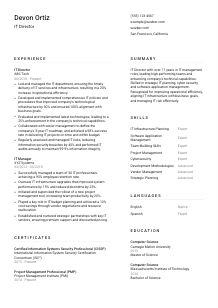
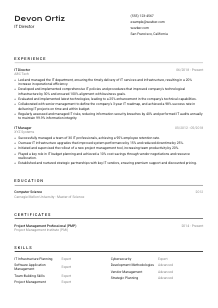
Leading tech teams but your resume isn't making the connection? Check out this IT Director resume example, created with Wozber free resume builder. Learn how to key in your strategic technology leadership to align with the job's directing requirements, propelling your career to a whole new level of IT brilliance!
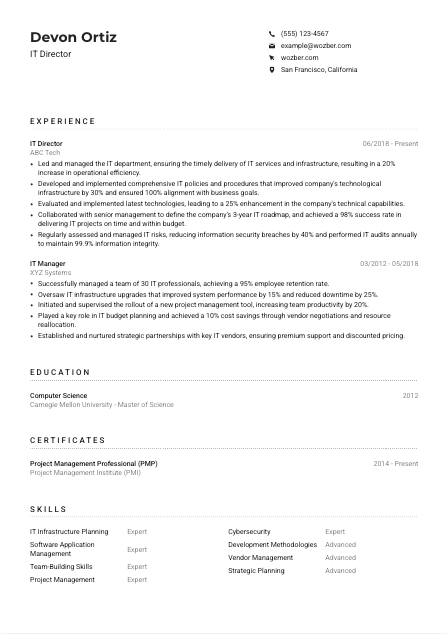
IT Director hiring usually turns on one question fast: can you lead a complex technology function without losing control of service delivery, security, or business priorities. A resume for this level needs to make your operating scope visible, from infrastructure decisions and policy ownership to budget, team leadership, and the results your IT organization delivered.
When that scope is tailored to the role, the reader can quickly separate a senior technical manager from someone who has already owned an IT roadmap, governed risk, and led cross-functional execution. Wozber's free resume builder helps you shape that story in an ATS-friendly resume format, so the right terms, achievements, and leadership signals are easy to read and easy to match to IT Director expectations.
For an IT Director, the header should establish professional credibility in seconds. Keep it clean, complete, and aligned with the practical requirements of the opening so nothing basic slows down the review.
Place your name prominently at the top using a clear, professional style. At director level, your resume should feel executive and organized from the first line, much like the way you would present an IT roadmap or governance update.
Add "IT Director" directly beneath your name when that is the role you are pursuing. It immediately frames your application around department leadership, operational oversight, and strategic planning rather than a broader IT management profile.
Your phone number and email should be simple, current, and professional. Hiring teams moving on senior IT roles often coordinate interviews quickly across executives, HR, and technical stakeholders, so accuracy matters.
If the role has a location requirement, reflect that in your header. Here, San Francisco, California supports a direct match to the stated requirement. For other IT Director roles, include city and state when proximity, onsite leadership, or regional oversight is relevant.
Include LinkedIn or a professional website if it reinforces your leadership profile. For an IT Director, that profile should align with your resume on titles, dates, and scope, and can add context around enterprise systems, transformation work, or speaking and advisory activity.
Your contact block should do more than identify you. It should confirm that you are presenting yourself at the right level, in the right market, and with the kind of professional polish expected from someone leading an IT function.




This section carries the most weight for an IT Director. Hiring teams are looking for proof that you have led teams, improved infrastructure and service performance, managed risk, and delivered projects that supported broader business goals.
Start by marking the responsibilities that define the role. For an IT Director, that usually includes departmental leadership, infrastructure oversight, policy creation, project delivery, security, audits, and roadmap ownership. Use those themes to decide which bullets deserve space and which older details can be cut.
List your most recent and most senior roles first. Director-level hiring depends heavily on progression, so your timeline should make it easy to see how you moved from hands-on management into broader ownership of teams, budgets, platforms, and business-facing IT decisions.
Don't stop at saying you managed an IT department or oversaw infrastructure. Show what changed because of your leadership. The example resume does this well with outcomes such as a 20% increase in operational efficiency, a 25% improvement in technical capability, and a 98% on-time, on-budget project delivery rate.
Quantify the work in terms that matter for senior technology roles: uptime, security incidents, operational efficiency, delivery rate, retention, cost savings, implementation timelines, audit results, or platform performance. Figures like a 40% reduction in breaches or 25% less downtime are far more convincing than general claims about improvement.
Prioritize achievements that show leadership judgment and organizational impact. Vendor negotiations, roadmap planning, policy implementation, audit readiness, and team development all support an IT Director case. A strong technical accomplishment only belongs here if it also reflects scale, governance, or business impact.
Your experience section should make it easy to picture you running the IT department. If the bullets show scope, outcomes, and leadership discipline, the reader can quickly connect your past work to the demands of a director seat.
Education matters at this level because it confirms the formal technical foundation behind your leadership experience. Present it clearly, and make sure it reflects the degree level and field the employer asked for.
When a posting asks for a bachelor's degree in computer science, information technology, or a related field, list that qualification exactly and prominently. If you also hold a master's degree, include it in the same section so the preferred credential is immediately visible.
Use a straightforward structure with degree, field, school, and graduation year. Senior resumes benefit from clarity. A hiring manager should be able to confirm your academic background as quickly as they can review your management scope.
Spell out the discipline rather than leaving it vague. "Master of Science in Computer Science" and "Bachelor of Science in Computer Science" directly support an IT Director profile and align tightly with the example job description.
For most experienced IT Directors, coursework is optional. Include it only if it strengthens a transition, supports a specialized area like cybersecurity or enterprise systems, or helps connect an older degree to the role you are targeting.
Honors, research, or leadership activities can stay if they add something meaningful, but they should not compete with your career achievements. At this stage, the priority is confirming the educational baseline behind your technical and strategic leadership.
Education should validate your technical grounding without distracting from your executive experience. Clear degree information is enough to satisfy the requirement and keep the focus where it belongs.
For IT Directors, certifications are most useful when they support the kind of work the role actually covers. Focus on credentials that strengthen your case in service management, security, project delivery, infrastructure, or governance.
If the posting calls out certifications such as ITIL, PMP, CISSP, or CCNA, move those to the front of the section when you have them. In this example, PMP, CISSP, and CCNA directly reinforce project leadership, security oversight, and network knowledge.
List certifications that support director-level responsibilities over broader or less relevant credentials. For example, a security certification matters when the role includes risk management and audits, while a project credential helps when delivery timelines and budgets are part of the brief.
Certification dates help employers judge whether your knowledge is current, especially in areas like security, networking, and service management. If a credential is active or renewed, showing that can strengthen your profile.
Your certifications should evolve with your leadership path. As your role expands from operations into governance, transformation, and enterprise risk, the most valuable credentials are the ones that support those broader responsibilities.
Used well, certifications add depth to your leadership profile. They should back up the parts of the job you are expected to own, especially delivery discipline, security posture, and operational governance.
An IT Director skills section should read like the toolkit of someone who runs an IT organization, not just contributes to one. Choose skills that reflect technical breadth, management range, and the ability to align systems with business priorities.
Use the job description to identify the capabilities the employer values most. Here, that includes IT infrastructure planning, software applications, development methodologies, leadership, and team-building. Those terms are useful because they mirror how the role is described and how ATS filters may categorize qualified candidates.
List the capabilities that match the level of work you want. Strong choices for an IT Director often include infrastructure planning, cybersecurity, project management, vendor management, strategic planning, service delivery, and team leadership. The example resume balances technical and managerial skills well, with items like IT Infrastructure Planning and Strategic Planning appearing alongside Team-Building Skills.
Keep the list structured and relevant rather than exhaustive. You can group by technical, operational, and leadership strengths or simply order by relevance. Either way, the section should quickly show that you can manage systems, people, risk, and execution at the same time.
The skills list should confirm the range of your leadership. It needs to show that you can guide infrastructure, delivery, security, and people management with equal confidence.
Language skills are usually a supporting section on an IT Director resume, but they still matter when the role calls for executive communication, cross-functional leadership, or a specific language requirement.
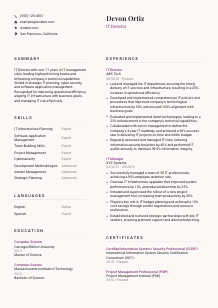
When the job explicitly requires English proficiency, list English at the top with an accurate level. That gives the employer an immediate match on a stated requirement and supports the communication demands of leadership, reporting, and stakeholder alignment.
If the role or company environment makes a certain language especially useful, place it early in the list and show your level clearly. Native, fluent, intermediate, and basic are all easy labels for a hiring team to interpret.
Extra languages can strengthen your profile when you lead distributed teams, work with global vendors, or support international operations. In the example, Spanish adds useful range, though English remains the primary requirement for the role.
Only claim the level you can use in real meetings, documentation, or negotiations. At director level, language ability can come into play in executive discussions, vendor calls, or incident communication, so accuracy matters.
If language is not central to the position, keep the section concise. It should support your candidacy without pulling attention away from infrastructure leadership, project delivery, or security and governance work.
Use language skills to satisfy the requirement and add useful context. Then let the rest of the resume carry the heavier proof of your IT leadership.
The summary is your opening case for why you belong in a director-level conversation. It should combine years of experience, leadership scope, technical focus, and business results in a few tight lines.
Before writing, identify the few themes the employer cares about most. For this kind of position, those are likely to be IT leadership, infrastructure planning, delivery discipline, security, and alignment with business goals. Your summary should reflect that hierarchy rather than trying to mention everything.
Lead with your title or equivalent level, followed by years of experience and your main domain strengths. The example summary does this effectively by positioning the candidate as an IT Director with more than 11 years in IT management and emphasizing high-performing teams and technical capability.
Use the middle of the summary to highlight what you consistently deliver. That might include strategic IT planning, cybersecurity oversight, infrastructure modernization, or improving operational efficiency. Choose strengths that connect directly to the target role's responsibilities.
Aim for a short paragraph that can be read in seconds. Three to five lines is usually enough to establish your leadership level, technical range, and business impact without repeating the experience section.
A well-written summary should quickly position you as someone who can lead the IT function, not just manage pieces of it. Once that frame is clear, the rest of the resume has a much easier job.
An effective IT Director resume shows controlled scale. The reader should see how you led teams, improved infrastructure, managed risk, delivered projects, and aligned technology decisions with business goals.
Use Wozber's free resume builder to shape that story in an ATS-compliant resume, then refine it with ATS optimization and targeted phrasing that matches the role's language. When the structure and wording are right, your resume makes it much easier to judge your readiness to lead the IT function.




