



Use Wozber and land your dream job
Create Resume
No registration required
Balancing budgets, but your resume doesn't add up? Crunch numbers confidently with this Chief Financial Officer resume example, created with Wozber free resume builder. It shows how to present your fiscal expertise to match job specifics, leading you to the prime position at the intersection of finance and strategy.
A Chief Financial Officer resume has to do more than confirm seniority. It needs to show that you can steer financial operations through growth, scrutiny, and board-level decisions while keeping reporting, controls, and risk management disciplined. Executive teams look for signs that you can translate numbers into business direction, not just close the books accurately.
When the resume is tailored well, the hiring team can quickly separate broad finance leadership from true CFO scope such as forecasting, compliance oversight, capital planning, audit readiness, and executive partnership. Wozber's free resume builder helps shape that story in an ATS-friendly resume format, so your experience reads clearly in both an ATS screen and a board-facing hiring review. That matters when the first question is whether you've already operated at this level.
At CFO level, the header should read like executive correspondence. Keep it clean, direct, and fully aligned with the role so there is no friction around title, contact access, or location expectations.
Use your full name prominently and keep the formatting polished. At executive level, visual clutter works against you. A simple, readable presentation signals judgment and professionalism before anyone reaches your experience section.
Place "Chief Financial Officer" directly beneath your name when that is the role you are pursuing. This is especially useful when your recent title varies across companies, such as divisional CFO, VP Finance, or Head of Finance. Clear title alignment helps both ATS systems and decision-makers place you in the right lane immediately.
Include a reliable phone number and a professional email address. CFO searches often involve board members, CEOs, recruiters, and private equity stakeholders moving quickly across interview rounds, so missed calls or an outdated email can create unnecessary delay.
If the employer requires you to be in a specific market, reflect that clearly in your location line. In this example, listing San Francisco, California directly supports the stated requirement. If you are relocating, make that intent easy to spot rather than leaving the employer to guess.
A LinkedIn profile or professional website can reinforce your executive narrative, especially if it reflects board exposure, transaction history, capital strategy, or finance transformation work. Make sure the dates, titles, and major achievements match your resume exactly.
Your personal details should confirm that you are accessible, appropriately positioned, and aligned with any practical requirements tied to the search. Keep this section sharp and factual so the focus stays on your financial leadership record.




This section carries the most weight. Companies hiring a CFO want to see command of the finance function, strategic influence with leadership, and measurable outcomes tied to growth, controls, cash, reporting, or enterprise value.
Read past the title and isolate the work that defines the seat. For a CFO posting, that usually means ownership of budgeting, forecasting, financial reporting, compliance, risk, executive advising, and team leadership. Those should become the spine of your experience bullets, using the employer's language where it accurately reflects your background.
List positions in reverse chronological order and give the most space to jobs where you owned the financial agenda at company or business-unit level. Senior finance progression matters here. Hiring teams want to see how you moved from controllership, FP&A, treasury, or divisional leadership into broader strategic and operational responsibility.
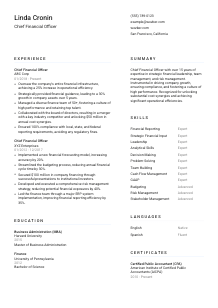
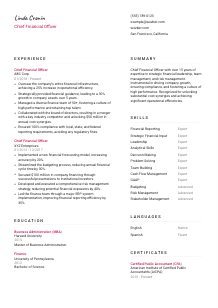
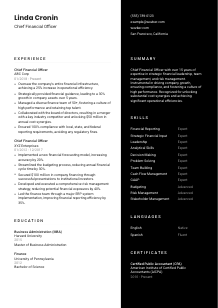
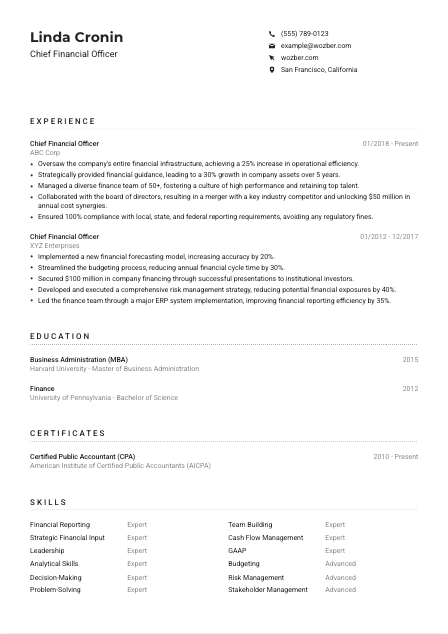
Generic statements like "responsible for budgeting" will undersell you. Show what changed because of your decisions. The example resume does this well by tying finance leadership to outcomes such as a 25% increase in operational efficiency, a 30% growth in company assets, and $50 million in annual cost synergies from a merger. Those are the kinds of results that make CFO impact tangible.
Numbers matter because they show scope. Include team size, financing raised, forecasting accuracy, reporting cycle improvements, audit results, asset growth, cost savings, working capital improvements, or risk reduction. Metrics such as securing $100 million in financing or improving reporting efficiency by 35% give a hiring committee a clearer sense of how you operate under material financial responsibility.
Every bullet should support your case for a CFO seat. Prioritize items tied to board reporting, strategic planning, M&A, audit oversight, internal controls, regulatory compliance, ERP transformation, investor relations, or finance team leadership. Leave out operational wins that are too minor, too tactical, or unrelated to senior financial decision-making.
Your experience section should leave no ambiguity about the level at which you operate. When budgeting, reporting, compliance, capital strategy, and leadership outcomes are all visible, the resume reads like a CFO profile rather than a senior finance resume with an upgraded title.
Education is usually not the deciding factor for a CFO, but it still anchors your technical foundation and can strengthen your executive profile. Present it clearly, especially when the employer has stated degree preferences.
If the posting asks for a Bachelor's degree in Finance, Accounting, or a related field, make that credential easy to find. When you also hold an MBA, place it prominently because it supports the strategic and leadership side of the CFO remit.
Use reverse chronological order with school, degree, field of study, and graduation year. At this level, clarity matters more than detail. In the example, a Bachelor of Science in Finance followed by an MBA creates a clean academic path that aligns well with the role's stated preferences.
Do not assume the degree title speaks for itself. Spell out finance, accounting, or business administration clearly so both ATS parsing and human review catch the connection quickly. This is especially useful if your degree name is broader or institution-specific.
Most CFO candidates do not need coursework listed, but there are exceptions. If your degree is adjacent rather than directly in finance or accounting, a short note on advanced corporate finance, accounting, or risk-related study can help explain the fit without overcrowding the section.
Honors, fellowships, or leadership distinctions can stay if they add real executive value, especially earlier in your career or when they reflect analytical rigor. If they do not strengthen your finance leadership story, keep the section lean.
For a CFO resume, education should confirm a solid finance foundation and support any preferred qualifications the employer listed. Present it cleanly, and let it complement the stronger proof in your leadership and financial results.
Credentials carry real weight in senior finance hiring when they support technical depth, regulatory understanding, or strategic credibility. For CFO roles, the key is relevance, not volume.
When a posting names an MBA or CPA as preferred, make those qualifications easy to spot. A CPA is especially valuable where the role emphasizes accounting standards, audit oversight, and compliance with local, state, and federal reporting requirements.
List certifications that reinforce the scope of the role, such as CPA, CFA, or other respected finance credentials. The example resume pairs CPA with CFA, which works well because it reflects both accounting discipline and broader financial analysis. Choose the credentials that best match your actual background and target industry.
For active licenses and credentials, include the date earned or active range if renewal matters. This is useful for showing that your qualification is current and maintained, particularly for credentials tied to professional standards or continuing education.
Remove expired or marginal certifications that do not strengthen your case for executive finance leadership. If you have completed recent governance, risk, treasury, or transformation-focused development that directly supports CFO responsibilities, that can be worth adding.
A focused certifications section can reinforce your command of accounting standards, financial analysis, and regulated reporting. Keep the emphasis on credentials that deepen your authority for the CFO seat you want.
A CFO skills section should read like an executive operating toolkit, not a generic finance list. Choose capabilities that reflect how you lead the function, advise the business, and control financial risk.
Look beyond the obvious keywords and identify the real operating requirements behind the posting. A CFO role often calls for financial reporting, forecasting, budgeting, compliance, risk management, leadership, board communication, and strategic decision support. These should shape your skills selection.
Include hard skills such as GAAP, financial reporting, cash flow management, budgeting, and risk management alongside leadership capabilities like team building, stakeholder management, and decision-making. That combination reflects the actual span of a CFO role better than either category alone.
Do not turn this into a master inventory. Lead with the skills most relevant to the employer's priorities and your strongest experience. In the example, financial reporting, strategic financial input, leadership, cash flow management, GAAP, and stakeholder management create a clear picture of board-facing finance leadership.
A well-built skills section should reinforce the same message as your experience bullets. The reader should see a finance executive who can control the numbers, guide strategy, and lead the department with confidence.
Language skills matter for a CFO when they affect reporting, investor communication, international operations, or cross-border leadership. If language ability is part of the posting, handle it directly and without overstatement.
If the role requires English proficiency, list it clearly and use an accurate level. That is a basic screening item, so do not bury it beneath less relevant language information.
Include additional languages when they genuinely strengthen your profile, especially for multinational companies, investor-facing roles, or regional finance oversight. In the example, Spanish adds value because it suggests broader communication range beyond the required English.
Terms such as Native, Fluent, Intermediate, and Basic are usually enough. Be precise. A CFO may need to present financial results, negotiate terms, or explain risk exposure, so inflated language claims can quickly become a credibility problem.
If you speak multiple languages, think about where that has mattered. Cross-border acquisitions, international subsidiaries, foreign lenders, or global vendor relationships are all contexts where language ability can support finance leadership. Keep the connection practical rather than decorative.
This section should stay short unless languages are central to the role. Use it to strengthen the profile, not to occupy space that would be better used for strategic finance achievements or leadership scope.
For CFO hiring, language skills are most useful when they clarify communication range in the markets, stakeholders, or operating environments you manage. Keep the section factual and relevant.
The summary needs to frame you as an executive finance leader in a few lines. Focus on scale, strategic influence, and the kinds of financial outcomes that matter at board and CEO level.
Before writing, identify the few priorities that define the opening. For this kind of CFO role, that includes strategic financial leadership, oversight of reporting and forecasting, compliance, and leading a finance department. Your summary should reflect that operating mandate, not a generic finance background.
Start with your title or equivalent level and years of experience, then anchor it in areas such as financial strategy, team leadership, reporting oversight, or enterprise growth. The example summary works because it immediately establishes more than 15 years of expertise in strategic financial leadership and risk management.
Use specific themes that match the job, such as improving operational efficiency, guiding growth, securing financing, strengthening compliance, or leading M&A activity. Brief references to outcomes, like substantial cost synergies or sustained asset growth, make the summary feel earned rather than self-described.
Aim for a concise paragraph that can be read in seconds. Avoid repeating every skill from the skills section. Instead, give a compact view of the value you bring so the reader enters your experience section already expecting CFO-level evidence.
Your summary should position you as a finance executive who can guide strategy, protect the company, and lead the function with authority. When it is specific and well aligned, the rest of the resume lands with much more force.
A Chief Financial Officer resume should make your command of financial operations, executive partnership, compliance, and team leadership easy to judge at a glance. When each section is aligned to the role, the hiring team can see the difference between senior finance experience and true CFO readiness.
Use Wozber to organize that story in an ATS-compliant resume, refine it with targeted language, and check alignment with an ATS resume scanner. The final result should show that you can lead the finance function, support board-level decisions, and take responsibility for the company's financial direction from day one.




