




Use Wozber and land your dream job
Create Resume
No registration required
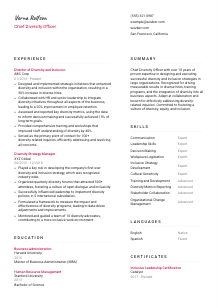
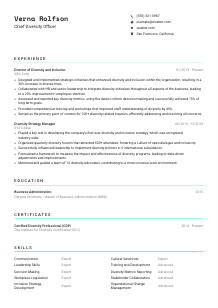
Championing inclusion, but your resume feels left out? Check out this Chief Diversity Officer resume example, created with Wozber free resume builder. Learn how to align your equity expertise with job specifics, inspiring a career journey as diverse and impactful as the teams you uplift!
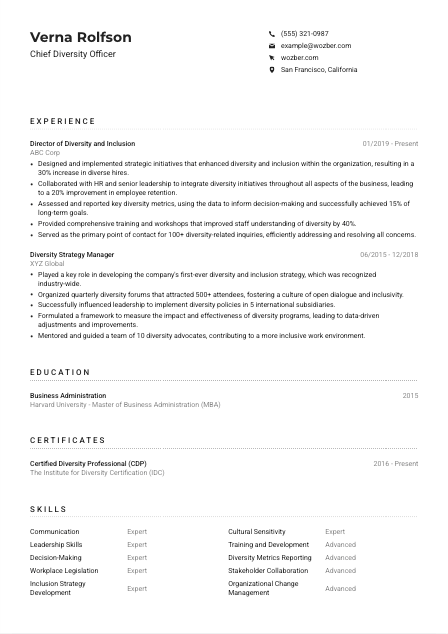
A Chief Diversity Officer is expected to move inclusion from stated values into operating reality. That usually means shaping enterprise strategy, working through senior leaders and HR, handling sensitive employee concerns, and using workforce data to guide decisions on hiring, retention, promotion, and culture. Your resume needs to show that you have led this work at organizational scale, not simply supported it.
Screening for this role often turns on one practical question: can this candidate connect DEI strategy to business systems and measurable outcomes? Wozber's free resume builder helps you build an ATS-compliant resume that reflects the language of the job description while keeping achievements clear and readable. That makes it easier for a hiring team to see your leadership scope, data fluency, and ability to influence change across the organization.
For a Chief Diversity Officer, the header should read like an executive profile, not a contact form. Keep it clean, accurate, and aligned with the role so nothing distracts from your leadership background or creates unnecessary questions about availability.
Use your full name as the most prominent text in the header. Keep the presentation simple and polished. At this level, your name should anchor the resume the way a leadership signature anchors a strategy document.
Place "Chief Diversity Officer" directly under your name when that is the role you are pursuing. If your current title is adjacent, such as Director of Diversity and Inclusion, you can still target the executive title as long as the experience section proves enterprise-level strategy, leadership influence, and accountability for DEI outcomes.
List a professional email address and a phone number you actually answer. Executive hiring often moves through board members, HR leaders, and retained search firms, so accuracy matters. One typo in your email or phone number can interrupt momentum at the wrong stage.
Include your city and state if geography is part of the employer's hiring criteria. In the provided example, listing San Francisco, California immediately supports the stated location requirement. If you are relocating, state that clearly so the employer does not have to guess.
A LinkedIn profile or professional website can reinforce your executive presence, especially if it shows speaking engagements, published thought leadership, board activity, or DEI program work. Make sure the titles, dates, and scope match your resume exactly.
This section should remove friction, confirm basic eligibility, and set a professional tone. For a Chief Diversity Officer, that means clear identity, reliable contact details, and no ambiguity about title or location requirements.




This is the section that carries the most weight for a Chief Diversity Officer. Hiring teams look for leadership over strategy, influence across the business, measurable workforce outcomes, and enough organizational scope to show you can operate with senior executives on sensitive, high-impact issues.
Read the posting for the work the organization needs done now. For this role, that includes designing DEI initiatives, partnering with HR and senior leadership, reporting diversity metrics, delivering training, and serving as a point of contact for concerns and investigations. Those priorities should shape which achievements you select and how you phrase them.
List roles in reverse chronological order and make the basics easy to scan: title, employer, and dates. Then write bullets that show the level at which you operated. For DEI leadership, that often means enterprise programs, policy influence, cross-functional collaboration, board or executive visibility, and responsibility for culture or workforce outcomes.
Your bullets should describe actions and results, not job duties alone. Strong Chief Diversity Officer content includes outcomes such as improved representation, stronger retention, broader promotion pathways, adoption of inclusive policies, or higher participation in learning programs. The example does this well by tying strategic initiatives to a 30% increase in diverse hires and collaboration with leadership to a 20% improvement in retention.
Numbers matter here because DEI leaders are often expected to report progress, justify investments, and set long-term goals. Include metrics tied to hiring, retention, promotion, participation, complaint volume, training completion, employee sentiment, or program reach where they are available and meaningful. Even a detail like handling 100+ inquiries helps show operational scope and trust placed in the role.
Keep the focus on work that supports strategic inclusion leadership. If an older bullet does not show policy work, culture change, stakeholder influence, analytics, training, or employee relations impact, revise it or remove it. Every line should help the reader see you as someone who can lead DEI across a large organization.
A hiring team should be able to trace your path from DEI program leadership to enterprise ownership. When your experience shows strategy, measurable results, cross-functional influence, and trusted handling of sensitive issues, your readiness for the Chief Diversity Officer seat becomes much clearer.
Education matters here as a qualification check and as context for your leadership foundation. It will not outweigh deep DEI leadership experience, but it should still confirm that you meet the degree expectations stated in the posting and present your academic background clearly.
If the role asks for a bachelor's degree and prefers a master's, make sure both are easy to find when you have them. Do not bury relevant credentials below less important information. In this case, the MBA helps reinforce executive-level business partnership, while the bachelor's degree in Human Resource Management supports people and workplace expertise.
List each school, degree, field of study, and graduation year in reverse chronological order. Executive resumes benefit from clean formatting because reviewers often scan education quickly before returning to experience and summary.
Degrees tied to human resources, organizational development, public policy, sociology, business, law, education, or related disciplines can all make sense for DEI leadership. The key is showing a credible academic foundation that complements your work in workforce equity, policy, culture, and leadership.
Most senior candidates do not need course lists. Include coursework, honors, research, or thesis topics only if they directly strengthen your case, such as organizational behavior, labor relations, equal opportunity policy, or inclusion-focused research. Otherwise, keep this section lean.
Academic clubs, advocacy work, or student leadership can be worth mentioning if they connect strongly to equity, inclusion, or institutional change, especially for earlier-career candidates. For a seasoned executive, those details should only stay if they add something your career history does not already show.
Your education section should confirm that you meet the stated degree expectations and support your executive profile. Once that is clear, let your experience and results carry the main argument.
Certifications are useful when they deepen your profile in inclusion strategy, inclusive leadership, workplace equity, or related areas of organizational change. For a Chief Diversity Officer, they work best as supporting proof of continued development, not as a substitute for executive-level experience.
Prioritize certifications that speak directly to diversity, inclusion, leadership development, workplace equity, cultural competence, or investigation-related responsibilities. The sample credentials, including Certified Diversity Professional and Inclusive Leadership Certification, are strong examples because they directly reinforce the function of the role.
Do not list every certificate you have earned over the years. Start with the ones most aligned with executive DEI work, especially if they support strategy design, leadership coaching, policy implementation, or organizational culture work.
Show when the certification was earned and, if relevant, whether it remains active. This helps the reader understand whether your formal development in the field is recent, ongoing, or foundational to your career progression.
DEI leadership changes with legislation, workplace policy, reporting expectations, and best practices in inclusion. Updated certifications can strengthen your resume by showing that your approach is informed by current standards, not only past experience.
Relevant certifications can sharpen your profile when they support the kind of DEI leadership the role requires. Keep this section focused on credentials that add weight to your strategic, policy, and organizational change experience.
A Chief Diversity Officer skill list should show how you lead change, not just that you care about the mission. The right mix usually includes strategy, analytics, policy knowledge, facilitation, stakeholder influence, and executive communication.
Start with the language in the posting, then translate it into resume-ready skills. Here, that means DEI strategy development, collaboration with HR and senior leadership, diversity metrics reporting, training delivery, knowledge of workplace legislation, and strong communication. These are operating capabilities, not generic personality traits.
This role sits at the intersection of business strategy and people systems. Include hard and soft skills that reflect that reality, such as inclusion strategy development, workforce analytics, equal opportunity compliance, stakeholder collaboration, facilitation, and organizational change management. The sample skill list handles this balance well.
Only include skills that are backed up elsewhere on the resume. If you list diversity metrics reporting, your experience should mention dashboards, reporting cadence, target setting, or data-informed program decisions. If you list training and development, show workshops, participation scale, or knowledge outcomes.
A focused skill list helps the reader understand how you operate as a DEI executive. Choose capabilities that match the posting and that your experience section already proves through outcomes, leadership scope, and cross-functional work.
For a Chief Diversity Officer, language proficiency can support communication across employee populations, leadership groups, and community stakeholders. It is most useful when it adds real reach to your work, especially in training, engagement, or global organizational settings.
If the employer explicitly requires English proficiency, list English clearly with your proficiency level. That simple choice helps you meet a stated qualification without forcing the reviewer to search for it.
Order matters. Lead with the language most relevant to the role, then add others that expand your ability to work across regions, employee communities, or multilingual environments.
Extra languages can strengthen your candidacy when they improve trust-building, training delivery, employee outreach, or collaboration across international teams. In the example, Spanish adds useful breadth without distracting from the required English proficiency.
Stick to standard terms such as native, fluent, advanced, intermediate, or basic. Executive roles often involve public speaking, facilitation, and sensitive conversations, so inflated language ratings can backfire quickly.
If the organization operates across regions or serves a diverse workforce, language skills may carry more weight. If not, keep the section concise and let it support, rather than overshadow, your DEI leadership record.
Language skills are most persuasive when they connect to the way you lead, train, and build inclusion across different groups. Keep them accurate, relevant, and easy to scan.
The summary should quickly establish the level at which you operate. For a Chief Diversity Officer, that usually means years of DEI leadership, organizational scale, measurable results, and an ability to influence senior stakeholders while grounding strategy in data and workplace practice.
Open with who you are professionally and the level of work you have led. A line such as "Chief Diversity Officer with 10+ years leading enterprise DEI strategy" immediately gives the reader seniority, function, and scope.
Fold in the points that make you credible for the target role, such as years in DEI leadership, work in large organizations, knowledge of workplace legislation, experience partnering with senior leadership, or success leading inclusion programs tied to hiring and retention outcomes.
Summaries become more persuasive when they include proof, not only descriptors. You might mention improvements in diverse hiring, retention, training reach, policy adoption, or the use of workforce metrics to guide long-term goals. The example summary works because it points to measurable results rather than relying only on mission language.
Aim for a short paragraph that sounds like an executive introduction, not a biography. Avoid repeating every skill or responsibility from the rest of the resume. Give enough detail to position your candidacy, then let the experience section carry the full record.
When the summary clearly establishes DEI leadership depth, business influence, and measurable impact, the reader knows what to look for in the sections that follow. That is exactly what this opening paragraph should accomplish.
A Chief Diversity Officer resume should show more than commitment to inclusion. It should make your strategy work, leadership reach, policy fluency, and measurable workforce impact easy to recognize across every section.
Use Wozber's free resume builder and ATS-friendly resume template to shape that story in a clean ATS-friendly resume format, then refine the language around the role's actual priorities. The finished resume should leave no doubt that you can lead DEI at organizational scale.




