



Use Wozber and land your dream job
Create Resume
No registration required
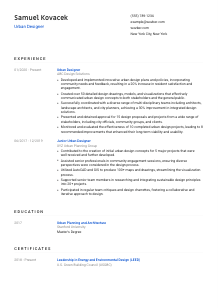
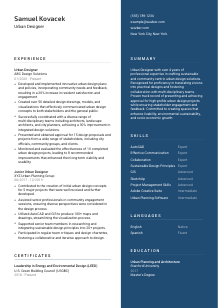
Shaping cityscapes, but your resume feels a bit suburban? Check out this Urban Designer resume example, created with Wozber free resume builder. Learn how to map your urban vision to job criteria, cementing your career at the heart of forward-thinking landscapes!
Urban design hiring usually turns on a practical question fast: can this person move from site analysis and concept development to drawings, stakeholder presentations, and built outcomes that actually work for the community? A resume for this field needs to make that process visible. Show how you shape places, work across disciplines, and translate planning ideas into plans, models, and recommendations that hold up in real civic and client settings.
When the resume is tailored well, the reader can quickly place you within the right part of the urban design pipeline, whether that is master planning, visualization, public-realm design, or post-implementation review. Wozber's free resume builder helps you build an ATS-compliant resume that reflects the language of the posting without flattening your experience, so your software strengths, sustainable design work, and collaboration with planners, architects, and community stakeholders come through clearly.
This section is brief, but for an Urban Designer it still carries practical information. Hiring teams need to know who you are, how to reach you, and whether your location or online portfolio setup creates any friction for interviews, project meetings, or relocation discussions.
Use your full name as the most visible text on the page. Keep the formatting simple and polished, the way you would present a title block on a drawing set. Avoid nicknames or decorative styling that distracts from the rest of the resume.
Place "Urban Designer" directly under your name if that is the role you are targeting. This immediately aligns your resume with the opening and helps separate your profile from adjacent candidates in planning, architecture, or landscape architecture who may have overlapping experience.
Include a current phone number and a professional email address. Check them carefully. If a hiring manager wants to discuss a portfolio review, stakeholder-facing project, or software-heavy assignment, they should not have to work around a typo in your contact line.
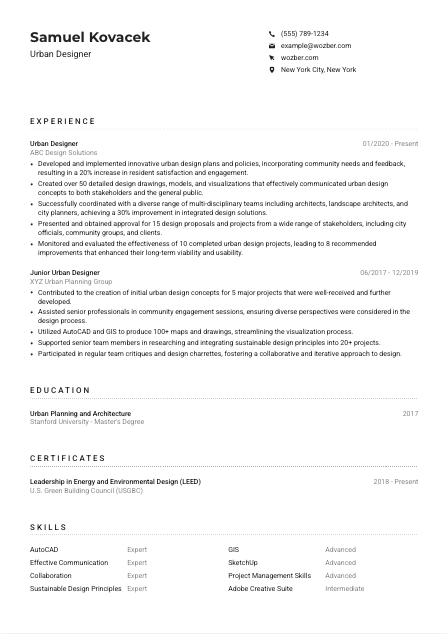
If a role specifies a city requirement or relocation expectation, include your city and state. In this example, listing "New York City, New York" directly answers a stated requirement. For other applications, use the location details that accurately support your availability.
If you have a LinkedIn profile, portfolio site, or project page with plans, renderings, public-space concepts, or urban design competition work, include it here. Make sure the projects, dates, and titles match your resume so the employer sees one consistent professional record.
Personal details do not need extra personality. They need to remove friction, confirm the basic logistics of your candidacy, and point the reader toward the urban design work behind the application.




This is the section where employers look for the real shape of your work. Urban design resumes stand out when they show project scale, collaboration across disciplines, public-facing communication, and the outcomes of design decisions, not just a list of duties.
Read the job description for the operating priorities behind the title. Here, the recurring themes are urban design plans, community feedback, visualization, multi-disciplinary coordination, stakeholder presentations, and post-implementation evaluation. Those themes should guide which projects and bullets move to the top, and they also give you the right language for ATS optimization.
Start with your most recent position and include job title, employer, and dates. For urban design work, clarity matters because hiring teams often want to see progression from junior production support into design ownership, public presentation, and broader master planning responsibility.
Focus each bullet on what you designed, coordinated, presented, or evaluated. Good urban design bullets mention deliverables such as plans, models, design drawings, visualizations, policy input, community engagement work, or implementation recommendations. The sample resume does this well by tying design plans and stakeholder work to concrete results rather than stopping at general participation.
Quantify output and impact where the numbers are meaningful. Counts of drawings, proposals approved, projects reviewed, resident satisfaction changes, or improvements identified after implementation all give hiring teams a better read on your scope. Metrics like "50 detailed design drawings" or "15 approved proposals" feel credible because they reflect how urban design work is actually delivered and reviewed.
Keep the section centered on urban design work that supports the role you want next. If an older bullet does not say anything about site planning, sustainable design, visualization, stakeholder communication, or coordination with planners and architects, either rewrite it or remove it. The goal is a project history that reads as increasingly relevant, not just increasingly long.
A well-built experience section should leave no doubt about your contribution to the design process. The reader should be able to see the plans you shaped, the teams you worked with, and the project decisions you helped move from concept to approval or improvement.
Urban Designer roles usually ask for formal training because the work sits at the intersection of planning, architecture, spatial analysis, and public-realm design. Your education section should confirm that foundation quickly and without clutter.
When a role asks for a Bachelor's or Master's degree in Urban Planning, Architecture, or a related field, make sure that qualification is easy to find. If you have both, list them in order of highest degree first so the academic level is visible right away.
Include the degree, field of study, school, and graduation year. This gives the reader the information they need without forcing them to decode abbreviations or hunt for dates. In urban design hiring, that straightforward structure helps your academic background support the rest of the resume instead of interrupting it.
If your degree combines urban planning, architecture, urban design, or a related built-environment discipline, name that field clearly. The example resume does this effectively with "Urban Planning and Architecture," which maps directly to the educational expectation in the posting.
Early-career candidates can benefit from listing advanced studios, GIS analysis, sustainable design coursework, transportation planning, public space design, or thesis work tied to urban form and community development. If you already have several years of strong professional experience, keep this selective.
Honors, design awards, studio recognitions, research projects, or thesis work can add useful context if they connect to urban systems, sustainability, neighborhood design, or civic space. Choose items that reinforce how you think and work as a designer, not every campus achievement.
Your education section should confirm that you have the training expected for urban design work and, when relevant, show a stronger focus in planning, architecture, or sustainable urban development.
Certifications are rarely the main deciding factor in urban design hiring, but they can strengthen your profile when they show technical depth, sustainability knowledge, or continued development in the built environment.
Some roles require licensure or specific credentials, while others simply value related qualifications. This posting does not require a certification, so the right move is to include credentials that support the work, especially in areas such as sustainable design or project delivery.
Choose certifications that reinforce the kind of projects you want to work on. LEED is a strong example because it supports the posting's emphasis on sustainable design principles and practical sustainability experience. Use that logic for other applications as well.
List the certificate name, the issuing body, and the relevant date or active period. That helps the reader understand both the credibility and current relevance of the credential without needing a separate explanation.
Urban design keeps evolving through climate resilience, public-space strategy, zoning shifts, mobility planning, and digital visualization workflows. Adding recent certifications or training can show that your methods are current, especially if your day-to-day work touches sustainable systems or interdisciplinary planning.
A certificate should add something specific to your candidacy. For Urban Designers, the most useful ones usually support sustainability, technical practice, or the broader planning and design context of the role.
Urban design hiring often looks for a combination of design software, planning knowledge, communication ability, and coordination across teams. A useful skills section makes that mix easy to scan without turning into a generic keyword dump.
Look beyond the obvious tool names. This role asks for AutoCAD, GIS, SketchUp, and Adobe Creative Suite, but it also calls for sustainable design knowledge, communication, collaboration, and project management. Your skills section should reflect both the production side and the public-facing side of the job.
Prioritize the capabilities that directly support the work described in the posting. For this example, software used for drawings, mapping, modeling, and visualization belongs near the top, alongside sustainable design and stakeholder communication. That gives the hiring team a faster read on whether you can step into the workflow.
Group technical tools, design knowledge, and collaboration skills in a way that reads naturally. The sample resume works because it balances software such as AutoCAD and GIS with practical strengths like collaboration and project management. If you use proficiency levels, be realistic. Inflated ratings are easy to spot in interviews when project files, visualization workflows, or community presentation experience come up.
Your skills list should quickly confirm that you can handle the technical tools, sustainability thinking, and cross-functional coordination expected in urban design work.
Urban Designers often work in settings where ideas need to travel between drawings, public meetings, consultant teams, and client reviews. Language skills matter when they support clear communication with stakeholders and communities, especially in diverse urban contexts.
If the role requires clear English communication, list English and your proficiency level directly. That requirement matters because urban design work often involves presenting proposals, discussing revisions, and responding to feedback from city officials, clients, and community groups.
Order languages by relevance to the role. In this case, placing English at the top immediately addresses the employer's stated need and supports the presentation-heavy nature of the position.
Additional languages can be genuinely useful in urban design, especially when projects involve multilingual neighborhoods, public consultation, or international teams. The sample resume includes Spanish, which can be an asset in community engagement contexts, though it is a bonus here rather than a stated requirement.
Describe your level with standard terms such as Native, Fluent, Intermediate, or Basic. These labels set expectations accurately and help interviewers judge when a language might support public meetings, written communication, or informal stakeholder interaction.
List languages that you can actually use in professional settings. For Urban Designers, that usually means explaining concepts, listening to feedback, navigating meetings, and building trust across groups, not simply having classroom familiarity with a language.
For this field, language skills matter most when they help you present ideas clearly, work across communities, and contribute confidently in collaborative planning and design environments.
The summary sits at the top of the resume, so it needs to tell the reader quickly what kind of Urban Designer you are. A useful version highlights your years of experience, design focus, and the kinds of teams, tools, or project settings where you have delivered results.
Before writing the summary, identify the few themes that define the opening. Here, those themes include urban design and master planning experience, visualization tools, sustainable design, and communication with varied stakeholders. Build the summary around that combination rather than trying to cover your entire career.
Start with a direct line that states your title and level, such as your years of experience in urban design, master planning, or related built-environment work. The sample resume does this well by establishing an Urban Designer profile with more than 4 years of relevant experience.
Choose strengths that connect to actual hiring priorities, such as community-centered planning, sustainable design practice, advanced visualization, or cross-disciplinary coordination. This is the right place to mention the kind of outcomes you are known for, like securing approvals, producing compelling design packages, or improving project usability after implementation.
Aim for a short paragraph of 3 to 5 lines. Urban design summaries work best when they sound grounded in real project work, not inflated. A concise statement about your planning experience, toolset, and stakeholder-facing capability gives the reader enough to continue into the project evidence below.
Your summary should position you as a designer who can think at the urban scale and communicate through drawings, analysis, and collaboration. Once that top section is clear, the rest of the resume can prove it with projects, tools, and results.
An Urban Designer resume works when it makes your planning judgment, visualization skills, sustainability thinking, and stakeholder communication easy to recognize in a few seconds. Use the example as a reference point, then tailor your own content to the actual scope of the role you are targeting.
Wozber's free resume builder gives you a practical way to shape that content into an ATS-friendly resume template, while the ATS resume scanner helps you align your language with the posting and spot missing requirements before you apply. The finished resume should make one thing clear right away: you can contribute to urban design projects from concept through communication and evaluation.