



Use Wozber and land your dream job
Create Resume
No registration required
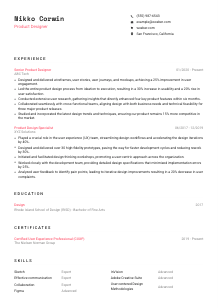
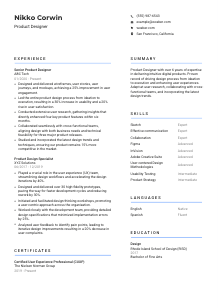
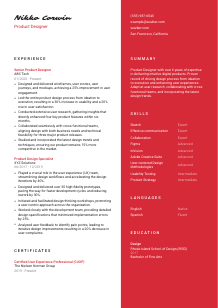
Molding innovative product concepts, but your resume doesn't fit the prototype? Sculpt your qualifications into shape with this Product Designer resume example, created with Wozber free resume builder. Learn how to align your design details with job specifications, bridging the gap between creativity and career growth!
Product design work gets judged in the details. Hiring teams look for people who can turn messy product problems into clear flows, thoughtful interface decisions, and user experiences that hold up in real product constraints. Your resume needs to show that you can move from research and ideation into wireframes, prototypes, handoff, and measurable product outcomes, not just that you have an eye for design.
When product design resumes are tailored well, reviewers can quickly tell whether your work matches the product stage, collaboration model, and UX depth they need. Wozber's free resume builder helps you shape that story into an ATS-compliant resume by aligning your language with the posting without flattening the substance of your work. That makes it easier for a hiring team to see how you design, what you improved, and where you can contribute fastest.
This section is short, but it still sets a professional standard. For Product Designers, clean basics matter because the role depends on clarity, structure, and thoughtful presentation. Your contact details should be easy to scan, accurate, and aligned with practical requirements such as location and portfolio access.
Use your full name prominently and keep the styling simple. Product design hiring teams care far more about clarity and hierarchy than decorative formatting, so choose a clean presentation that feels deliberate and easy to read.
Place "Product Designer" directly under your name when that is the role you are targeting. This helps recruiters and ATS systems connect your resume to the opening quickly, especially when the posting is distinguishing product design from adjacent paths such as UX design, UI design, or visual design.
Include a phone number and professional email address you actively monitor. Small errors here create unnecessary friction, and for a role that depends on careful execution, even basic details should feel dependable and polished.
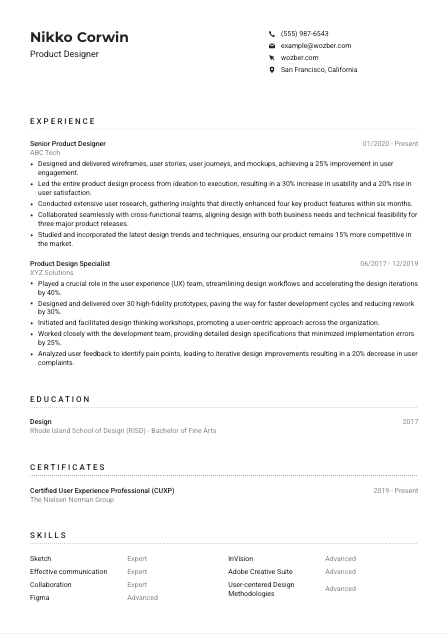
If the employer requires candidates to be based in a specific city or state, reflect that clearly in this section. In the example, listing San Francisco, California directly supports a stated location requirement and removes uncertainty early in the review process.
For Product Designers, a portfolio often carries as much weight as the resume itself because it shows process, interaction decisions, and shipped work. Include a working link to your portfolio, case study site, or professional website, and make sure it reflects the same level of quality, product thinking, and recent work described in your resume.
Your personal details should confirm that you are easy to contact, professionally presented, and ready for the practical realities of the role. For product design, that also means making your portfolio and any location requirement easy to confirm at a glance.




This is the section where hiring teams look for proof of how you design in practice. Product design experience should show more than screens produced. It should reveal how you approached user problems, worked with product and engineering partners, and improved adoption, usability, or workflow performance through design decisions.
Start by pulling out the actual deliverables and responsibilities in the posting, then make sure your bullets reflect comparable work. If the role asks for wireframes, user stories, user journeys, mockups, user research, and cross-functional collaboration, your experience should use those terms where they honestly match your background. The example does this well by naming wireframes, user journeys, and user research directly rather than hiding them behind vague design language.
List your positions in reverse chronological order and focus on the work most relevant to product design. Under each role, show the product context, who you worked with, and what part of the design lifecycle you owned, whether that was discovery, prototyping, usability testing, design systems, or developer handoff. This gives a clearer picture than a generic list of responsibilities.
Strong product design bullets connect design decisions to outcomes. Use metrics tied to engagement, task success, usability, satisfaction, iteration speed, reduced rework, or release quality. In the sample resume, improvements such as a 25% increase in user engagement and a 30% rise in usability give the hiring team concrete evidence that the design work changed product performance.
Prioritize experience that strengthens your case for the specific opening. If an older role leaned heavily toward visual production, marketing design, or unrelated creative work, keep only the parts that show product thinking, UX process, research, prototyping, or collaboration with product and engineering. Relevance matters more than volume here.
ATS optimization works best when the posting's terminology matches real work you have done. Weave in terms such as "user research," "user-centered design," "wireframes," "mockups," and "cross-functional teams" inside accomplishment bullets instead of dropping them into a keyword list. Wozber can help surface missing role language and strengthen phrasing so your experience reads clearly to both the ATS and the design lead reviewing it.
Your experience section should show how you think through product problems, how you collaborate, and what changed because of your work. If a team can quickly connect your past projects to their product, users, and delivery model, this section is doing its job.
Education matters differently depending on career stage, but it still helps frame your grounding in design, interaction, and user-centered thinking. For Product Designers, this section should quickly confirm that you have relevant academic preparation without distracting from stronger proof in your portfolio and experience.
When a posting asks for a bachelor's degree in Design, Human-Computer Interaction, or a related field, list your degree in a straightforward way that makes the match easy to see. A Bachelor of Fine Arts in Design, like the example resume includes, clearly supports that requirement without any extra explanation.
List school, degree, field of study, and graduation year in a simple structure. Product design resumes benefit from the same clarity expected in interface work, so avoid overloading this section with unnecessary detail when the key qualification can be understood in seconds.
If you are earlier in your career, include relevant studio work, HCI coursework, capstone projects, or research that connects to UX methods, prototyping, interaction design, or accessibility. This can help bridge limited work history with concrete design practice.
Honors, scholarships, or leadership in design organizations are worth mentioning when they reinforce your trajectory in product design. For experienced candidates, keep these brief unless they are especially relevant to the role or the institution is particularly recognized in design circles.
Product design changes fast, especially in areas such as research methods, design systems, accessibility, and prototyping workflows. If you have completed additional training after graduation, mention it in the appropriate section because it shows that your practice has stayed current with the field.
Your education section should quickly establish relevant design training and then get out of the way. The main value is clarity: a reviewer should be able to confirm that your academic background supports the product design work shown elsewhere on the resume.
Certificates are most useful when they sharpen your story as a Product Designer. They can reinforce strengths in UX research, interaction design, accessibility, or design leadership, especially when the role values structured process and current methods.
Choose certifications that connect to product design work, not generic professional development. A credential in UX, usability, research, or service design is usually more helpful here than something broad and unrelated. The sample's Certified User Experience Professional works because it supports the posting's emphasis on user-centered design and research.
List the certificate name, issuing organization, and date earned or active period if relevant. That context helps the reader understand both the quality of the credential and whether it reflects current practice.
A short, relevant certificate section reads better than a long inventory of courses. Focus on the credentials that strengthen your position for the target role, especially those tied to UX methodology, product thinking, prototyping, or user research.
Employers often want Product Designers who keep pace with evolving tools, testing approaches, and interface standards. Recent certificates can help show that you are actively developing your craft and staying current with the discipline.
The right certificates support your resume by adding credible, job-relevant depth. Used selectively, they reinforce that your product design practice is current, intentional, and grounded in recognized methods.
The best Product Designer skills sections do not read like software inventories. They show the mix of design tools, UX methods, and collaboration abilities needed to move work from discovery to delivery. Keep the list close to how product teams actually operate.
Start with the tools and capabilities named in the job description, then match them against your actual experience. For this role, that includes software such as Sketch, Figma, InVision, or Adobe Creative Suite, along with user-centered design methods and communication skills. If you have them, place the most relevant ones near the top.
A Product Designer needs more than interface software proficiency. Include research, prototyping, usability testing, information architecture, or design systems where relevant, then pair those with collaboration, presentation, and stakeholder communication skills. The sample resume does this well by mixing Figma and Sketch with communication and collaboration rather than treating the role as purely visual execution.
Only include skills you can back up through projects, case studies, or interview discussion. A focused list is stronger than a crowded one, especially in product design where hiring teams often test how deeply you understand the methods and tools you claim to use.
This section should show that you can work inside a real product environment, not just produce polished screens. The right combination of tools, UX methods, and collaboration skills helps a hiring team picture how you will contribute on day one.
Language ability is not always a major selection factor for Product Designers, but it can matter when the role specifies communication requirements or when the product serves multilingual users and teams. Present language skills clearly and keep the focus on what is relevant to the job.
If the posting explicitly asks for strong English, list English first with an honest proficiency level. For a Product Designer, strong English matters because research synthesis, design rationale, workshop facilitation, and cross-functional communication often depend on it.
Additional languages can be useful when working across international teams, supporting localization, or designing for multilingual user groups. They are usually a secondary advantage, but they can add value when they connect to the product environment.
Terms such as "Native," "Fluent," "Professional," or "Intermediate" are easy to understand and help set accurate expectations. Avoid overstating your ability, especially if the role involves presenting work, running interviews, or collaborating across functions.
Only give this section more space if language skills truly affect the work. For many Product Designer roles, English proficiency and strong communication are enough, while additional languages remain a useful but optional differentiator.
If you are studying another language and it relates to the market, team, or users you want to work with, you can include it briefly. Keep the wording modest and practical rather than aspirational.
Your language section should clarify communication capability, especially when the role names English as a requirement. Anything beyond that should support how you collaborate, research, or design for the users the product serves.
Your summary sits at the top of the resume, so it needs to establish your product design profile fast. The best ones combine years of experience, core strengths, and a few role-relevant outcomes without slipping into generic creative language.
Open with your title, years of experience, and the kind of product design work you do best. That might include end-to-end product design, user-centered design, mobile experiences, SaaS workflows, or research-informed UX. The sample summary works because it quickly establishes both experience level and product focus.
Use the summary to echo the themes that matter most in the posting. Here, that means user-centered design, research, cross-functional collaboration, and driving work from ideation through execution. This helps the reader connect your background to the job before they reach the experience section.
Aim for a short paragraph with concrete language instead of broad claims about creativity or passion. Mention the kind of outcomes you influence, such as improved usability, stronger engagement, or smoother product flows, so the summary feels grounded in product work.
Use phrases from the job description where they fit naturally, such as "user research," "wireframes," "mockups," or "cross-functional teams." Wozber's AI resume builder can help you align this wording with the target role and improve ATS optimization while keeping the summary readable for human reviewers.
A good summary gives a design lead or recruiter a fast, accurate read on your product design background. By the time they move into your experience bullets, they should already know your level, your process strengths, and the kind of product impact your work tends to create.
A Product Designer resume should show structured thinking, strong execution, and a clear link between design work and product outcomes. When your sections line up with the posting, your case becomes easier to follow from the first line through the final bullet.
Use Wozber to build an ATS-friendly resume format, strengthen ATS optimization, and tailor your language to the role without losing the substance of your work. The result should make it easy to judge your product thinking, your collaboration style, and your ability to design experiences people can actually use.




