



Use Wozber and land your dream job
Create Resume
No registration required
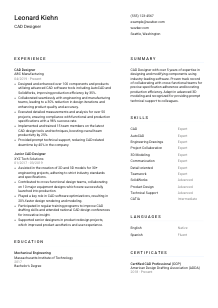
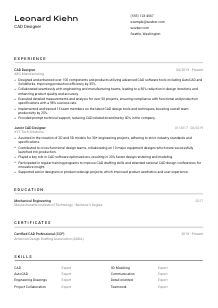
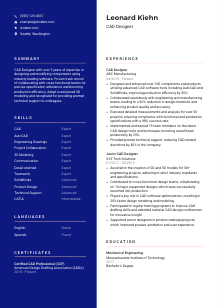
Crafting intricate models, but your resume looks flat? Check out this CAD Designer resume example, created with Wozber free resume builder. It shows how to blueprint your drafting skills to match job criteria, setting your career trajectory as visually stunning as the designs you create!
CAD Designer hiring usually turns on one practical question: can you translate engineering intent into accurate models and drawings that manufacturing, testing, and other teams can actually use. Resumes fall short when they stay at the level of
software familiarity
and never show what was designed, how complex the work was, or what improved because of it. Your resume needs to make design output, drafting accuracy, and cross-functional contribution easy to see.
A tailored resume changes how quickly that picture comes into focus. When your wording reflects the posting's CAD tools, drawing work, validation tasks, and collaboration needs, both reviewers and an ATS can sort you correctly against adjacent profiles like drafters, mechanical designers, or general engineers. Wozber's free resume builder helps you shape an ATS-compliant resume around the job description so your modeling experience, drawing standards, and production-facing work are read in the right context.
For CAD Designer roles, the top of the resume should establish professional identity fast and remove any avoidable friction. Hiring teams want to know who you are, how to reach you, and whether you meet any practical constraints before they spend time on your modeling history or drawing work.
Use your full name in the largest text on the page, then place the target title directly below it. If you are applying for a CAD Designer opening, say "CAD Designer" rather than a broad label like "Designer" or "Engineer." That simple match helps frame the rest of the resume around drafting, 3D modeling, assemblies, and engineering drawings instead of leaving your specialty open to interpretation.
List a reliable phone number and a professional email address you check often. Accuracy matters here more than people think. A CAD Designer is trusted with dimensions, revisions, tolerances, and documentation, so even small mistakes in contact details can undercut the precision your role depends on.
Some CAD roles are fully flexible, while others depend on proximity to engineering teams, labs, or manufacturing sites. In the example posting, the employer asks for someone located in Seattle, Washington, so stating "Seattle, Washington" in your header helps remove an immediate screening barrier. Use location as a tailoring move when it is relevant, not as filler.
If you have a portfolio, LinkedIn profile, or project site, include it only if it strengthens your application. For CAD Designers, a portfolio can be especially useful when it shows drawing packages, 3D models, product concepts, fixture designs, or documentation samples that align with the kind of work you want. Make sure the projects, tools, and dates match the claims on your resume.
Do not include age, marital status, gender, or other personal details unrelated to design work. Keep the section focused on professional information that supports the application and maintains attention on your CAD capability, communication, and availability.
This section should confirm your professional identity and any practical requirement, such as location, in a few seconds. Once that is clear, the hiring team can move straight to your design work and technical contribution.




Experience is where a CAD Designer proves the difference between knowing software and delivering production-ready design work. Hiring managers look for scope, tool use, drawing quality, revision control, and collaboration with engineering or manufacturing teams, not just a list of tasks.
Before editing bullets, mark the requirements that define the role. For CAD Designer jobs, that usually includes specific CAD platforms, 2D and 3D modeling, assemblies, engineering drawings, validation work, and coordination with engineering or manufacturing. Those are the themes your experience bullets should reflect, because they describe how the work is actually performed and reviewed.
List your most recent role first, then work backward. For each position, include your title, employer, and dates. This straightforward structure helps reviewers track your progression from junior drafting support to independent design ownership, software depth, or broader collaboration across product development and production teams.
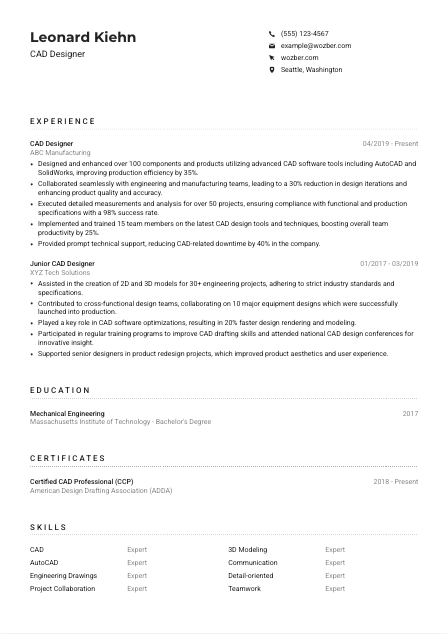
Focus each bullet on what you designed, modified, analyzed, or improved. Strong CAD bullets mention components, assemblies, drawings, redesigns, validation work, or released products, then connect that work to a result. The example resume does this well with a bullet about designing more than 100 components in AutoCAD and SolidWorks and linking that work to a 35% production efficiency gain.
Use numbers where they reflect real CAD performance. Good metrics for this field include component count, project volume, reduction in design iterations, faster rendering or modeling, compliance rate, fewer production issues, or improved team productivity. Metrics like a 30% reduction in design iterations or a 98% success rate on specification compliance tell a hiring team far more than vague claims about being effective.
Prioritize experience that proves you can handle the workflow the employer needs. If the job centers on engineering drawings, validation, and manufacturing collaboration, give those bullets more space than unrelated administrative work or general design duties. Relevance matters most when your background spans nearby roles such as drafting, product design, or junior engineering support.
A CAD Designer's experience section should read like a record of design execution, revision quality, and production value. When your bullets show what you built and what changed because of it, your resume becomes much easier to shortlist.
Education matters in CAD hiring because it points to your technical foundation. A degree in mechanical engineering, industrial design, or a related field helps explain your comfort with geometry, manufacturing constraints, materials, and the logic behind engineering drawings and assemblies.
If the posting asks for a bachelor's degree in Mechanical Engineering, Industrial Design, or a related field, make that qualification easy to find. In the provided example, a Bachelor's Degree in Mechanical Engineering directly supports the role, so it should appear clearly without extra wording around it.
Include the degree, school, field of study, and graduation year. That is usually enough for an experienced CAD Designer. Clean formatting works best here because the value comes from the qualification itself, not from decorative detail.
When your education closely connects to the job, let that alignment do some work for you. Mechanical Engineering, Industrial Design, manufacturing engineering, and similar fields support CAD roles because they relate directly to product geometry, tolerancing, materials, and design-for-production thinking.
If you have limited professional experience, include relevant courses, lab work, capstone projects, or design competitions that involved modeling, drafting, product development, or testing. Once you have several years of CAD experience, those details usually become secondary to your professional project history.
Academic honors, scholarships, or standout project work can strengthen this section if they reinforce your design credibility. A senior project involving assemblies, prototype validation, or manufacturing documentation is more useful than general campus activities because it points back to the work CAD Designers are hired to do.
Keep this section concise, but make sure it supports the role's academic requirement and your design background. When the degree aligns naturally with CAD work, it strengthens the logic of everything else on the page.
Certifications are not required for every CAD Designer position, but they can strengthen your resume when they show current software knowledge, drafting standards, or continued development in product design and technical documentation. They are especially useful when they reinforce tools or methods already used in your experience.
Choose certificates tied to drafting, modeling, design documentation, or the software used in the roles you target. A credential such as Certified CAD Professional can support your profile because it signals formal commitment to CAD practice beyond day-to-day job use.
Only include certifications that add something relevant to the role. A short list of software, design, or engineering-related credentials is more effective than a long list of unrelated training. The section should sharpen your technical profile, not dilute it.
Include issue or validity dates when that helps demonstrate current knowledge. In a field where software versions, workflows, and design standards change, dates can show that your training is recent enough to be credible and useful.
CAD work changes with new releases, modeling features, file-management practices, and industry expectations. Ongoing training in platforms such as AutoCAD, SolidWorks, or CATIA, as well as GD&T or manufacturing-oriented design courses, can make your resume more competitive for roles that expect quick ramp-up time.
A well-chosen certification section tells employers you are keeping your CAD practice current, whether that means software capability, drafting standards, or better support for engineering and manufacturing teams.
The skills section should mirror the actual toolkit of a CAD Designer. That means leading with software, modeling, drawing, and documentation capabilities, then supporting them with collaboration and communication skills that matter when design work moves between engineering, manufacturing, and other stakeholders.
Review the posting and note the tools, technical tasks, and collaboration requirements it names directly. In this example, AutoCAD, SolidWorks, CATIA, 2D and 3D models, assemblies, engineering drawings, communication, and cross-functional collaboration all belong in the skill mix if you genuinely have them.
Lead with the technical capabilities most central to the role, such as CAD software, 3D modeling, 2D drafting, assemblies, engineering drawings, product design, revision handling, or technical support. Soft skills still matter, but they should support the technical story rather than overshadow it.
Do not turn this section into an inventory of everything you have ever touched. Group and order skills so the reader can quickly spot the match between your toolkit and the posting. A concise list that includes the right platforms and design tasks will do more for ATS optimization and human review than a crowded list of generic strengths.
A hiring team should be able to glance at this section and immediately understand your CAD environment, modeling range, and collaboration readiness. Keep the emphasis on the tools and design tasks the role actually depends on.
Language skills are a supporting section for most CAD Designer resumes, but they matter when the role calls for clear written and verbal communication. Design reviews, drawing clarifications, manufacturing discussions, and technical support all depend on being understood precisely.
If the posting specifies English communication, list English clearly and indicate your level accurately. In the provided job description, effective oral and written English is required, so that should appear before any additional languages.
Additional languages can help when you work with global suppliers, distributed engineering teams, or multilingual production environments. If you include more than one, place the most professionally useful first rather than listing them at random.
Terms such as Native, Fluent, Intermediate, and Basic are easy to understand and sufficient for most resumes. Avoid inflating proficiency. In CAD and engineering contexts, accuracy matters because language skill affects documentation, feedback loops, and technical discussion quality.
Not every CAD Designer role needs multilingual ability, but some product and manufacturing environments do. If your work has involved overseas vendors, international teams, or cross-border product development, additional languages can support your collaboration profile.
When English is specifically mentioned in the posting, do not bury it. Whether your level is Native or Fluent, place it prominently so the employer does not need to infer whether you can handle documentation, meetings, and technical explanations in English.
For CAD work, language skills matter most when they support clear drawings, cleaner communication, and fewer handoff errors. Present them simply and let them reinforce your ability to work across teams.
Your summary should tell a hiring manager, in a few lines, what kind of CAD Designer you are and where your value shows up. Focus on software depth, design scope, cross-functional work, and measurable outcomes that relate to engineering drawings, modeling accuracy, or production efficiency.
Before writing the summary, isolate the core priorities in the posting. For CAD Designer roles, that often means CAD platform proficiency, 2D and 3D design work, engineering drawing accuracy, validation support, and collaboration with engineering or manufacturing. Those themes should guide what you lead with.
Start with your role and years of experience in a direct sentence. A line such as "CAD Designer with 5+ years of experience creating 2D and 3D models, assemblies, and production drawings" gives immediate context and places you in the right hiring lane.
Use the next lines to connect your tools and results to the employer's needs. The example summary works because it combines software-driven design work, collaboration with cross-functional teams, and a business result like improved production efficiency instead of listing generic traits.
Aim for 3 to 5 lines with enough detail to establish your profile without repeating the whole resume. Mention the software, design scope, and one or two outcomes that best match the target role. Avoid broad claims that could apply to any technical professional.
By the time someone finishes this section, they should already understand your CAD environment, your level of responsibility, and the kind of production or engineering impact you usually deliver. That makes the rest of the resume easier to trust.
A CAD Designer resume should show more than software familiarity. It should connect modeling, drawings, validation, and cross-team coordination to outcomes that matter in engineering and production.
Use Wozber's free resume builder and ATS resume scanner to align your wording, structure, and section detail with the target job, then review the final version for technical accuracy and clean prioritization. The result should be an ATS-friendly resume that makes your design capability and production readiness easy to judge.