



Use Wozber and land your dream job
Create Resume
No registration required
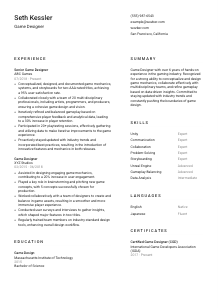
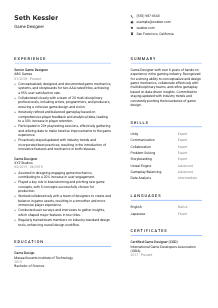
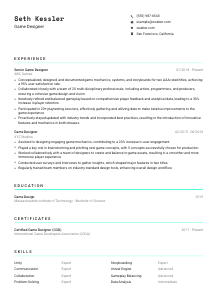
Crafting virtual worlds, but your resume feels like the wrong level? Level up with this Game Designer resume example, made with Wozber free resume builder. Learn how to present your design skills to match job questlines, ensuring your career ends with unbeatable high scores!
Game design resumes fall flat when they stay at the level of ideas. Studios need to see how you turn concepts into playable systems, document them clearly, and improve the experience through iteration. Your resume should make that progression visible, from mechanic design and narrative framing to balancing decisions shaped by playtests, analytics, and cross-functional production work.
A tailored Game Designer resume quickly separates design thinking from general game enthusiasm. When your wording reflects the studio's priorities, whether that is shipped-title experience, gameplay balancing, narrative systems, or engine familiarity, hiring teams can place you faster in the right lane. Wozber's free resume builder helps you organize that targeting in an ATS-friendly resume format, so the resume surfaces the design work, collaboration habits, and production context that matter first.
This section is simple, but it still affects whether your application moves forward. For game design roles, the header should immediately confirm who you are, what role you do, and whether you meet basic logistical requirements such as location and contact availability.
Use your full name in a clean, readable format so it stands apart from the rest of the page. Avoid decorative styling. Game studios review many portfolios and resumes in one pass, and a straightforward header keeps your application easy to track across ATS records, interview notes, and portfolio links.
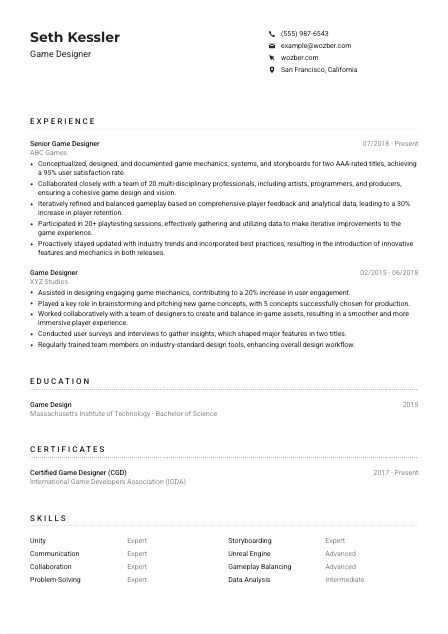
Place your professional title directly under your name and keep it aligned with the role you want. If you are applying for a Game Designer position, say "Game Designer" rather than a broad label like "Creative Professional." In the example resume, that direct title instantly lines up with the posting and removes ambiguity about your discipline.
Include a current phone number and a professional email address you check regularly. If you also have a personal website, portfolio, or LinkedIn page with documented projects, prototypes, design documents, or shipped titles, add it here. For a Game Designer, those links often provide the context a one-page resume cannot, especially around mechanics, systems, and collaboration scope.
Some game studios screen for location early, especially for hybrid or on-site design roles. In this example, San Francisco, California is part of the requirement, so listing it in the personal details helps clear that filter immediately. Treat this as targeted tailoring, not a rule for every Game Designer resume.
If you include a website, make sure it does more than display screenshots. A strong Game Designer portfolio can show level briefs, feature documentation, combat or economy tuning notes, prototypes, or case studies explaining design decisions and iteration cycles. That kind of material reinforces the resume and gives substance to claims about systems design and player-focused problem solving.
When your header confirms role, reachability, and any required location detail, reviewers can move straight to your design work instead of chasing missing basics.




Experience is where studios look for proof that you can contribute to production, not just brainstorm ideas. For Game Designers, that usually means showing how you designed mechanics, documented systems, worked across disciplines, and used playtesting or analytics to refine the player experience.
Start by identifying the recurring design demands in the posting. Here, the emphasis is on mechanics, systems, narratives, documentation, collaboration with artists and programmers, and iterative balancing based on feedback and data. Those are the themes your bullets should echo if they reflect your real work.
Lead with your most recent position and include title, studio name, and dates. That structure helps reviewers quickly map your design progression, whether you moved from implementing content to owning systems or from assisting on features to leading design on shipped titles. In game development, recent engine familiarity and production scope matter, so the timeline should be easy to scan.
Each bullet should show what you designed, how you worked, and what changed because of it. Good Game Designer bullets mention systems, loops, balance passes, narrative structures, feature documentation, or playtest-driven revisions. The sample line about designing mechanics and storyboards for two AAA-rated titles works because it ties creative ownership to a shipped-product context and a player satisfaction result.
Use numbers where they are meaningful to design work. Retention lift, engagement gains, satisfaction scores, playtest volume, feature adoption, concept approval rate, or team size can all help. In the example resume, a 30% increase in player retention and participation in 20+ playtesting sessions give concrete proof that design choices were tested and improved against real player response.
Keep the section focused on work that supports your target role. General gaming enthusiasm, unrelated jobs, or vague statements about creativity dilute the value of the page. If a side project belongs here, make sure it shows role-relevant work such as prototyping, balancing, narrative design, user testing, modding systems, or a released indie title.
Studios want to see more than imagination. Your experience section should make it easy to spot the systems you shaped, the teams you worked with, and the player or product outcomes that followed.
Education matters most when it confirms the training or technical grounding the role asks for. In game design hiring, that often means a degree in Game Design, Computer Science, interactive media, or a related field, especially when the posting states it directly.
Check the posting for the exact education baseline and reflect your qualification clearly. This example asks for a bachelor's degree in Game Design, Computer Science, or a related field, so a "Bachelor of Science in Game Design" directly supports the requirement. Use the formal degree wording so it is clear to both recruiters and ATS parsing.
List the institution, degree, field of study, and graduation year or date. Clear formatting helps this section scan quickly, especially when education is a firm filter rather than a discussion point. The example does this well by keeping the MIT degree concise and easy to verify.
If your concentration ties closely to gameplay systems, programming, narrative design, level design, or interactive storytelling, make that visible. For candidates earlier in their careers, the field of study can help explain why they are prepared to work with mechanics, documentation, and engine-based workflows.
You do not need to turn this section into a syllabus. Add coursework, capstones, or team projects only if they strengthen your case for the target role, such as a systems design thesis, a Unity prototype, AI behavior design, or a multiplayer balancing project. This is especially useful if your professional experience is still limited.
Academic distinctions can help if they show initiative or relevance, such as leading a game development club, winning a student game jam, or graduating with honors in a related discipline. Keep these details brief and selective so they support your design profile instead of crowding the section.
For an experienced Game Designer, education is usually a supporting section. Keep it clear, relevant, and aligned with the technical or creative base the studio asked for.
Certifications are rarely the deciding factor for Game Designer roles, but they can help when they reflect ongoing skill development, tool familiarity, or formal study in a specialty area. Include them when they add something useful to your profile, not just to fill space.
Start with the job description. This role does not require a certification, so any certificate you include should support your candidacy rather than try to compensate for missing experience. Relevant credentials can still help if they show commitment to game design methods, tools, or adjacent areas like UX, systems design, or technical implementation.
Choose certifications that connect directly to your work as a designer. A credential such as "Certified Game Designer" can reinforce your professional focus, while unrelated certificates usually add noise. One or two strong entries are more useful than a long list with little connection to mechanics, systems, narrative, or production workflows.
Include the year earned and, if relevant, whether the certification is still active. That helps reviewers understand whether the learning is recent, maintained, or tied to current practices. In fast-moving production environments, recency matters more than old coursework that no longer reflects today's tools or pipelines.
Game design changes quickly as player expectations, monetization models, live-service needs, engine capabilities, and analytics practices evolve. If you pursue more training, focus on areas that make your resume sharper for current roles, such as Unreal workflows, economy balancing, narrative systems, player research, or technical documentation.
A well-chosen certification can add useful context, especially when it strengthens your toolset or design specialization. It should support your experience, not compete with it.
The skills section should give a fast, accurate picture of how you work. For Game Designers, that usually means a mix of design tools, systems thinking, balancing, documentation, analytics awareness, and collaboration skills that matter in production.
Review the posting and note both explicit and implied capabilities. Here, that includes Unity or Unreal Engine, game mechanics and systems design, narrative work, collaboration, communication, and problem solving. Those repeated priorities should shape the section more than generic creative traits.
List a focused mix of hard and soft skills that reflect your actual work. Engines such as Unity and Unreal Engine belong here, along with gameplay balancing, storyboarding, systems design, data analysis, or prototyping. Pairing those with collaboration and communication makes sense for Game Designers because much of the job happens through iteration with artists, engineers, producers, and QA.
Do not turn this into a complete inventory of everything you have ever used. Prioritize the skills most relevant to the target role and place the strongest matches first. The example resume works because it stays close to the job's language, highlighting Unity, Unreal Engine, storyboarding, gameplay balancing, and the interpersonal skills needed for multidisciplinary production.
A focused skills list helps a studio quickly understand your tool fluency and design strengths. Keep every entry tied to work you can support elsewhere on the page or in your portfolio.
Language requirements are often practical in game development. Design work depends on clear written documentation, feature reviews, playtest reporting, and collaboration across disciplines, so language proficiency can matter more than it does in some other creative roles.
If the job posting specifies a language level, reflect it clearly. This example asks for advanced English, so English should appear first with an honest proficiency level such as Native or Fluent. That matters because Game Designers are expected to write design documents, explain changes, and discuss player feedback with precision.
Additional languages can be worth including when they have practical value, such as helping with international teams, localization collaboration, player research, or culturally specific narrative work. They are a bonus, not a substitute for the core design qualifications.
Stick to familiar labels like Native, Fluent, Intermediate, or Basic so there is no confusion. Avoid overstating ability. In design roles, inaccurate language claims become obvious quickly when discussion moves into documentation, feedback synthesis, or cross-team meetings.
Not every game design role will care equally about multiple languages, but some studios do, especially on global products or distributed teams. Include language skills when they add real context to how you can contribute, not simply to make the resume feel fuller.
For a Game Designer, language proficiency supports design docs, feedback loops, and team alignment. List it clearly when it strengthens how your work will land in production.
Your summary should quickly establish the kind of designer you are and the value you bring to a studio. The best ones connect years of experience with a recognizable design focus, such as systems, mechanics, narrative, live balancing, or player-driven iteration.
Before writing, identify what the studio seems to value most. In this posting, that is professional game design experience, at least one shipped title, mechanics and systems design, narrative thinking, and collaborative iteration. Build your summary around those ideas if they genuinely describe your background.
Your first sentence should establish your title and level. Mention your years of experience and, if relevant, the type of games or production environments you have worked in. The example summary does this well by leading with more than 6 years in the gaming industry, which immediately establishes seniority.
Choose strengths that match the job and point toward business or player outcomes. For a Game Designer, that might include designing mechanics that improve retention, balancing systems through player data, documenting features for production teams, or shaping narratives that support engagement. Keep these claims specific enough to feel earned.
Aim for three to five lines. This section should frame the rest of the resume, not repeat it. If you are tailoring for a particular role, swap in the priorities that matter most, such as shipped-title experience, engine familiarity, or data-informed gameplay iteration.
A focused summary helps reviewers understand your design lane before they reach the details. It should make your experience, strengths, and production value clear within a few lines.
A Game Designer resume works when it connects creative thinking to production reality. Mechanics, systems, documentation, cross-functional teamwork, and iteration based on player feedback all need to show up in concrete, believable language.
Use Wozber's free resume builder to shape that experience into an ATS-compliant resume, then refine the wording with its ATS resume scanner and AI-powered tailoring features so the right tools, outcomes, and requirements stand out. The finished resume should make it easy for a studio to see where you can contribute from day one.




