



Use Wozber and land your dream job
Create Resume
No registration required
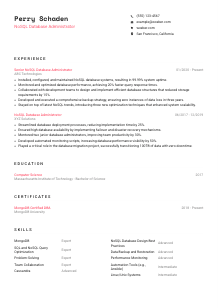
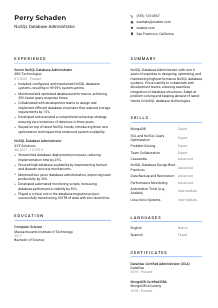
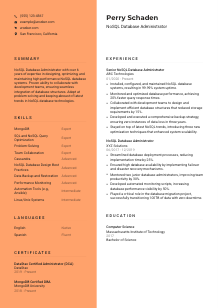
Mastering NoSQL, but your resume feels all over the place? Check out this NoSQL Database Administrator resume example, created with Wozber free resume builder. Learn how to organize your non-relational expertise to match job expectations, making your career as seamlessly scalable as the databases you manage!
NoSQL database administration is judged in production, not in theory. Teams need someone who can keep clusters stable, tune query performance, protect data through tested backup and recovery routines, and work closely with developers when schema decisions affect scalability or latency. Your resume should make that operational judgment easy by showing how you handled uptime, performance, resilience, and change.
When your resume is tailored well, a hiring team can quickly separate hands-on database administrators from broader infrastructure candidates or developers with light database exposure. Wozber's free resume builder helps you shape that experience into an ATS-compliant resume by aligning your wording with the posting while keeping tools, outcomes, and database responsibilities clear enough to show where you can own production NoSQL systems.
This section is short, but it still carries screening value. For a NoSQL Database Administrator, the basics need to confirm professional identity, make contact easy, and address practical requirements such as location without wasting space that belongs to technical depth elsewhere on the resume.
Use your full name as the most prominent text at the top of the page. Keep the styling clean and readable so the header feels like a technical professional's resume, not a design exercise.
Place the job title directly under your name and match the role you are pursuing. If the posting is for a "NoSQL Database Administrator," using that exact title helps frame the rest of your resume around database operations, performance tuning, availability, and platform ownership from the first line.
List a reliable phone number and a professional email address that looks current and business-ready. Hiring teams filling infrastructure and database roles often move quickly once they find someone with the right production experience, so your contact details should never create friction.
If the posting specifies a location, reflect it clearly in your header. In this example, listing San Francisco, California immediately addresses a stated requirement and avoids questions about relocation or work eligibility logistics before the team gets to your MongoDB or Cassandra experience.
Include a LinkedIn profile, GitHub, or professional site only if it strengthens your application. For this profession, useful links might show automation scripts, infrastructure projects, certification details, or a polished technical profile that supports the database administration work described on your resume.
Your personal details should confirm who you are, how to reach you, and whether any practical requirement is already covered. Then the resume can stay focused on database reliability, performance, and operational ownership.




This is the section hiring managers read most closely for database administration roles. They want to see what systems you supported, how you improved performance or availability, how you handled backups and recovery, and whether you worked effectively with engineering teams when data models or workloads changed.
Read the job description line by line and pull out the operational themes: installation, configuration, maintenance, performance monitoring, high availability, schema collaboration, backup and restore, and continuous optimization. Then rewrite your bullets so each major requirement appears through real work you have done, rather than generic platform support language.
List roles in reverse chronological order and make the scope of each one clear. For a NoSQL Database Administrator, that means showing whether you moved from day-to-day administration into larger responsibilities such as failover planning, migration work, automation, mentoring, or architecture input across production environments.
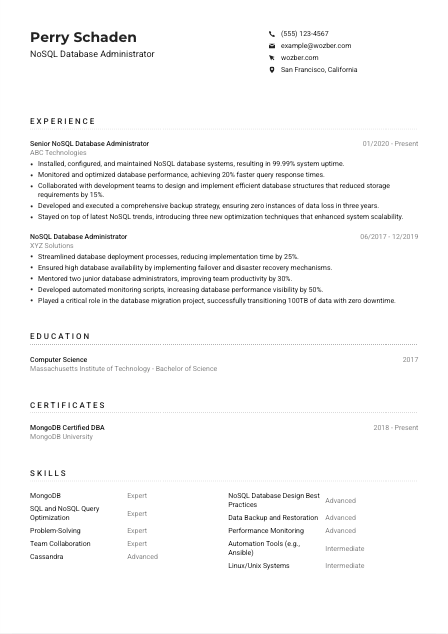
Your bullets should focus on measurable operational results. The sample resume does this well with outcomes like 99.99% uptime, 20% faster query response times, reduced storage requirements, and zero data loss over three years. Those are the kinds of performance and resilience metrics that tell a hiring team you understand live systems, not just database concepts.
Use numbers wherever they naturally reflect the work. Include uptime targets, response-time improvements, backup success rates, migration volume, storage savings, deployment time reductions, or reduced incident frequency. A bullet about migrating 100TB with zero downtime is far stronger than saying you "supported a database migration project."
Every bullet should reinforce your value as a database administrator. Prioritize query tuning, monitoring, replication, failover, backup validation, automation, Linux-based administration, and collaboration with developers on schema or workload changes. Leave out unrelated work that does not help explain how you keep NoSQL systems stable, fast, and recoverable.
By the end of this section, a reviewer should understand what environments you owned, what problems you solved, and what results you delivered in production. That is the clearest proof that you can step into another NoSQL administration role and contribute quickly.
Education matters most here as context for your technical base, especially in computer science, data systems, or related engineering fields. It will not outweigh strong production experience, but it should still reinforce that you have the underlying knowledge to work with distributed databases, query logic, and system behavior.
If you have a degree in Computer Science, Information Systems, Software Engineering, or a related field, make it easy to find. Even when a posting does not require a specific degree, that academic background supports the kind of systems thinking needed for database design, performance analysis, and operational troubleshooting.
List school, degree, field of study, and graduation year or date range. For experienced database administrators, that is usually enough. The section should add credibility without pulling attention away from your uptime, performance, and administration work in the Experience section.
If your degree directly connects to the role, name that connection through the field of study rather than extra explanation. In the example, a Bachelor of Science in Computer Science fits naturally because it supports the database, systems, and query work expected in NoSQL administration.
Relevant coursework or academic projects can help if you are earlier in your career or if a project directly supports the role, such as distributed systems, database design, storage engines, data modeling, or large-scale application performance. Once you have several years of hands-on DBA work, keep this brief.
Honors, research, or technical student work can stay if they reinforce analytical ability, systems knowledge, or leadership. Skip details that do not strengthen your profile as someone trusted with production data platforms and operational reliability.
Your education section should confirm a solid technical base and then get out of the way. In this field, the strongest case still comes from what you have run, tuned, protected, and improved in production.
Certifications are especially useful in database administration because they show platform-specific commitment. For MongoDB or Cassandra roles, the right credential can support your experience by confirming that your knowledge is current and tied to real administration practices.
When a posting mentions MongoDB or Cassandra certification as a plus, prioritize any credential tied to those platforms. That mirrors the employer's language and helps connect your resume to the exact database technologies named in the role.
List certifications that strengthen your case for NoSQL administration rather than every technical course you have completed. A MongoDB Certified DBA or DataStax Certified Administrator says more for this role than a long list of unrelated cloud or general IT badges.
Include dates so reviewers can place the certification in context. In fast-moving infrastructure and database environments, timing helps show whether your training is recent enough to support current operational practices, tooling, and platform versions.
Database administrators are expected to stay current on replication models, performance features, backup methods, automation practices, and new operational tooling. Adding fresh certifications over time shows that your knowledge evolves along with the platforms you support.
Relevant certifications work best when they support hands-on experience with the same technologies. For a NoSQL Database Administrator, they add useful weight around MongoDB, Cassandra, and the administration practices that keep data systems stable.
A skills section for this role should read like the toolkit behind your experience. Hiring teams are looking for platform knowledge, performance and query expertise, operational practices, and the collaboration skills needed to work with developers, SREs, and infrastructure teams.
Pull skills directly from the job description when they match your background. Here that includes MongoDB, Cassandra, NoSQL database design, SQL and NoSQL query optimization, performance monitoring, backup and restoration, and cross-functional collaboration. Matching the employer's wording helps with ATS optimization and makes your relevance obvious faster.
Lead with the technologies and capabilities most central to the role. Database engines, query tuning, replication, high availability, backup and recovery, Linux or Unix administration, and automation tools should appear before broader soft skills or lower-priority tools.
Choose skills you can defend through your experience bullets, certifications, or project work. A tighter list is stronger because it reads like your real operating toolkit. The sample resume handles this well by combining core platforms like MongoDB and Cassandra with job-relevant capabilities such as query optimization, performance monitoring, and data backup.
Your skills should reinforce the technical story already proven elsewhere on the page. If a hiring manager can connect each listed skill to actual database administration work, the section is doing its job.
Language ability matters in database administration when the role involves documentation, incident response, change coordination, and collaboration with developers or support teams. If the posting names a required language, include it clearly rather than assuming it will be inferred.
If the job asks for strong English, list English at the top with an honest proficiency level. For roles involving production support, runbooks, troubleshooting, and cross-functional communication, that requirement is practical, not decorative.
Lead with the language required for the role, then list any others that may support broader team communication. This keeps the section aligned with the posting instead of treating all language skills as equal.
Additional languages can still add value, especially in global engineering environments or companies with distributed teams. They are secondary to your database expertise, but they can support collaboration across regions or documentation contexts.
Stick to straightforward terms such as Native, Fluent, Professional, Conversational, or Basic. Precise labels help hiring teams understand how comfortably you can handle meetings, incident updates, technical documentation, and day-to-day collaboration.
For most NoSQL Database Administrator positions, language skills support the application rather than drive it. Give the required language proper visibility, then keep the emphasis on the technical work that defines your candidacy.
This section only needs to answer a practical question: can you work effectively in the language the team uses? Once that is clear, the resume should return to database operations, performance, and reliability.
Your summary should read like a concise operating profile. In a few lines, it needs to establish your years of experience, core NoSQL platforms, strongest administration capabilities, and the kind of results you deliver in live environments.
Before writing, identify the requirements that appear most central to the role. For this posting, that means hands-on NoSQL administration, platform depth in MongoDB or Cassandra, query optimization, performance monitoring, backup and recovery, and collaboration with development teams. Those themes should shape your wording.
Start with a direct introduction such as your title, years of experience, and area of focus. A line like "NoSQL Database Administrator with 6+ years of experience managing high-performance MongoDB and Cassandra environments" gives immediate context and positions you correctly.
Follow with the capabilities that matter most for the role, supported by concrete results or responsibilities. The example summary works because it mentions designing, optimizing, and maintaining high-performance NoSQL systems while also pointing to collaboration with development teams. You can make yours even stronger by hinting at results like uptime, query speed, recovery reliability, or scalability gains.
Aim for a short paragraph that a hiring manager can scan in seconds. Avoid broad claims like "results-driven professional" and use space for real substance instead: database platforms, operational strengths, and the kind of production outcomes you are known for delivering.
A strong summary gives immediate context for the rest of the resume. By the time someone moves into your experience section, they should already know your database focus, your level of responsibility, and the operational results you are built to deliver.
A NoSQL Database Administrator resume needs to show more than tool familiarity. It should make your production judgment visible through uptime, performance tuning, backup discipline, schema collaboration, and the platforms you can support with confidence.
Use Wozber's free resume builder to organize that experience into an ATS-friendly resume format, then refine it with the ATS resume scanner so the wording matches the target role without losing technical accuracy. The finished resume should make it easy to see that you can keep critical NoSQL systems fast, available, and recoverable.




