



Use Wozber and land your dream job
Create Resume
No registration required
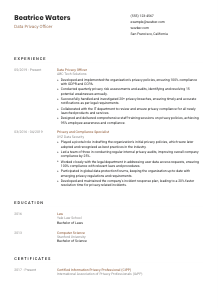
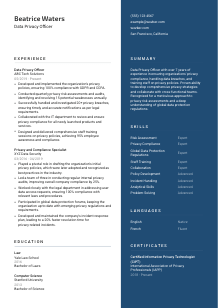
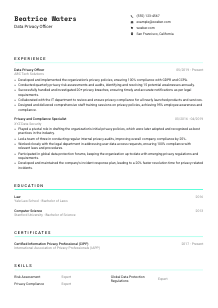
Safeguarding secrets, but your resume is feeling exposed? Check out this Data Privacy Officer resume example, built with Wozber free resume builder. Learn how to present your privacy expertise in line with job protocols, crafting a career no data breach can unravel!
Data Privacy Officer resumes are reviewed through the lens of risk, judgment, and regulatory depth. Hiring teams want to see who has actually written privacy policies, run audits, handled incidents, and advised product or business stakeholders before launch, not just who knows the vocabulary of compliance. Your resume should make that operational ownership easy to see.
When the resume is tailored well, reviewers can quickly distinguish broad compliance experience from hands-on privacy leadership in areas like GDPR, CCPA, incident response, and privacy review workflows. Wozber's free resume builder helps shape that experience into an ATS-compliant resume with language that matches the posting, so your record reads clearly as Data Privacy Officer material from the first scan.
For a Data Privacy Officer, the header should be clean, credible, and aligned with the practical filters attached to the job. This section does not need personality. It needs accuracy, professional labeling, and any location detail the employer has made relevant.
Use your full name in the largest text on the page so it is easy to find in both ATS parsing and human review. Keep the styling simple. In a privacy-focused role, a restrained, professional presentation sets the right tone immediately.
Place "Data Privacy Officer" under your name when that is the role you are applying for. This instantly ties your profile to the position and helps frame the rest of the resume around privacy governance, regulatory compliance, and risk management rather than broader legal or security work.
Recruiters need a reliable way to reach you, and that is all this part should do.
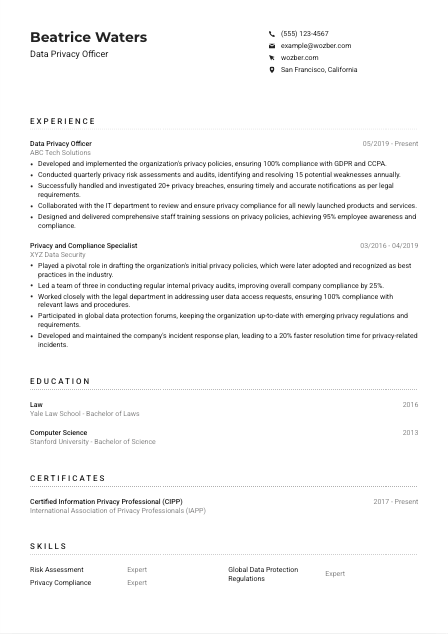
If a role has a stated location requirement, include your city and state in the header. In the example, "San Francisco, California" supports a posted requirement and removes an early logistical question. If location is not a factor in another application, keep this detail proportional to the posting.
A LinkedIn profile or professional website can strengthen your application if it reflects the same privacy work shown on the resume. Make sure titles, dates, certifications, and major achievements match, especially if you discuss audits, breach handling, or policy leadership in both places.
Your personal details should confirm that you are easy to contact and already aligned with the role's practical requirements. Then the rest of the resume can stay focused on privacy governance, incident handling, and compliance leadership.




This is the section hiring teams study most closely for a Data Privacy Officer. They want to see whether you have led privacy programs, managed regulatory risk, worked across departments, and responded effectively when incidents or audits put the organization under pressure.
Start by identifying the responsibilities carrying the most weight in the job description. For this role, that includes building privacy policies, conducting risk assessments, investigating breaches, reviewing products and services for compliance, and training staff. Your experience bullets should mirror that work with your own scope, tools, and outcomes.
List roles in reverse chronological order and include your title, employer, and dates for each position. For privacy leadership jobs, progression matters. A move from specialist or compliance roles into formal ownership of privacy policy, audits, and response programs tells a clear story of growing responsibility.
Focus each bullet on what you changed, improved, or protected. Good examples in this field include implementing policies, closing audit gaps, improving breach response time, or guiding compliant product launches. The sample resume does this well with bullets such as achieving 100% compliance with GDPR and CCPA and investigating more than 20 privacy breaches with proper notification handling.
Numbers matter when they reflect the way privacy programs are measured. That can include audit cadence, number of weaknesses identified, incident volume, resolution time, training completion, or compliance rates. "Conducted quarterly privacy risk assessments and resolved 15 weaknesses annually" is much stronger than a generic claim about improving compliance.
Every bullet should reinforce your suitability for a role centered on data protection law, risk mitigation, governance, and cross-functional guidance. General administrative tasks or unrelated legal work dilute the message unless they directly support privacy operations, regulatory interpretation, or stakeholder management.
A well-built experience section should make it easy to picture you running a privacy program, not just participating in one. If your bullets show policy ownership, audit discipline, incident judgment, and business collaboration, you are speaking the language of this role.
Education helps establish the foundation behind your privacy judgment. For this role, degrees that connect to legal interpretation, information systems, or technical understanding are especially useful because the work often sits between regulation, operations, and product decisions.
If you have a bachelor's degree in Law, Computer Science, Information Systems, or a related field, make that easy to spot. The posting here names those areas directly, so matching them in your education section reinforces that you meet the baseline requirement.
List degree, field of study, school, and graduation year in a format that is easy to scan. Privacy hiring rarely rewards creativity in this section. Clear structure keeps the focus on the relevance of your academic background.
When you hold more than one degree, order and framing can help explain your profile. In the example, Law and Computer Science together support both regulatory interpretation and technical fluency, which is especially useful in privacy roles that involve product reviews, data flows, and breach investigations.
If you are earlier in your career or your degree title is broad, selected coursework can help. Topics like data protection law, cybersecurity, information governance, databases, or risk management may strengthen the section. For a senior candidate with substantial privacy experience, this is usually optional rather than necessary.
Honors, research, publications, or major projects belong here only if they reinforce your privacy profile. A thesis on digital rights, a capstone on information security governance, or leadership in a law and technology society can add value. Generic campus activity usually does not move a Data Privacy Officer application forward.
Your education section should confirm that you have the academic grounding to interpret regulation, understand systems, and work credibly with legal, security, and product teams. Let it support the story your experience already tells.
Privacy certifications matter because they show current, specialized commitment in a field shaped by changing regulation, enforcement trends, and operational standards. When a posting mentions CIPP, CIPM, or CIPT, those credentials deserve clear placement.
If you hold CIPP, CIPM, CIPT, or a closely related credential, list it prominently. The job description here explicitly prefers those certifications, so surfacing them early helps confirm specialist knowledge in governance, program management, or privacy technology.
Do not overload this section with unrelated certificates. Prioritize certifications that support privacy law, compliance operations, information governance, or incident handling. A short, relevant list is stronger than a long mixed one.
Privacy standards evolve, and employers notice whether a certification is active or recently maintained. Include earned and renewal dates where appropriate. In the sample, current IAPP credentials reinforce that the candidate stays engaged with modern privacy practice.
Ongoing certification work can strengthen your profile over time, especially if your target roles span global privacy programs. As laws, enforcement priorities, and privacy engineering expectations develop, updated credentials help show that your knowledge has kept pace with the field.
Relevant privacy certifications can move your resume from qualified to clearly focused. They tell employers that your expertise is formalized, current, and tied to the regulatory realities of the role.
A Data Privacy Officer skills section should read like a snapshot of how you operate, not a pile of generic strengths. The most useful entries point to privacy program work, legal and operational judgment, and the ability to work across business, product, security, and legal teams.
Start with the capabilities named or implied in the posting. For this one, privacy compliance, risk assessment, global data protection regulations, incident handling, policy development, analytical problem-solving, and staff training all belong in scope. This kind of alignment improves ATS optimization and keeps the section grounded in the real demands of the job.
List the skills most central to the job before broader supporting strengths. For a Data Privacy Officer, technical or legal privacy capabilities should come before softer terms like collaboration. The example gets this balance right by giving prominent space to risk assessment, privacy compliance, and global regulations.
Choose skills you can support elsewhere in the resume through achievements, certifications, or scope of work. A compact list of relevant abilities is more persuasive than an inflated catalogue. If you mention incident handling, policy development, or staff training here, make sure your experience section proves those capabilities in practice.
This section should quickly confirm the kind of privacy leader you are, whether your strength is regulatory interpretation, audit execution, breach response, or cross-functional guidance. Keep it tight, relevant, and supported by the rest of the resume.
Language ability matters in privacy work when the role involves negotiation, policy communication, training, or cross-border coordination. Treat this section as a professional capability, especially when the employer names a required language directly.
If the posting specifies English or another language, list it at the top with an honest proficiency level. Here, the ability to negotiate effectively in English is a stated requirement, so that detail should be immediately visible.
Lead with the language most important to the role, then add others that may support cross-jurisdiction work. For privacy positions dealing with global regulations, vendor discussions, or international teams, the order of languages can subtly reinforce where you can operate effectively.
Extra languages are useful when they support international privacy reviews, policy rollouts, employee training, or coordination across regions. They are not mandatory for every Data Privacy Officer position, but they can strengthen a profile when the organization works across multiple markets.
Choose simple levels such as Native, Fluent, Intermediate, or Basic and avoid vague descriptions. Privacy roles often involve sensitive communication around obligations, risk, and incidents, so overstating language ability can create real issues later.
If the organization operates across several jurisdictions, multilingual ability may support work with global stakeholders and differing regulatory expectations. When the role is more localized, keep the section brief and accurate rather than trying to imply international scope that the job does not require.
For privacy work, language proficiency is most useful when it supports negotiation, policy communication, and cross-border coordination. Present it plainly so employers can judge where you can operate effectively.
The summary should quickly establish the level of privacy work you have handled and the type of environment you can support. For a Data Privacy Officer, that usually means showing command of regulation, risk assessment, incident response, and cross-functional influence in just a few lines.
Before writing, decide which part of the Data Privacy Officer profile the job emphasizes most. Some roles lean toward governance and policy, others toward operational risk, breach response, or product review. Your summary should reflect that emphasis rather than trying to cover every aspect of privacy in one paragraph.
Start with your title or closest equivalent plus years of relevant experience. For example, "Data Privacy Officer with 7+ years of experience" immediately establishes seniority and focus, especially when followed by a short description of the environments or regulatory scope you have handled.
Choose two or three details that connect directly to the employer's priorities. For this role, that could include leading GDPR and CCPA compliance, running privacy risk assessments, handling breach investigations, or training staff. The sample summary works because it stays close to those responsibilities instead of drifting into generic compliance language.
Aim for a short paragraph that reads quickly and sets up the rest of the resume. Three to five lines is usually enough. Use concrete phrases, avoid buzzwords, and make sure every sentence adds something useful about your privacy scope, regulatory knowledge, or operating impact.
A focused summary helps the reviewer place you quickly, whether as a privacy program builder, a regulatory specialist, or a leader in incident and risk management. Once that frame is clear, the rest of the resume has a stronger job to do.
A Data Privacy Officer resume should leave no doubt about your ability to manage regulatory obligations, assess risk, guide stakeholders, and respond decisively when privacy issues surface. If those strengths are visible in your experience, certifications, skills, and summary, the document is doing its job.
Use Wozber's free resume builder to tighten structure, tailor language with ATS optimization in mind, and present your background in an ATS-friendly resume format that keeps privacy leadership easy to recognize. The final result should make one thing clear fast: you can be trusted with the organization's privacy program.




