



Use Wozber and land your dream job
Create Resume
No registration required
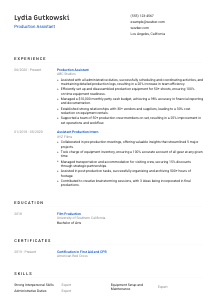
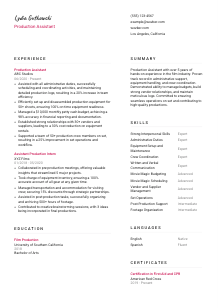
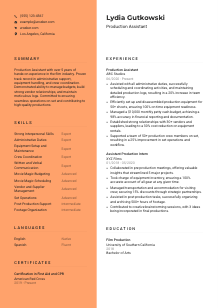
Behind the scenes, but it feels like your resume is off-camera? Check out this Production Assistant resume example, created with Wozber free resume builder. Learn how to sync your production prowess with job specifications, so your career journey takes center stage!
Production Assistant work is built on reliability under pressure. Hiring teams want to see that you can keep a shoot moving, track the details that others miss, and support crew, equipment, vendors, and paperwork without slowing down production. Your resume should make that day-to-day usefulness visible right away.
Resume tailoring changes how quickly that value comes through. When your wording reflects the posting's language around scheduling, production logs, equipment support, petty cash, and post-production help, an employer can sort your background from adjacent roles like office assistant or general intern much faster. Wozber's free resume builder helps you shape that experience into an ATS-compliant resume that clearly shows you can contribute on set and behind the scenes.
Production moves fast, and your contact section needs to answer practical questions immediately. Can they reach you quickly, are you applying for the right role, and do you meet any location requirement tied to shoot logistics. Keep this section clean, accurate, and easy to scan.
Use your full name in a larger, readable font so it is easy to spot at the top of the page. In production hiring, simple professionalism goes further than style. Save the creativity for your portfolio or reel, and let your name anchor the resume clearly.
Place "Production Assistant" directly under your name if that is the job you are pursuing. This helps position your background immediately, especially if your prior titles include variations like Production Intern or Set PA. A direct headline keeps the resume aligned with the opening from the first line.
List a phone number you answer, a professional email address, and any relevant professional link. A missed digit or outdated email matters when production teams are trying to fill support roles quickly for upcoming shoots, meetings, or call times.
Some production jobs are tied to local availability because call times, vendor pickups, and on-set support leave little room for relocation delays. In the example, Los Angeles, California is worth stating plainly because the posting asks for it. Treat location this way when it is a stated requirement, not as a universal rule for every Production Assistant resume.
If you have a LinkedIn profile or website that supports your production background, include it only if it is current and useful. For this profession, that might mean project credits, student film work, coordination experience, or related production samples rather than a generic personal page.
This section should answer the practical basics in seconds. Clear contact details, a direct role title, and any stated location requirement make it easier for a production team to move you forward.




Production Assistant experience is strongest when it shows useful execution, not vague busyness. Employers want to see how you supported the crew, handled logistics, managed gear or vendors, and kept production running on schedule across prep, shoot days, and post.
Start by marking the responsibilities and tools the employer repeats. For this role, that includes scheduling, activity coordination, production logs, equipment setup and breakdown, petty cash, vendor support, and post-production organization. Those points should guide which bullets you keep, rewrite, or move higher in your experience section.
List positions in reverse chronological order, including job title, company, and dates. If you have related titles such as Production Intern, Office PA, or Assistant Coordinator, keep them if the work involved real production support. Hiring teams care less about title purity than whether you handled the workflow they need.
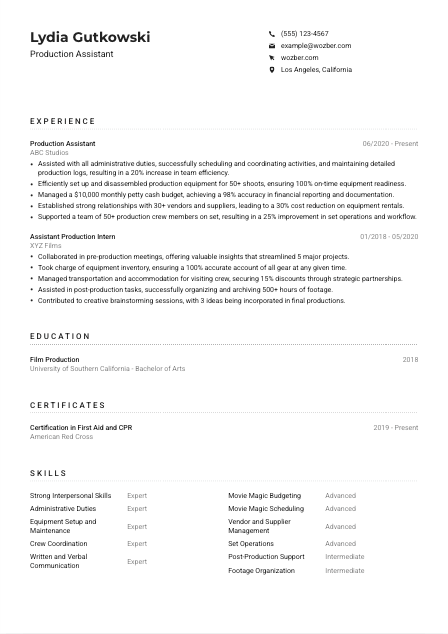
Each bullet should show what you handled and what improved because of it. The example does this well by tying scheduling and production logs to a 20% increase in team efficiency, and equipment setup to on-time readiness across 50+ shoots. That kind of phrasing shows operational value instead of just listing duties.
Quantify the scope where you can. Good metrics for this field include number of shoots supported, crew size, petty cash managed, vendor savings, footage hours organized, or reductions in delays and rental costs. The sample's $10,000 monthly petty cash budget and 30% equipment rental savings are strong because they reflect real production responsibilities.
Keep the focus on logistics, set support, equipment handling, coordination, documentation, and post-production assistance. If a bullet does not help show that you can support a working production environment, trim it or rewrite it. A leaner set of targeted achievements will read better than a long list of loosely related tasks.
Your experience should show that you can support a production from prep through wrap with dependable coordination, accurate admin work, and practical on-set help. That is the standard this role is hired on.
Education matters most here when it confirms a relevant foundation in production, communications, or adjacent media work. It is especially useful early in your career, when coursework, campus productions, and hands-on training can reinforce limited professional experience.
If you have a bachelor's degree in Film Production, Communications, or a related field, name it clearly. The posting asks for that background, so do not make the reader guess. The example's Bachelor of Arts in Film Production is a direct match and should be easy to spot.
List the school, degree, field of study, and graduation year or date range. This section should be fast to read. In production hiring, education supports your case, but it should not distract from the experience and skills that show how you work on real sets and projects.
A relevant major helps connect your training to the role, especially if you are applying against candidates with mixed administrative or media backgrounds. Film Production, Communications, Media Studies, or closely related programs can all work when the rest of the resume shows applicable set, coordination, or post-production work.
If you are earlier in your career, relevant coursework can help fill in technical context. Software training in Movie Magic Budgeting or Scheduling, production management classes, editing labs, or equipment workshops can strengthen the section when that experience is not yet covered elsewhere.
Awards, student film credits, festival selections, or production leadership roles can be worth adding if they show real responsibility. Choose items that connect to planning, crew support, equipment handling, or post workflows, not every campus accomplishment you collected along the way.
Use education to confirm relevant training and, if needed, to support early-career production experience. Keep the emphasis on preparation that connects directly to set operations, coordination, and production workflow.
Certifications carry weight when they map to the realities of production work. Safety training, software knowledge, and current credentials can help separate you from candidates whose experience looks similar on paper.
When a job description calls out a certificate, include it prominently if you have it. Here, First Aid and CPR are listed as a plus, which makes them worth featuring. On active sets, that credential adds practical value because it connects to crew safety and basic emergency readiness.
Choose certificates that strengthen your case for this kind of role. First Aid, CPR, set safety training, production software coursework, or related media operations credentials are more useful than generic learning badges that do not connect to shoot-day responsibilities.
Include the issuer and date earned, plus renewal details if the certification is active over time. The example's American Red Cross First Aid and CPR entry works because it shows both the credential and that it remains current. For safety-related certifications especially, dates matter.
Production careers often widen from set support into scheduling, coordination, budgeting, or post assistance. As your responsibilities grow, update this section with certifications that reflect that shift, especially if they strengthen software proficiency or production management capability.
A focused certificate section can reinforce safety awareness, technical preparedness, and current training. Keep it short, relevant, and tied to how you support production work in practice.
Production Assistant skills should read like tools you use in the real workflow, not broad personality claims. Balance software, logistics, equipment support, communication, and coordination so the section reflects the pace and practical demands of production.
Start with the language in the job description. Here, that includes interpersonal communication, written communication, production software, equipment handling, coordination, vendor support, and post-production help. Those should shape the core of your list because they reflect the job's working reality.
A Production Assistant role sits between admin support and hands-on set execution, so your skills section should show both. Movie Magic Budgeting and Scheduling fit well alongside production logs, petty cash handling, equipment setup, vendor coordination, crew support, and strong communication. The sample gets this balance right by covering software, set operations, and interpersonal strengths together.
Do not overload this section with every skill you have ever used. Prioritize the capabilities that connect directly to production schedules, shoot-day readiness, equipment availability, post organization, and smooth coordination across crew and suppliers. A concise list reads as more credible than an inflated one.
This section should quickly tell the reader that you can handle the logistics, tools, and communication load of a busy production environment. Relevance matters more than volume.
Language ability matters in production when it affects communication on set, with vendors, or across a diverse crew. Keep this section straightforward and honest, and prioritize any language the employer specifically requests.
If the posting asks for strong English communication, address that clearly. For this role, effective English communication is a stated requirement, so English should appear prominently and at an accurate proficiency level.
Use a plain proficiency label such as Native or Fluent. Since Production Assistants often handle coordination, notes, directions, logistics, and vendor communication, language claims should reflect what you can actually do in fast-moving professional settings.
Additional languages can be useful when working with diverse crews, talent, or clients. Spanish, for example, may be a practical asset in many production environments, but it should be presented as added value rather than a substitute for the required English communication ability.
Choose terms that match your real ability to speak, understand, read, and write. Overstating language skills can create problems quickly in production work, where instructions, call sheets, and fast responses need to be understood accurately.
If languages are not central to the role, a short list is enough. Include them when they strengthen your profile, but keep the main weight of the resume on scheduling, support work, equipment readiness, and coordination.
Show the required English proficiency clearly, then add any extra languages that genuinely support on-set communication or broader production work. Accuracy matters more than range.
Your summary should sound like someone who understands how production runs. In a few lines, show your level, your strongest areas of support, and the kind of results or scope that make your background worth a closer look.
Start by naming your role and amount of relevant experience. For this position, a line such as "Production Assistant with 5+ years of experience in film production" immediately places you in the right lane and reflects the employer's need for someone with practical background.
Mention the parts of the workflow where you add the most value, such as administrative coordination, production logs, equipment setup, vendor management, petty cash, or post-production support. Choose the areas that match the target job most closely rather than trying to summarize your entire career.
A short summary becomes stronger when it includes measurable proof. The sample summary could be sharpened further by hinting at outcomes already shown in the experience section, such as improved team efficiency, on-time equipment readiness, or vendor cost savings. Those details make the opening paragraph feel grounded in real production work.
Aim for a brief paragraph that reads quickly and mirrors the tone of the role you want. Wozber's AI resume builder can help refine the wording so your summary stays aligned with the posting's terminology while still sounding natural. The result should make it easy to see your usefulness on set and across production support tasks.
Your summary should position you as a dependable Production Assistant who can step into a working production environment and contribute quickly. Keep it specific, role-aligned, and supported by the experience that follows.
A Production Assistant resume works best when it shows practical support, dependable follow-through, and familiarity with how shoots actually run. If your sections clearly cover scheduling, logs, equipment, vendors, crew support, and post-production assistance, hiring teams can quickly see where you fit.
Use Wozber's free resume builder to organize that experience into an ATS-friendly resume format, then refine your wording with its ATS resume scanner and tailoring tools so the language matches the posting without sounding forced. The finished resume should make one thing easy to judge: you can help keep production on track from setup to wrap.




