



Use Wozber and land your dream job
Create Resume
No registration required
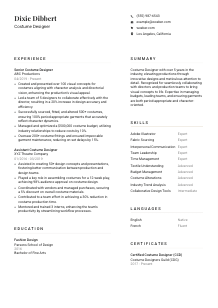
Dressing up sets, but your resume feels like it's still in its pajamas? Check out this Costume Designer resume example, created with Wozber free resume builder. Learn how to tailor your artfully curated portfolio to meet job expectations, ensuring your career in creativity is always dressed to impress!
Costume design sits at the intersection of storytelling, research, and production reality. Hiring teams look for designers who can translate character analysis and directorial vision into garments that work on stage or on camera, hold up through fittings and maintenance, and stay within budget. Your resume needs to make that full range visible, from concept development to sourcing, alterations, and collaboration across departments.
When that story is tailored to the posting, the reader can quickly connect your background to the production's needs instead of piecing it together from scattered credits. Wozber's free resume builder helps you shape an ATS-compliant resume around the language of the role, so skills like CAD work, textile knowledge, period styling, and fitting supervision are easy to track from the first scan to the interview shortlist.
In costume design, presentation matters, and that starts before the first portfolio link is opened. Your personal details should be clean, professional, and easy to scan so the hiring team can move straight to your production work, credits, and design experience.
Use your full name as the most prominent text on the page. Keep the styling polished and readable. Costume design is a creative field, but your header should still look production-ready rather than decorative.
Place the role title directly under your name and use the wording the employer uses when it matches your background. Here, "Costume Designer" is the right choice. It immediately frames your experience around design ownership rather than a broader wardrobe or styling profile.
Include a phone number and a professional email address that you actively monitor. If someone wants to discuss your fitting schedule experience, renderings, or availability for a production timeline, they should not have to work to reach you. Double-check every character before sending the resume.
Some productions hire locally because fittings, rehearsals, and last-minute adjustments move fast. When a posting specifies a location, reflect it in this section. In the example, listing Los Angeles, California directly answers the employer's local requirement without adding extra explanation.
If you have a portfolio site, personal website, or strong LinkedIn profile, include it here. For a Costume Designer, this link should support your resume with sketches, renderings, production stills, period research, or examples of fabric and silhouette work. Keep it updated so it reinforces the same level of professionalism as the resume.
This section does not need flair. It needs accuracy, professionalism, and the right production details so the team can move quickly from your name to the work you've done.




This section carries the most weight because costume design is judged through applied work. Hiring teams want to see what kinds of productions you supported, how you shaped visual concepts, how you handled fittings and sourcing, and whether you can manage the practical side of costume execution under real production deadlines.
Before writing bullets, identify the work the employer keeps returning to. For this role, the recurring themes are visual concepts, collaboration with the director and production team, sourcing and alterations, period accuracy, budget management, and fitting supervision. Those priorities should drive which achievements you choose and how you phrase them.
Start with your most recent production role and work backward. For each entry, include company name, title, and dates. That straightforward structure helps the reader follow the progression from support roles to design leadership, whether your background comes from theatre, film, television, or a mix of all three.
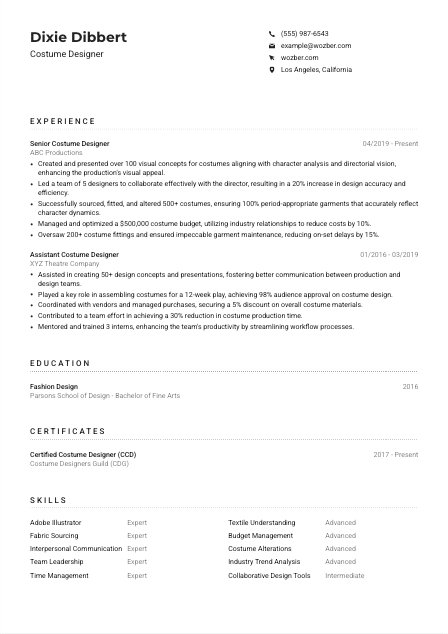
Strong Costume Designer bullets show what you designed, coordinated, or improved. The sample does this well with points like creating more than 100 visual concepts, sourcing and altering 500+ costumes, and supervising over 200 fittings. Those details tell the hiring team far more than generic statements about being creative or collaborative.
Metrics are especially effective when they reflect how costume departments operate. Include counts of concepts delivered, costumes built or altered, fittings managed, budget size, cost savings, production timelines, or reductions in on-set delays. A bullet about managing a $500,000 costume budget and cutting costs by 10% shows both design responsibility and operational control.
Every line should strengthen your case for the specific opening. Prioritize bullets tied to character interpretation, visual research, textiles, CAD-supported design work, fittings, maintenance, purchasing, and department collaboration. If an older role includes unrelated duties, trim them so the resume stays focused on costume design rather than general production support.
A hiring manager should be able to see how you move from concept to finished garment, and how you handle the budget, fittings, and production pressure that come with it. That is what turns experience into a credible Costume Designer application.
Formal training matters here because the work draws on design fundamentals, garment construction, textile knowledge, and historical reference. Your education section should show the foundation behind your creative decisions without taking attention away from your production experience.
If the posting asks for a bachelor's degree in Theatre, Fashion Design, or a related field, make sure that information is easy to find. The example's Bachelor of Fine Arts in Fashion Design aligns well because it directly supports costume sketching, garment development, and material knowledge.
List degree, field of study, school, and graduation year. Keep it clean and consistent. This section is usually scanned quickly, so clarity matters more than extra description unless a course or academic project is directly relevant to costume design work.
When your degree closely matches the role, do not bury that connection. Fashion Design, Theatre Design, Costume Design, and similar fields should be spelled out clearly because they reinforce your technical preparation in silhouette, construction, textiles, and period interpretation.
Earlier-career candidates can include specialized coursework, thesis work, or productions that show costume-specific training. Historical dress research, draping, rendering, patternmaking, or theatrical production design are useful examples. If you already have several years of production experience, keep this brief.
Honors, scholarships, design showcases, or leadership in theatre and fashion programs can add value when they connect to the role. Choose details that support your development as a costume professional, not every extracurricular item from school.
Your degree should reinforce the technical and artistic base behind your production credits. When it is presented clearly, it supports the rest of the resume without competing with your experience.
Certificates are usually a supporting section for Costume Designers, not the main driver of hiring decisions. They become useful when they reinforce professional standing, specialized training, or active engagement with industry standards and design practice.
Start with the job description. This one does not require a certification, so certificates should support your application rather than dominate it. Keep the section lean and relevant to costume design, garment work, or recognized industry associations.
Prioritize credentials tied to costume design, theatrical costuming, apparel construction, or professional guild recognition. A certificate such as "Certified Costume Designer" works because it relates directly to the field and adds credibility without distracting from production experience.
Add the organization and the date earned, or the active date range if the credential remains current. This helps the reader place the certificate in your career timeline and understand whether it reflects recent professional development.
If a credential requires renewal, make sure the date reflects that. You can also add newer training in digital design tools, textile specializations, or costume technology when those skills support the role you are targeting.
Relevant certifications can reinforce your credibility, especially when they connect to recognized costume design practice. They work best as a concise addition to a resume already grounded in production results.
A Costume Designer's skills section should read like a practical toolkit for production, not a loose collection of traits. The hiring team is looking for design tools, material knowledge, execution skills, and collaboration strengths that connect directly to how costumes are developed, fitted, purchased, altered, and maintained.
Start with the language used in the job ad. Here that includes CAD software such as Adobe Illustrator, textiles, period styles, collaboration, communication, sourcing, fitting, alterations, and budget work. Those are better anchors than vague terms like creativity or passion.
Lead with tools and abilities that affect day-to-day delivery. Adobe Illustrator, fabric sourcing, costume alterations, textile understanding, budget management, and team collaboration all map directly to the responsibilities in the posting. The example skill list does a good job of balancing design software, hands-on costume work, and leadership.
Do not overload this section with every design or production term you know. Choose the skills you can back up in your experience section. If you claim expertise in CAD, fittings, or period costume research, your bullets should show where and how you used those strengths in real productions.
The best skill lists feel confirmed by the rest of the resume. When your tools, textile knowledge, and production abilities line up with your achievements, the hiring team can picture you contributing from the first design meeting.
Language skills matter in costume design when they support communication with directors, performers, vendors, and production teams. This section should stay straightforward and reflect the level of fluency you can actually use in a professional setting.
If the posting names a required language, list it prominently. In this case, English proficiency is explicitly required, so it should appear first and with an accurate rating such as Native or Fluent, depending on your level.
Extra languages can be useful when productions involve international teams, multilingual casts, overseas sourcing, or work across different markets. They are a plus, but they should remain secondary to the main language requirement unless the role makes them central.
Choose clear levels such as Native, Fluent, Advanced, Intermediate, or Basic. Avoid overstating. In a production environment, language ability affects fittings, vendor communication, and rehearsal coordination, so accuracy matters.
You do not need to justify every language on the page. Simply list the ones you can use meaningfully. If a second language such as French supports past production work or broader collaboration, it is worth including.
While language skills rarely outweigh design experience, they can strengthen your profile when they improve collaboration across departments or with external suppliers. Include them when they add real value to the kind of productions you target.
For this section, precision beats range. A clear, honest language list tells the reader how you can communicate on set, in fittings, and across the broader production process.
The summary should give a fast, credible read on the kind of Costume Designer you are. In a few lines, show your level of experience, the environments you have worked in, and the practical strengths you bring to production, from concept development to fittings, sourcing, and budget control.
Read the posting first, then build the summary around the capabilities it emphasizes most. For this opening, that means design concepts, collaboration with the director and production team, period-appropriate costuming, textiles, and budget oversight. Your first lines should reflect that mix.
A clear first sentence helps the reader place you quickly. The sample summary begins with "Costume Designer with over 5 years in the industry," which works because it immediately establishes seniority. You can refine this further by naming your primary environment, such as theatre, film, or television, if that strengthens the match.
After the opening line, mention strengths that matter in this profession. Good examples include turning character analysis into visual concepts, managing costume budgets, leading fittings, working with textiles and period styles, or coordinating effectively with directors and production crews. Keep the claims close to what your experience section proves.
Aim for a short paragraph, not a biography. Three to five lines is usually enough. The summary should invite the reader into the rest of the resume by clarifying your production value quickly, not by repeating every achievement or using broad creative language.
A well-written summary tells the production team what kind of Costume Designer you are before they reach the first job entry. It should quickly connect your design strengths to the kind of work the role requires.
Once each section reflects the actual work of costume design, your resume becomes much easier to read as a production document rather than a generic creative profile. Hiring teams should be able to trace your strengths in concept development, period accuracy, sourcing, fittings, alterations, and budget management without guessing.
Wozber's free resume builder can help you shape that experience into an ATS-compliant resume with clear structure and role-matched language. If you want a faster tailoring pass, Wozber's AI resume builder and ATS resume scanner can help surface missing keywords, tighten phrasing, and strengthen alignment with the posting while keeping the final result grounded in your real production work.
That is the standard your resume should meet before it goes out.




