



Use Wozber and land your dream job
Create Resume
No registration required
Jazzing up stages, but your resume feels flat? Groove to this Dancer resume example, created with Wozber free resume builder. Learn to show your artistry and grace in sync with job criteria, pirouetting your career to front and center!
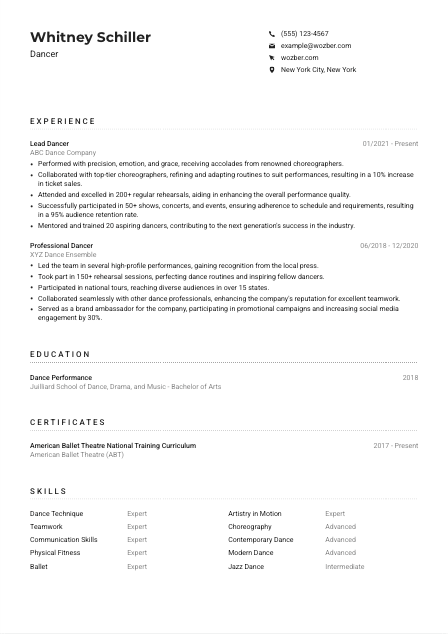
A dancer resume has to show more than stage presence. Hiring teams look for disciplined rehearsal habits, reliable live performance experience, technical range, and the ability to take direction while still delivering emotional clarity on stage. If those strengths are buried under vague artistic language, the resume misses what matters most in a professional company setting.
When the resume is tailored to the production, artistic directors and recruiters can quickly see whether your background matches the style, training standard, and ensemble demands of the role. Wozber's free resume builder helps you shape that experience into an ATS-compliant resume with language that reflects the posting, so your choreography work, rehearsal volume, certifications, and performance record are easier to evaluate.
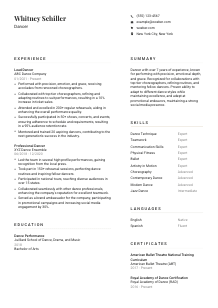
This section handles the practical checks before anyone gets to your credits. For dancers, that means clear identity, direct contact information, and any location detail that answers a stated company requirement without cluttering the top of the page.
Use your full name as the most prominent text on the page. In performing arts hiring, your name often becomes the label attached to reels, portfolios, audition notes, and callbacks, so keep it easy to read and consistent across every professional platform.
Place "Dancer" directly beneath your name, or use a more specific title when the opening calls for it, such as Ballet Dancer or Contemporary Dancer. For this position, matching the stated title keeps your resume immediately aligned with the company's search criteria.
Include a reliable phone number and a professional email address based on your name. If a company wants to confirm rehearsal availability, audition scheduling, or production dates, they should not have to work around outdated or overly casual contact details.
If a company requires candidates to be based in a specific city, state that clearly. Here, listing "New York City, New York" addresses the posting's location requirement right away and removes uncertainty about availability for rehearsals, training sessions, and scheduled performances.
Add a portfolio, personal website, or professional profile if it shows performance footage, production history, press mentions, or training background that supports your resume. For dancers, a digital portfolio is especially useful when it gives context on style range, stage presence, and featured roles rather than just listing social links.
Keep this section clean and practical. It should confirm that you are reachable, professionally presented, and available for the production realities the company has already outlined.




Experience is where a dancer resume proves professional consistency. Companies want to see where you performed, how often you worked, what kind of choreography you handled, and whether you contributed to rehearsal rooms and productions as a dependable ensemble member or featured performer.
Read the description closely and mark the phrases that reflect how the company works. In this opening, that includes professional company experience, precision in choreography, teamwork, collaboration with choreographers, live performances, and ongoing training. Those ideas should guide which credits and bullet points you emphasize first.
List your most recent company or ensemble work first, then move backward. Include your title, the company name, and dates. This structure helps reviewers quickly understand your current level, whether you have the required 5+ years of professional experience, and how recently you have been performing in a structured setting.
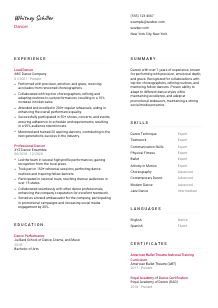
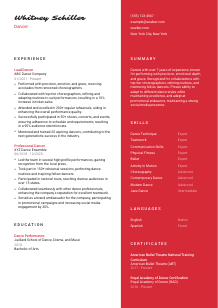
Your bullets should describe execution, collaboration, and performance scope. Strong dancer bullets mention learning and refining choreography, adapting routines with choreographers, performing in live productions, mentoring other dancers, or representing the company in public-facing work. The sample resume does this well by tying stage performance to collaboration and rehearsal discipline instead of relying on generic artistic claims.
Use metrics that make sense for dance: number of rehearsals attended, shows performed, tours completed, audiences reached, ticket sales influenced, or dancers coached. "Attended 200+ rehearsals" and "participated in 50+ shows" give concrete scale, while a result like increased ticket sales works when your contribution to the production is clearly connected.
Keep the focus on credits that support this kind of role. Community performances, unrelated jobs, or vague statements about passion do less for you than bullet points showing technical range, rehearsal stamina, stage reliability, and collaboration with choreographers and production teams. Every line should help the reader picture you inside a demanding rehearsal and performance schedule.
A strong experience section should leave no doubt that you can step into rehearsals, learn material quickly, perform consistently, and contribute to the artistic standard of the company.
Education matters in dance because it helps explain your technical foundation. Whether your background comes from a conservatory, university program, or serious pre-professional training, this section should support the level of discipline and style preparation your experience already suggests.
Start with the degree or formal dance education that best supports the role. If you trained in dance performance, ballet, contemporary, or a closely related discipline, place that first so the hiring team can connect your technique to your performance history.
List the institution, degree, field of study, and graduation year. A simple structure works best here because artistic staff want to identify training level quickly, not decode decorative formatting.
If your degree or program has a dance-specific focus, state it plainly. "Bachelor of Arts in Dance Performance," like in the sample, immediately shows formal preparation that fits a professional stage environment and complements years of company experience.
You do not need to turn this into a transcript. Add courses, intensives, or concentration details when they directly support the opening, such as pointe, partnering, improvisation, choreography, or injury-prevention training relevant to your target company's style.
Scholarships, performance honors, showcase selections, or leadership in student productions can help when they show competitive training, artistic recognition, or early professional responsibility. Keep them selective and tied to dance, performance, or ensemble work.
This section should confirm that your technique was built in a serious training environment and that your professional work rests on more than raw talent alone.
For dancers, certificates can carry real weight when they come from respected training bodies and connect directly to technique, pedagogy, or formal standards in a style. They are especially useful when a job posting names specific qualifications or signals that structured training matters.
When an employer mentions certifications outright, include those first if you have them. In this case, the American Ballet Theatre National Training Curriculum and Royal Academy of Dance qualifications are direct matches and should appear prominently.
Choose certifications that strengthen your technical credibility, not every workshop or short-term class you have attended. Recognized programs in ballet, teaching methodology, conditioning, or style-specific training usually add more value than a long list of miscellaneous seminars.
Dates help reviewers understand whether the training is recent, active, or part of an ongoing credential. That is particularly useful for certifications tied to continuing professional development or sustained affiliation with a recognized institution.
Dance companies value performers who keep refining technique, conditioning, and stylistic fluency. Updated certifications or continuing study can support that point, especially if your target work demands a high technical standard or frequent adaptation across genres.
A short, relevant certification section can quickly reinforce that your technique has been developed and validated through recognized dance training, not only through informal experience.
The skills section should read like a hiring shortcut to your working strengths. For dancers, that means balancing technical abilities, style proficiency, physical conditioning, and the collaboration skills that matter in rehearsals, cast changes, and live productions.
Pull both categories from the job description. Technical skills might include ballet, contemporary, modern, jazz, choreography retention, or performance technique. Professional skills often include teamwork, communication, adaptability, and rehearsal discipline. This role asks for both, so your list should reflect both.
Lead with the styles and capabilities that best match the company's needs. If the opening values variety of dance styles with deep strength in one genre, organize your list to show that balance. The sample resume does this by pairing broad technique with a clear specialization in ballet.
Do not overload the page with every skill you have touched once. Choose the abilities you can support elsewhere in the resume through performance credits, training, certifications, or measurable accomplishments. A shorter list with clear relevance is more persuasive than an inflated inventory.
When this section is done well, it gives a quick, accurate read on your technique, versatility, and rehearsal-room value before the hiring team gets deeper into your credits.
Language ability matters in dance when it affects instruction, collaboration, touring, teaching, or media work. Even when language is not central to the art itself, companies still need performers who can communicate clearly in rehearsals, promotional settings, and written correspondence.
If the posting specifies a language requirement, put it first. Here, strong English speaking and writing abilities are explicitly required, so English should appear prominently with an accurate proficiency level.
Other languages can strengthen your profile for touring companies, multicultural productions, outreach work, or media appearances. They are especially useful when they expand your usefulness beyond performance alone.
Use clear terms such as Native, Fluent, Intermediate, or Basic. Rehearsal communication, interview participation, and promotional activity all depend on real language ability, so this is not the place to overstate proficiency.
If you have worked with international choreographers, diverse audiences, or bilingual promotional campaigns, additional language skills can support that experience. In the sample, Spanish adds another layer to a profile that already includes live performance and brand-facing responsibilities.
Only include languages you would be comfortable using in a professional context. For a dancer, that may mean taking notes in rehearsal, speaking with press, assisting in outreach, or interacting with touring partners without hesitation.
Language skills are most valuable when they support the real working environment around the stage, from rehearsals and touring to interviews and audience engagement.
The summary should read like a concise professional introduction, not a dramatic statement. In a few lines, it needs to establish your level, your strongest performance qualities, and the parts of your background that best match the company's needs.
Before writing, identify the two or three ideas the company cares about most. For this opening, those are professional experience, technical range, precision in performance, collaboration, and formal training. Build your summary around that combination instead of trying to mention everything.
A direct line such as "Dancer with over 7 years of professional experience" works because it anchors the reader immediately. Follow that with your main strengths, such as live performance, choreography execution, or specialization in a style that matches the role.
Choose details that help distinguish you, such as work with choreographers, number of performances, mentoring, touring, or promotional representation. The sample summary is strongest where it connects artistic qualities like precision and emotional depth to real professional collaboration and adaptability.
Aim for a short paragraph that can be scanned quickly before the rest of the resume. Avoid generic claims about passion or creativity unless they are backed by concrete credits, training, or outcomes already shown elsewhere on the page.
Your summary should make it clear, within seconds, that you are an experienced dancer who can handle rehearsal demands, deliver on stage, and contribute to the company's artistic standard.
Once each section is aligned to the role, your resume should show a clear professional story: serious training, dependable rehearsal work, strong live performance credits, and the technical range the company actually asked for. That is what helps a dancer move from application to audition.
Wozber's free resume builder supports that process with ATS-friendly resume templates, ATS optimization, and AI-assisted tailoring that helps you match your wording to the posting without losing the reality of your stage experience. The final result should make your readiness for company work, choreography precision, and ensemble collaboration easy to judge.




