



Use Wozber and land your dream job
Create Resume
No registration required
Surfing circuit boards, but your resume crashes on entry? Plug into this Electronic Technician resume example, created with Wozber free resume builder. Learn how to seamlessly match your tech talents to job specs, keeping your career current and connected!
Electronic Technician resumes work best when they show how you keep equipment running, trace faults accurately, and work safely around real circuits and components. Hiring teams want to see practical bench-level capability, whether that means troubleshooting intermittent failures, reading schematics, soldering clean repairs, or supporting engineers during testing and evaluation.
A tailored resume changes how quickly that capability comes through. When your wording mirrors the job's equipment, maintenance work, and documentation needs, both recruiters and software can place you faster in the right lane instead of mistaking you for a broader maintenance or assembly candidate. Wozber's free resume builder helps organize that experience into an ATS-compliant resume that makes your troubleshooting depth, test-equipment fluency, and day-to-day repair work easy to recognize.
For an Electronic Technician, the header does one simple but important job: it confirms who you are, what role you do, and whether basic requirements are already covered. Keep it clean, accurate, and aligned with the position you want.
Use your name as the most visible text in the header so the hiring team can immediately connect it to the rest of your application. A straightforward font and clean layout are enough. This role does not call for design flourishes. It calls for clarity and precision, the same traits expected when documenting repairs or reading circuit diagrams.
Place "Electronic Technician" directly under your name if that is the role you are pursuing. This keeps your resume aligned with the posting and helps ATS systems categorize your background correctly. If your current title is slightly different, such as "Electronic Repair Technician" or "Senior Electronic Technician," you can still lead with the target title when your work has covered troubleshooting, maintenance, and equipment repair.
List a phone number and professional email address that you check regularly. Accuracy matters here. If a company needs someone for ongoing maintenance support, bench repair work, or urgent equipment coverage, they will move quickly with candidates they can reach without friction.
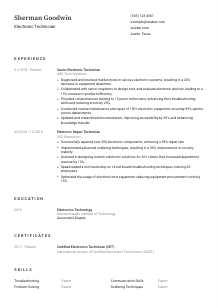
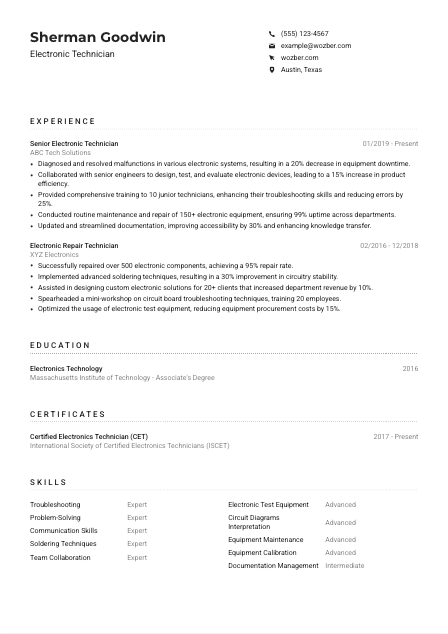
Some openings include a location requirement up front. Here, Austin, Texas is specifically requested, so listing Austin, Texas in your header immediately answers that filter. Use location this way when it removes a practical concern for the employer, not as filler.
Include LinkedIn or a personal site only if it reinforces your technical background. For Electronic Technicians, that might mean certifications, repair projects, test setups, board-level work, or documentation samples. Make sure those details match the resume so your professional story stays consistent.
Your header should confirm the essentials quickly: role, contact access, and any location requirement that affects eligibility. Once that is handled, the rest of the resume can focus on repairs completed, systems maintained, and results delivered.




This section carries the most weight for most Electronic Technician roles. Hiring managers want to know what kinds of equipment you maintained, how you approached diagnosis, what test tools you used, and whether your work improved uptime, repair quality, or team performance.
Read the job description closely and mark the repeated technical themes. For this role, the core work centers on routine maintenance, malfunction diagnosis, repair, collaboration with engineers, documentation, and support for junior technicians. Those themes should shape the bullets you choose and the wording you use.
List your most recent position first, then work backward. Include job title, employer, and dates so the reader can follow your progression from repair support into more independent troubleshooting, maintenance ownership, or senior technician responsibilities. A clear timeline also helps ATS parsing and gives context to your years of bench and field experience.
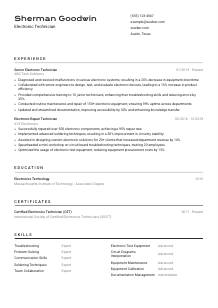
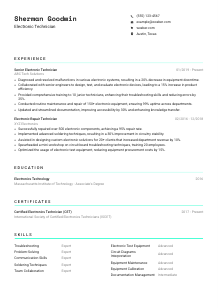
Write bullets around work performed and the result it produced. Instead of stopping at "repaired electronic systems," show what changed because of your work. The sample resume does this well with a bullet about diagnosing malfunctions and reducing equipment downtime by 20 percent. That gives the employer a concrete reason to trust the candidate's troubleshooting value.
Metrics are especially useful when they reflect how electronics work is measured in practice. Include repair rate, equipment volume, uptime, downtime reduction, error reduction, training reach, or process improvement. In the example, maintaining 150+ pieces of equipment at 99 percent uptime and repairing 500+ components at a 95 percent repair rate makes the scope immediately credible.
Prioritize bullets about fault isolation, test equipment, soldering, board or component repair, calibration, maintenance routines, documentation, and collaboration with engineering or production teams. General teamwork claims are less persuasive on their own. What matters is how you solved equipment problems, supported product reliability, or improved repair workflows.
A well-built experience section should make your technical range visible within seconds. If a hiring manager can quickly see the systems you handled, the results you delivered, and the level of troubleshooting you owned, the resume is doing its job.
Education often serves as a baseline check in technician hiring, especially when the posting asks for a specific credential. It does not need a lot of space, but it should clearly confirm that you have the academic grounding for electronics troubleshooting, repair, and system work.
Start with the qualification the employer actually requested. In this case, an Associate's degree in Electronics Technology or a related field is named directly, so that should appear clearly in your education section if you have it. When a job posting specifies a degree this plainly, do not bury it under unrelated education.
List degree, field of study, school, and graduation year in a clean structure. That keeps the section easy to read for both people and ATS systems. Technical resumes benefit from straightforward formatting throughout, and education is no exception.
If your degree is in Electronics Technology, say so exactly. If it is in a related field such as electrical engineering technology, instrumentation, or industrial electronics, use the formal title and let the relevance be clear. The example resume handles this directly with "Associate's Degree" in "Electronics Technology."
This is most useful for early-career candidates or anyone whose hands-on experience is still developing. Include projects involving circuit analysis, diagnostics, soldering labs, PCB work, digital systems, or electronic instrumentation if they support the kind of maintenance and troubleshooting work you are targeting.
Honors, competitions, capstone projects, or lab-intensive coursework can help if they reinforce electronics capability. For a candidate with several years of repair experience, keep these details brief. Experience will usually carry more weight than classroom distinctions at that stage.
This section should quickly confirm that your training supports the technical demands of the job. Once the required degree is easy to spot, the hiring team can move on to the repair history and troubleshooting depth that matter most.
Certifications are useful in technician hiring when they support the kind of work you actually do. They can reinforce your grounding in electronics, show current professional development, and add weight to specialties like repair standards, soldering, or equipment handling.
The posting does not require a certification, so treat this section as an advantage rather than a checklist. Choose credentials that support electronics troubleshooting, repair, testing, or maintenance. A certification such as Certified Electronics Technician can help because it maps naturally to the role's core responsibilities.
List certifications that connect to real technician tasks. Training in soldering, IPC standards, calibration, test equipment, or electronics diagnostics will carry more weight than broad credentials with little connection to circuit-level work. Relevance matters more than stacking names.
If a certification is active, renewable, or recently completed, show that. Dates help hiring teams understand whether your qualification is current, especially in roles where standards, equipment, and testing practices evolve over time. The sample resume does this by showing an active CET credential with its timeframe.
A current or recently renewed certification tells employers you are staying engaged with the trade. That is particularly useful if you are moving toward more advanced troubleshooting, mentoring junior technicians, or closer collaboration with engineers during testing and evaluation.
This section works best when each item supports your actual repair and maintenance profile. A short, relevant list says more than a long one that drifts away from electronics work.
The skills section should read like a compact map of how you work at the bench, in maintenance routines, and alongside engineers or other technicians. Keep it focused on the tools, technical abilities, and communication strengths that the role actually requires.
Start with the employer's language. Here, that includes troubleshooting, electronic test equipment, circuit diagrams, soldering techniques, problem-solving, and communication. Named tools such as multimeters, oscilloscopes, and signal generators deserve attention because they show day-to-day technical fluency, not vague interest in electronics.
Choose abilities you can back up in the experience section. For an Electronic Technician, that often means fault diagnosis, equipment maintenance, schematic reading, calibration, soldering, documentation, and repair workflow discipline. The sample resume connects these well by pairing skills like troubleshooting and equipment maintenance with measurable repair and uptime results.
Technical skills should lead, but soft skills still matter when the role includes training junior technicians, documenting procedures, or working with engineers during test and evaluation. Include communication and collaboration if they are truly part of your work, especially when you have examples of knowledge transfer, team support, or reduced error rates to support them.
A focused skills section helps the employer see your technical range fast. Wozber's free resume builder and ATS resume scanner can help match your language to the posting, but the strongest list is still the one grounded in the tools, systems, and repair work you have actually handled.
Language ability is usually a supporting section for Electronic Technicians, but it matters when the posting names communication expectations directly. Use it to confirm required fluency and, where relevant, show added versatility for training, documentation, or team coordination.
This posting explicitly asks for strong English communication, so English should be listed clearly with an honest proficiency level. That helps confirm you can handle repair documentation, explain technical issues, and communicate findings to engineers, supervisors, or junior team members.
Additional languages can strengthen your profile if the workplace serves diverse teams, suppliers, or customers. In the sample resume, Spanish is listed alongside English, which can be a practical plus in training or shop-floor communication. Treat extra languages as added range, not as a substitute for technical capability.
Terms like "Native," "Fluent," "Professional," or "Basic" are easy to understand and set accurate expectations. This is especially important when communication is part of the work, whether that means writing maintenance notes, walking a teammate through a repair, or reporting test findings.
If languages are not central to the job, do not overbuild this section. A concise list is enough. The primary value for most technician roles remains your troubleshooting history, equipment knowledge, and repair results.
If you have used another language to train colleagues, support multilingual teams, or communicate technical instructions more effectively, that can be worth highlighting elsewhere in the resume too. It becomes more meaningful when tied to actual work outcomes rather than listed in isolation.
For this kind of role, language details should quickly answer one question: can you communicate clearly in the environments where repairs, testing, and documentation happen. Once that is clear, the rest of the resume should return to your technical work.
The summary is where you set the direction of the resume in a few lines. For an Electronic Technician, it should quickly establish your years of experience, the kind of systems or equipment you support, and the technical strengths that make you useful from day one.
Before writing, identify the two or three themes the job emphasizes most. Here, those are troubleshooting and repair experience, proficiency with electronic test equipment, and the ability to support maintenance, documentation, and team collaboration. Your summary should reflect that mix instead of sounding like a generic technical profile.
Start directly with who you are professionally. The example summary opens with "Electronic Technician with over 6 years of hands-on experience," which immediately positions the candidate within the role. That kind of opener works well because it establishes both title alignment and practical depth.
Choose strengths that matter in technician hiring, such as fault diagnosis, circuit troubleshooting, soldering, maintenance of electronic equipment, or confident use of oscilloscopes and multimeters. If you mention an impact area, keep it grounded in technician outcomes like reduced downtime, stable repairs, or improved equipment reliability.
Aim for a short paragraph that can be read in seconds. Three to five lines is usually enough. Avoid broad claims about passion or hard work and use the space to show what you repair, how you work, and what results your technical skill tends to produce.
A strong summary should make the reader expect solid repair experience, clean troubleshooting logic, and relevant equipment knowledge before they even reach the first job entry. That opening frame matters because it shapes how the rest of the resume is read.
An Electronic Technician resume should make three things easy to see: the equipment you have worked on, the problems you know how to solve, and the results your repairs or maintenance produced. When those points come through clearly, the document feels credible to both hiring teams and ATS screening.
Use Wozber to build a targeted, ATS-friendly resume format, sharpen the language around test equipment and troubleshooting, and check alignment with the posting through ATS optimization tools. The finished resume should make one conclusion easy to reach: you can step into the role and handle the technical work with confidence.




