



Use Wozber and land your dream job
Create Resume
No registration required
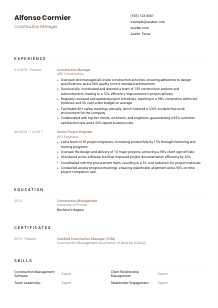
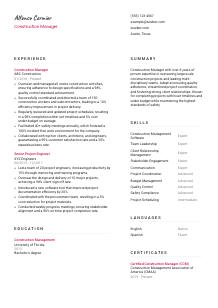
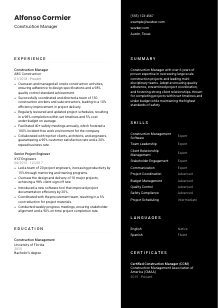
Directing builds, but your resume feels under construction? Hammer out your prospects with this Construction Manager resume example, created with Wozber free resume builder. Learn how to showcase your site management skills to match job blueprints, ensuring your career skyline always reaches new heights!
Construction managers are trusted with jobs that have little room for drift. Delays, rework, safety issues, and budget overruns all show up fast on a live site, so your resume needs to make one thing clear early: you have already run construction work with control over schedule, quality, crews, and field coordination.
Resume tailoring changes how quickly that control comes through. When your wording reflects the posting's language around onsite oversight, subcontractor coordination, scheduling, and safety, hiring teams can separate true construction management experience from adjacent project roles much faster. Wozber's free resume builder helps you shape an ATS-compliant resume around those priorities, so the document reads clearly for both screening systems and the people judging whether you can keep a project moving.
Construction hiring moves quickly when a candidate is easy to contact, clearly based where the project needs them, and immediately identifiable as the right kind of field leader. Your personal details section should handle those basics cleanly so the rest of the resume can focus on project delivery, site supervision, and stakeholder coordination.
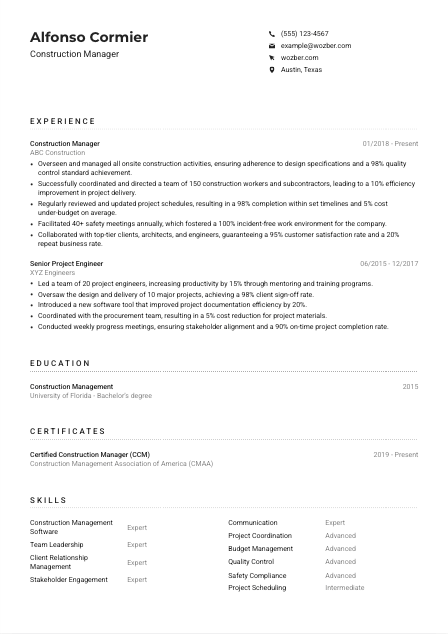
Use your full name as the most visible line on the page. Keep it slightly larger than the rest of the text so it anchors the resume immediately. In construction hiring, especially for roles tied to active projects and tight timelines, no one should have to hunt for who the resume belongs to.
Place the role title directly under your name and keep it aligned with the position you want. If you are applying for a Construction Manager opening, say "Construction Manager" rather than a broader alternative like "Project Professional" or an older title that undersells your current scope. That quick alignment matters when employers are sorting candidates across superintendent, project engineer, and project manager tracks.
List a phone number you actually answer and an email address that looks business-ready. Construction managers often move between the office, meetings, and the site, so accuracy matters here. If a recruiter wants to schedule a call about project pipeline, team size, or start availability, your contact information should not slow that down.
If the employer names a location requirement, include your city and state clearly. Here, Austin, Texas is worth showing because it addresses a stated condition of the role and removes immediate questions about relocation or local availability. Use location as a tailoring detail when it is relevant, not as filler.
Include a LinkedIn profile, project portfolio, or professional site when it adds useful detail such as project scale, sector experience, or certifications. For a Construction Manager, that might mean a profile with commercial builds, site photos, or a fuller work history with budgets and timelines. If the link is outdated or thin, leave it off.
This section does not need flair. It needs clean identification, reliable contact information, and any location detail the employer has asked for. Once that is in place, the hiring team can focus on the part that matters most for construction management: how you run projects in the field.




Construction management resumes are often decided in the experience section. Hiring teams want proof that you have directed field activity, kept schedules current, worked with subcontractors, maintained safety standards, and delivered against budget and design requirements. Your bullets should read like project outcomes, not a generic list of duties.
Read the posting the way you would review a set of construction documents before kickoff. Mark the responsibilities that define the role's day-to-day pressure points, such as onsite oversight, quality control, subcontractor coordination, schedule updates, safety meetings, and collaboration with clients, architects, and engineers. Then use those same priorities to choose which achievements deserve space on your resume.
List your positions in reverse chronological order so employers see your current project level first. For construction management, recent experience carries extra weight because methods, software, safety practices, and delivery models evolve quickly. Include the company, title, and dates clearly so the reader can track your progression from engineering, coordination, or supervision roles into full project leadership.
The strongest bullets show what changed because you were in charge. Instead of saying you managed crews or reviewed schedules, show the scale and result: team size, on-time delivery rate, cost performance, quality metrics, safety record, or client satisfaction. The sample resume does this well with details like leading 150 workers and subcontractors, hitting 98% on-time completion, and averaging projects 5% under budget.
Not every past task belongs here. Focus on experience that shows control over field execution, coordination across trades, schedule management, quality standards, procurement input, safety practices, and stakeholder communication. If you have older experience in design support or engineering, keep the bullets that clearly connect to project delivery and team leadership rather than technical tasks with no management relevance.
Construction resumes improve when the wording sounds like real project work. Mention superintendent coordination, subcontractor direction, schedule reviews, safety meetings, inspections, budget tracking, RFIs, change management, client updates, or design-specification compliance where those are part of your background. In the example, references to safety meetings, quality control standards, and work with architects and engineers help show field leadership rather than vague oversight.
A good experience section leaves little doubt about your level. Team size, schedule performance, budget control, safety outcomes, and coordination across trades all help hiring managers picture you running the next job. That is the standard this section should meet.
Education matters in construction management because it gives employers a quick check on your technical base. Degrees in construction management, civil engineering, or related fields signal familiarity with project delivery, estimating, scheduling, building systems, and construction methods. Present that background clearly without overloading the section.
Start by matching your education to the requirement as directly as you can. If you hold a bachelor's degree in Construction Management, Civil Engineering, or a closely related field, show that clearly. In this case, a Bachelor's degree in Construction Management lines up neatly with the posting and should be easy to spot.
List the degree, school, field of study, and graduation year or date. Construction hiring managers are usually scanning for a fast qualification check, not reading a narrative. Clear formatting lets them confirm your academic background quickly and move on to your project record.
If your program included a concentration or emphasis tied to project controls, structural systems, civil works, or construction operations, include it when it strengthens the fit. This is especially useful if your degree title is broad and you need to make the construction connection more obvious.
Most experienced construction managers do not need a long course list. Add selected coursework only if it helps explain a relevant background, such as scheduling, cost estimating, construction law, safety management, or materials and methods. Early-career candidates can use this space more heavily than professionals with several years of project history.
If you have completed later training in project scheduling tools, safety standards, contract administration, or delivery methods, include the most relevant items either here or in certificates, depending on how your resume is structured. That ongoing education reinforces that your knowledge has stayed current as the field has changed.
For this role, education is usually a qualification checkpoint, not the main selling point. Make the degree easy to confirm, add detail only where it sharpens your construction background, and let the experience section carry the heavier proof of project leadership.
Certifications can strengthen a Construction Manager resume when they reflect recognized standards in project delivery, safety, or professional practice. They are especially useful when they show commitment to staying current on construction processes, compliance expectations, and management discipline across active jobsites.
Some construction postings require a license or credential. Others do not, but still value professional certifications that support trust in your judgment and process control. When a posting does not list one, relevant credentials can still help by showing commitment to the craft, as a Certified Construction Manager designation does here.
Prioritize credentials tied to construction leadership, safety, scheduling, quality, or contract administration. A shorter list of relevant certifications is stronger than a long list of loosely connected courses. Choose the items that reinforce your ability to run projects, manage risk, and work credibly with clients, engineers, and subcontractors.
Construction standards and compliance expectations change, so dates matter. Show when the certification was earned and whether it is active, renewed, or current. That helps employers understand whether the credential reflects recent professional practice rather than old coursework.
If your sector values updated knowledge in safety regulations, sustainability, scheduling platforms, or delivery methods, keep that learning visible. Ongoing certification work shows that you do not rely only on past project experience and that you keep your methods current as tools, standards, and project complexity evolve.
Well-chosen certifications add credibility to a construction resume because they point to current standards, disciplined practice, and professional investment. They will not replace solid field experience, but they can strengthen how your experience is read.
The skills section should reflect the mix of field leadership, project control, and communication the role actually requires. Construction managers are expected to coordinate crews and subcontractors, work with project software, keep stakeholders informed, and hold quality and safety standards on active jobs. Your list should make that balance obvious.
Start with the skills that the employer has made explicit, then support them with abilities you have used in real projects. For this opening, that includes construction management software, team leadership, communication, stakeholder coordination, scheduling, budgeting, quality control, and safety oversight. Only include skills you can support elsewhere in the resume.
Lead with the capabilities that matter most for the position you are pursuing. If the role emphasizes managing multidisciplinary teams and running onsite activity, team leadership, project coordination, software proficiency, and schedule control should appear before lower-priority items. The sample resume handles this well by keeping software, leadership, and client-facing skills near the top.
Do not turn this section into a dump of every tool or trait you have ever used. Construction hiring teams need a concise view of your operating strengths. A clean list of role-relevant skills is more useful than broad terms with no hiring value. If possible, use language that matches the posting while staying true to your actual background.
Every skill on the page should support the same picture: you can run construction work, coordinate people, manage project controls, and communicate clearly across the site and the client side. If a skill does not help tell that story, it probably does not belong here.
Language skills matter in construction when they affect coordination, safety, and day-to-day communication. A Construction Manager may need to lead meetings, explain schedule changes, work through site issues with subcontractors, and speak clearly with clients, architects, and engineers. List languages in a way that reflects real working ability.
If the posting names a required language, make sure it is listed clearly with an accurate proficiency level. Here, proficient English is essential, so English should appear plainly on the resume. That matters because so much of the role depends on meetings, instructions, documentation, and stakeholder communication.
Additional languages can be valuable when you manage diverse crews, vendor relationships, or community-facing work. If you speak another language well enough to use it on a jobsite or in meetings, include it. In the example, Spanish is a practical addition because it can support smoother coordination with a broader workforce.
Use straightforward levels such as Native, Fluent, Intermediate, or Basic. Construction managers are often expected to communicate under pressure, whether in a safety meeting, a client walkthrough, or a field correction conversation, so vague claims are less useful than honest proficiency labels.
In some regions or sectors, extra language ability can improve crew communication and reduce friction in day-to-day coordination. That does not make any one second language universal, but if your language skills have practical value in the market you are targeting, they are worth including.
If you routinely use a second language in meetings, field coordination, or client communication, keep that skill active. Language ability is most persuasive when it reflects something you can use on the job today, not something you studied years ago and rarely apply.
For construction management, language skills matter when they improve communication, safety, and coordination. Lead with the required language, add others that support real project work, and describe your proficiency in terms that a hiring team can trust.
The summary is your opening read on the page, and for a Construction Manager it should quickly establish level, scope, and control. A hiring team wants to know whether you have led active construction work, managed teams, and delivered against schedule, budget, quality, and safety expectations. Keep the summary tight and specific.
Before writing the summary, identify the two or three priorities that define the role. For this opening, those include onsite construction management, multidisciplinary team leadership, software-backed coordination, and communication with clients and design partners. Your summary should reflect the priorities you actually meet rather than trying to cover everything.
Start with a clear statement of who you are professionally and how long you have worked at that level. "Construction Manager with over 6 years of experience" works because it gives immediate context and matches the level expected by the role. This opening should help the reader place your seniority in one line.
Use the next sentence or two to show what your management actually looks like. Mention project scale, team leadership, schedule performance, budget control, quality standards, safety record, or stakeholder coordination. The sample summary does this effectively by tying large-scale projects to team leadership, timeline control, budget discipline, and safety standards.
Avoid generic claims about being hardworking or results-driven. Construction managers are hired on execution. Use terms connected to the work itself, such as onsite operations, subcontractor coordination, project scheduling, quality compliance, budget management, and client collaboration. In a short section, every phrase should help confirm that you can run the job.
A well-written summary gives the reader an accurate first picture of your level before they reach the detailed bullets below. For a Construction Manager, that picture should be straightforward: you have led construction work, managed people and project controls, and delivered jobs to standard.
A Construction Manager resume works when it shows control over the realities of the job: field execution, crew and subcontractor coordination, schedule discipline, budget awareness, safety leadership, and clear communication with clients and design teams. When each section supports that picture, your application feels grounded in actual project delivery rather than generic management language.
Use Wozber's free resume builder to organize that experience into an ATS-friendly resume format, sharpen the wording with role-specific terminology, and check alignment with an ATS resume scanner before you apply. The final result should make one judgment easy for the employer: you are ready to take responsibility for the site, the team, and the outcome.




