



Use Wozber and land your dream job
Create Resume
No registration required
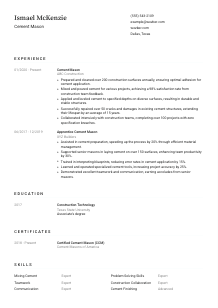
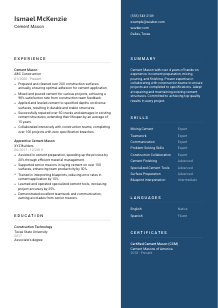
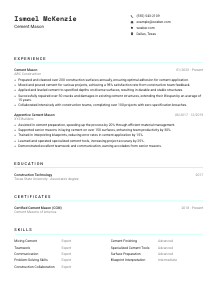
Building solid foundations, but your resume feels a bit crumbly? Lay your eyes on this Cement Mason resume example, made with Wozber free resume builder. Learn how to mix your masonry mastery with job requirements, setting your career trajectory as strong and level as the structures you create!
Cement masonry gets judged in the field by how well the surface holds up after the forms come off. Hiring teams want a resume that reflects that same standard. They look for proof that you can prep surfaces correctly, mix to ratio, place and level concrete cleanly, and handle repairs without slowing down the crew or missing specifications.
When that experience is tailored to the posting, the difference is immediate. A foreman or hiring manager can quickly see whether your background matches the actual work on site, and Wozber's free resume builder helps shape that into an ATS-compliant resume with the right trade language, from blueprint reading to crack repair. The result should make your day-to-day value on a construction crew easy to recognize.
Personal details are simple, but they still affect how quickly your application moves. In construction hiring, missing contact information, an unclear title, or a location mismatch can get a resume set aside before anyone reads your project history.
Your name should sit at the top in a clean, readable font. Keep it straightforward and professional. On a trade resume, clarity matters more than styling, especially when a superintendent or office coordinator is reviewing several candidates at once.
Place "Cement Mason" directly under your name if that is the role you are applying for. This immediately connects your background to the position and helps ATS screening pick up the match. If your recent title was similar, such as apprentice or concrete finisher, you can still headline the resume with the role you are pursuing when your experience supports it.
Include a current phone number and a professional email address. One typo can block an interview request or a same-day call from a project team trying to fill labor quickly. If you also have a portfolio page or professional site with finished flatwork, repair work, or commercial pours, add it only if it is current and useful.
Some masonry jobs move fast, and location can affect whether you are considered right away. Here, listing Dallas, Texas directly supports the posting's requirement. If you are relocating, make that clear in a simple way so the employer does not have to guess about your availability.
A LinkedIn profile is optional, but it should reinforce your experience with construction crews, employers, and certifications. If you include a website, make sure it shows relevant work such as slab finishing, patch and repair projects, or commercial concrete jobs rather than unrelated content.
This section should confirm that you are reachable, local or ready to relocate, and applying for the right trade role. Once that is clear, the hiring team can move straight to your field experience.




For a Cement Mason, experience carries the most weight because it shows how you work under actual site conditions. Hiring managers want to see the surfaces you handled, the tools you used, the pace you kept, and whether your work held to spec across pours, finishes, and repairs.
Read the job description line by line and mark the tasks that appear most often or carry the most responsibility. For this role, that includes surface preparation, mixing to formula, pouring and leveling, reading blueprints, repairing damaged concrete, and working closely with the crew. Build your bullets around those functions so your experience reads like a direct answer to the work being advertised.
List every job with your title, company name, and dates worked. Then use bullet points to show what you actually did on the job. Trade hiring often moves quickly, and a clean structure helps both ATS systems and construction managers spot the basics fast, from years of experience to the type of concrete work you handled.
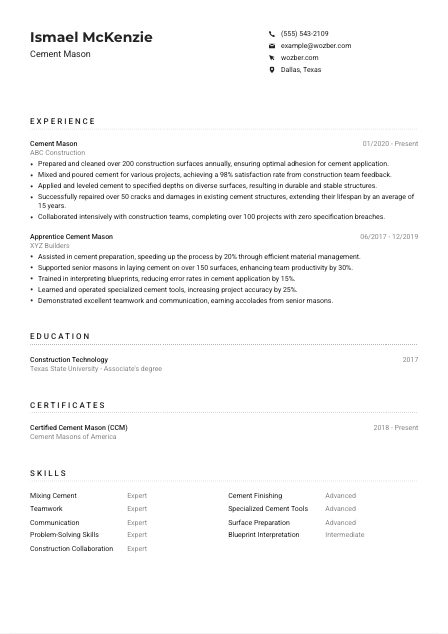
Do not stop at "mixed cement" or "repaired surfaces." Show scope, quality, or consistency. The sample resume does this well with lines such as preparing more than 200 construction surfaces annually and completing over 100 projects with zero specification breaches. That kind of phrasing tells an employer you can produce reliable work, not just perform the task once.
Metrics work especially well in construction when they describe volume, quality, speed, safety, or durability. Surface counts, project totals, error reduction, rework avoided, or lifespan extended all make sense for this trade. A bullet like repairing more than 50 damaged cement structures and extending service life by an average of 15 years gives much more hiring value than a vague statement about maintenance work.
Prioritize work that supports your case as a Cement Mason. General labor experience can stay if it shows relevant site skills such as reading plans, using power tools, or supporting pours, but the focus should stay on concrete placement, finishing, repairs, and crew coordination. The closer your bullets are to the actual day-to-day work, the stronger the section reads.
This section should leave no doubt that you can step onto a job site and handle the core work. Surface prep, mix accuracy, finishing quality, repair skill, and dependable teamwork should all be visible in the bullets you keep.
Education usually plays a supporting role for Cement Masons, but it still adds useful context. It can show formal exposure to construction methods, materials, safety practices, blueprint reading, or technical coursework that strengthens your hands-on background.
If you have a degree, diploma, or vocational training tied to construction, list it clearly. An Associate's degree in Construction Technology, like the one in the example, adds credibility because it supports field skills with classroom knowledge of plans, materials, and job-site processes.
Include the school, degree or program, field of study, and graduation year or date range. Keep this section clean and direct. Most hiring managers will scan it in seconds, so make the relevant detail visible without extra wording.
When a posting mentions blueprint reading, specifications, or technical understanding, place related education where it is easy to spot. Formal training can strengthen your case if your field experience is solid but you want to show additional grounding in construction drawings or material standards.
You do not need to turn this into a transcript, but short additions can help if they relate directly to the work. Courses in construction drawings, concrete materials, site safety, or equipment operation can reinforce practical skills, especially for candidates earlier in their careers.
Honors, distinctions, or trade competition results are worth including if they show work ethic or technical ability. Keep them brief and relevant. On a masonry resume, they should support your hands-on credibility, not compete with it.
Keep this section concise and relevant. Its job is to back up your site experience with useful technical training, not distract from the work you have already done in concrete and cement applications.
Certifications are not always required for Cement Mason roles, but they can help separate you from applicants with similar field experience. In construction, a relevant credential suggests formal training, commitment to standards, and a stronger base in materials, methods, or safety.
List credentials that connect directly to cement, concrete, masonry, construction safety, or equipment use. A certification such as Certified Cement Mason is a clear match because it supports the exact trade focus of the role rather than adding a generic credential.
A short list of strong certifications is better than a long list of loosely related ones. Prioritize credentials that reinforce what the employer needs to trust, such as finishing skill, construction knowledge, repair capability, or job-site compliance.
Add the year earned and, if relevant, whether the certification is still active. This helps employers understand how current the training is. The example's "2018 - Present" format works well for an active certification that remains in good standing.
Construction methods, safety expectations, and material standards do change over time. Ongoing certification or updated training signals that you stay current with the work rather than relying only on older field habits. That matters when crews need dependable execution and fewer avoidable mistakes.
A well-chosen certification section gives extra confidence in your trade background. Keep it closely tied to cement work, construction practice, or active safety and skill standards, and it will strengthen the resume without taking over it.
The skills section should read like a quick technical snapshot of how you work. For Cement Masons, that means a practical mix of material-handling ability, finishing technique, tool use, drawing interpretation, and the crew skills needed to keep a pour moving safely and accurately.
Start with the language the employer already uses. Here, the most important terms include mixing, pouring, finishing, blueprint interpretation, specialized cement tools, teamwork, communication, and problem-solving. Using the same trade language helps ATS matching and keeps your resume aligned with the actual work.
Lead with the abilities that matter most on site. Technical skills such as surface preparation, leveling, crack repair, form-related work, tool handling, and reading construction drawings usually deserve more attention than broad personality terms. Soft skills still matter, especially on crew-based projects, but they should support the trade work rather than replace it.
Do not overload this section with every tool or trait you have ever used. A tighter list is more credible and easier to scan. The example works because it combines core technical abilities like mixing cement and finishing with essential crew skills such as teamwork and communication, giving a balanced picture of job-site performance.
A hiring manager should be able to glance at this section and understand your trade strengths immediately. Focus on the skills that affect pour quality, repair accuracy, blueprint execution, and how well you work with the rest of the crew.
Language skills matter in construction because work depends on clear instruction, safety communication, and coordination with the crew. For a Cement Mason, this section is usually short, but it can still help when the posting specifically calls for English proficiency or when extra languages improve communication on mixed teams.
If the employer asks for English, list it clearly and give an honest proficiency level. In this case, a strong grasp of English is part of the requirement, so it should appear first and be easy to find.
Start with the language required for the role, then add others in descending order of fluency or relevance. This keeps the section practical and prevents secondary language skills from distracting from the main hiring requirement.
Extra languages can be valuable on construction sites where teams, subcontractors, or supervisors come from different language backgrounds. Spanish, for example, may strengthen day-to-day coordination on many crews, as long as it is listed accurately and not overstated.
Use clear labels such as Native, Fluent, Conversational, or Basic. Avoid vague claims. Language ability affects safety, coordination, and instruction-following, so employers need a realistic picture of how well you can communicate on the job.
Language skills are usually secondary to your field experience, unless communication is a stated hiring priority. Include them cleanly, meet the English requirement, and let the rest of the resume carry the heavier proof of your trade qualifications.
This section should confirm that you can communicate clearly where it counts most, on the job site, during instructions, and when coordinating with the crew. If you speak more than one language, that can be a useful added strength.
The summary is your quickest chance to establish trade level, core strengths, and the kind of concrete work you handle well. For a Cement Mason, a few well-chosen lines can tell the employer whether you belong on a repair-focused crew, a new construction team, or a job that needs both precision and pace.
Pick out the trade tasks the employer cares about most and echo them naturally. For this role, that means preparation, mixing, pouring, finishing, blueprint reading, repairs, and teamwork. You are not copying the posting word for word. You are showing that your background lines up with the work they need done.
Start with a direct line such as "Cement Mason with 4+ years of hands-on experience" or the equivalent that matches your background. This immediately places you at the right level and helps the reader understand whether you meet a stated experience threshold such as 3 years or more.
A short summary gets stronger when it includes a specific performance marker. The example does this by pointing to collaboration with construction teams and consistent work to specification. You might also mention project volume, repair outcomes, surface quality, or experience across residential and commercial jobs if that reflects your history.
Aim for a short paragraph that can be read in a few seconds. Skip generic claims about being hardworking and focus instead on the work you do well, the environments you have handled, and the standards you meet. A summary should sound like a capable tradesperson introducing real field experience, not a slogan.
By the time someone finishes these lines, they should understand your experience level, your core cement skills, and the type of value you bring to a construction crew. That sets up the rest of the resume to confirm the details.
A Cement Mason resume works best when it reflects the actual job from the ground up. Clear personal details, practical experience bullets, relevant training, focused skills, and a direct summary all help show that you can prep surfaces, mix and place material correctly, follow drawings, and deliver durable results with the crew.
Use Wozber to turn that experience into a clean, ATS-friendly resume format, strengthen wording with role-specific terminology, and check alignment with an ATS resume scanner before you apply. The final document should make one thing easy to judge: whether you can step onto the site and handle the work to spec.




