



Use Wozber and land your dream job
Create Resume
No registration required
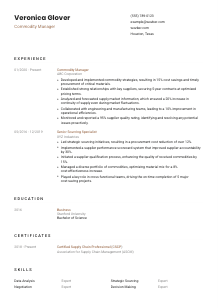
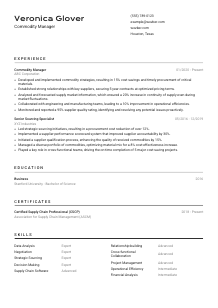
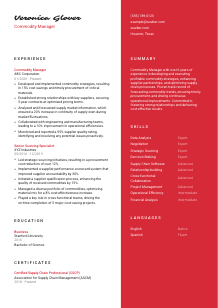
Navigating global markets, but your resume feels like a surplus commodity? Check out this Commodity Manager resume example, created with Wozber free resume builder. It shows how to position your strategic sourcing skills in line with job requirements, ensuring your career remains as valued as the commodities you manage!
Commodity management sits at the intersection of cost control, supply continuity, and supplier leverage. Hiring teams want to see whether you can shape a category strategy, read market movement, and turn supplier negotiations into measurable business gains. Your resume needs to make those decisions visible through results, not broad procurement language.
When a Commodity Manager resume is tailored well, the first read quickly shows category ownership, savings impact, and the scale of supplier work behind your titles. Wozber's free resume builder helps structure that experience into an ATS-compliant resume, so terms like strategic sourcing, commodity strategy, supplier quality, and spend reporting are easy to surface where they matter most.
This section should communicate professionalism fast and remove any friction before a hiring manager reaches your sourcing experience. For commodity roles, that means a clean identity line, reliable contact information, and any location detail that answers a stated requirement without cluttering the top of the page.
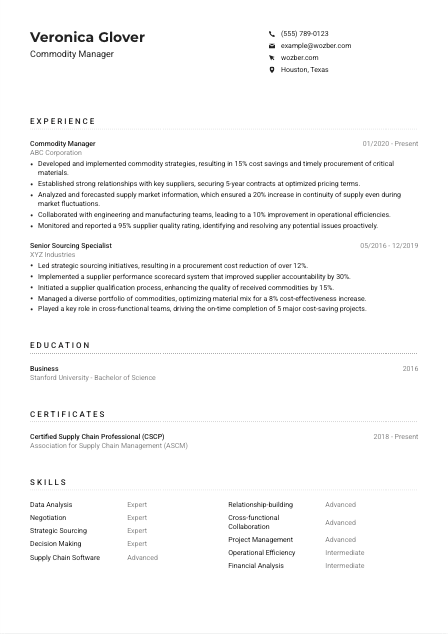
Put your name first and make it easy to read. Directly beneath it, use the target title "Commodity Manager" when that matches the role you are pursuing. This immediately frames you around category strategy, supplier negotiations, and procurement ownership instead of a broader operations or purchasing label.
Use the exact job title when it reflects your background. For this opening, "Commodity Manager" is the clearest choice because it aligns with the employer's language and helps position your experience around strategic sourcing and commodity planning from the start.
List one phone number and one professional email address you check regularly. Accuracy matters here. In a role built on contract terms, supplier communication, and reporting discipline, even small errors in contact details can suggest a lack of care.
If the employer specifies a location, address it directly in your header. Here, listing "Houston, Texas" helps clear a stated requirement early. That is a tailoring choice for this job, not a rule for every Commodity Manager resume.
A LinkedIn profile or professional website can support your resume when it reflects the same dates, titles, and supply chain focus. Keep it consistent with your resume language, especially around sourcing scope, supplier programs, cost savings, or category work.
Your personal details should answer the practical questions first and let the rest of the resume focus on commodity strategy, supplier management, and procurement results. Keep this section lean, accurate, and aligned with the opening you want.




For a Commodity Manager, experience carries the most weight. Hiring teams look for proof that you have managed spend, built supplier relationships, negotiated terms, forecasted market shifts, and worked across functions to keep materials flowing without sacrificing cost or quality.
Start by identifying the job's operational priorities, then mirror them in your work history using your own results. In this case, that means commodity strategy, supplier negotiations, market analysis, continuity of supply, and collaboration with engineering or manufacturing. Each bullet should connect your work to one of those priorities.
List your most recent role first, then work backward. This format makes it easier to follow your progression from sourcing or procurement roles into full commodity ownership, and it works cleanly with ATS parsing as well as recruiter review.
Write bullets that show what changed because of your decisions. The sample resume does this well with a 15% cost savings tied to commodity strategy and a 20% increase in continuity of supply tied to market analysis. Those are the kinds of outcomes that show you can manage both cost and risk.
Numbers give your sourcing work commercial weight. Include savings percentages, contract terms, supplier quality ratings, lead-time improvements, spend under management, or risk reduction when you have them. "Secured 5-year contracts at optimized pricing terms" works because it shows negotiation scope and business value in one line.
Prioritize bullets that show category decisions, supplier performance management, forecasting, and cross-functional problem solving. Routine purchasing activity without strategic scope will not carry as much value for a Commodity Manager opening. Keep the section centered on decisions, outcomes, and ownership.
This section should leave no doubt that you can manage suppliers, protect continuity, and deliver cost performance. When your bullets show measurable sourcing outcomes and real operational partnership, the move into a Commodity Manager role feels credible and earned.
Education usually plays a supporting role at this career stage, but it still matters because many Commodity Manager openings ask for a degree in business, supply chain, or a related field. Present it clearly so the requirement is easy to confirm in seconds.
If the posting asks for a bachelor's degree, make sure that information is immediately visible. A Bachelor of Science in Business, as shown in the example, clearly aligns with the educational baseline for many sourcing and procurement roles.
List degree, field of study, school, and graduation year in a consistent order. That keeps the section easy to review and supports ATS readability without distracting from the more important experience section.
When your degree connects to business, supply chain, operations, finance, or a related discipline, let that relevance speak for itself. For this role, a business degree supports the commercial side of negotiation, cost analysis, and supplier management.
You can add coursework, projects, or academic concentration when it strengthens your case, especially if your professional experience is lighter. Topics like supply chain management, procurement, analytics, or operations can reinforce your fit without taking over the section.
Academic honors, leadership roles, or relevant extracurriculars can stay if they are recent or clearly support your profile. For experienced Commodity Managers, keep these additions brief so the spotlight stays on sourcing results and category achievements.
Your education section should confirm the degree requirement and support your commercial and supply chain foundation. Once that is clear, let your sourcing experience carry the stronger argument.
Certifications can strengthen a Commodity Manager resume because they show formal training in supply chain practices, sourcing discipline, and continuous professional development. They are especially useful when a posting mentions SCM credentials as preferred rather than required.
List certifications that connect directly to sourcing, procurement, operations, or supply chain management. For this opening, a credential such as Certified Supply Chain Professional aligns well because it reinforces the strategic and operational side of commodity work.
Do not overload this section with unrelated training. A short list of respected certifications is more effective than a long catalog, especially when the employer is looking for practical capability in negotiations, supplier management, and market analysis.
Include earned or active dates when they help clarify that your certification is current. That is useful in fields where best practices, compliance expectations, and supply chain tools continue to evolve.
Commodity markets, supplier risk, and sourcing technology change over time. Keeping certifications active or adding new relevant ones shows that you stay current on the methods behind cost management, continuity planning, and procurement performance.
A well-chosen certification adds another layer of trust to your resume. It will not replace real sourcing results, but it can strengthen the case that your approach is grounded in current supply chain practice.
The skills section should read like a practical toolkit for commodity leadership. Focus on the capabilities that support category planning, supplier negotiations, market analysis, and cross-functional execution, not a long inventory of generic strengths.
Pull the technical and commercial skills directly from the posting where they match your background. Here, data analysis, negotiation, relationship-building, and supply chain management software all belong near the top because they are central to the work and clearly requested.
Lead with the skills that drive category outcomes. Strategic sourcing, supplier management, forecasting, spend analysis, contract negotiation, and cross-functional collaboration usually matter more than broad soft skills listed without context.
Group or order your skills so the reader can scan them quickly. The sample resume works because it balances core sourcing capabilities such as strategic sourcing and negotiation with supporting strengths like project management and financial analysis. That mix reflects how commodity decisions affect both operations and cost.
This list should reinforce the sourcing and supplier work already proven in your bullets. When the skills line up with the job description and your experience backs them up, the profile feels coherent and credible.
Language skills can matter in commodity management when supplier networks, manufacturing footprints, or regional sourcing activities extend beyond one market. Even when the role is domestic, the posting may still require clear business communication in English for negotiations, reporting, and cross-functional work.
If the job specifically asks for English proficiency, list English clearly with an accurate level such as Native or Fluent. That immediately addresses a stated requirement and supports your ability to handle supplier communication, internal reporting, and contract discussions.
Additional languages can strengthen your profile when they connect to vendor relationships, global sourcing, or multicultural teams. Spanish, for example, may be useful in some supply chain environments, but include it as an advantage rather than assuming every employer will need it.
Use honest proficiency levels. If you can negotiate, present, or manage supplier conversations in another language, that distinction matters. If your ability is basic, label it that way rather than overstating it.
Not every Commodity Manager role requires multilingual ability, so keep this section proportional to the job. It carries more weight when the employer has international suppliers, offshore manufacturing, or regional commodity exposure.
Language ability is most persuasive when it supports an actual business scenario, such as supplier calls, plant coordination, or market communication across regions. Present it as a working asset, not just a personal detail.
For this role, English needs to be clear and prominent. Any additional languages should strengthen your sourcing reach or supplier communication story without distracting from your core procurement achievements.
Your summary should quickly establish the level and type of commodity work you do best. In a few lines, it should signal your years of experience, your sourcing scope, and the business outcomes you are known for, whether that is savings delivery, supplier performance, continuity of supply, or category strategy.
Read the posting closely and identify the commercial center of the job. For this one, the summary should reflect strategic sourcing, commodity planning, supplier negotiation, and market analysis because those are the functions shaping the role.
Your first line should establish who you are professionally. A phrase like "Commodity Manager with over 6 years of experience" works because it gives level, function, and tenure immediately without wasting space.
Use two or three role-specific strengths that line up with the opening. The sample summary highlights profitable commodity strategies, supplier partnerships, timely procurement, and operational improvements, which map closely to what this employer wants to see.
Aim for a short paragraph that reads cleanly in one pass. Three to five lines is usually enough to connect your experience, sourcing strengths, and business impact without repeating the full experience section.
A strong summary makes your procurement profile legible before the reader reaches the details. When it captures your category experience, negotiation strength, and supply chain impact in clear language, the rest of the resume has a sharper context.
A Commodity Manager resume works when it shows how you influence cost, supply stability, supplier performance, and operational improvement. Each section should support that story with direct language and measurable sourcing outcomes.
Use Wozber's free resume builder to shape your content into an ATS-friendly resume format, then refine it with job-specific terminology and clear metrics. The final read should make it easy to understand your category ownership and the value you bring to procurement decisions.




