



Use Wozber and land your dream job
Create Resume
No registration required
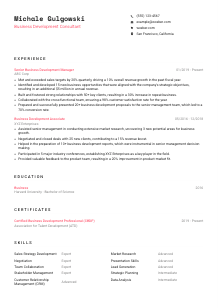
Crafting growth strategies, but your resume feels stagnant? Check out this Business Development Consultant resume example, created with Wozber free resume builder. Learn how to align your forward-thinking initiatives with job specifics, paving a career trajectory as dynamic as the deals you close!
Business development hiring turns quickly on proof. Teams want to see whether you can open new revenue paths, move prospects through the pipeline, and turn market insight into deals, partnerships, or expansion plans. A Business Development Consultant resume works best when it makes that commercial track record obvious through outcomes such as target attainment, client growth, proposal wins, and relationship ownership.
Screening gets harder when business development experience is described in broad sales language. Wozber's free resume builder helps you match the wording of the role, keep an ATS-compliant resume clean, and surface priorities like prospecting, negotiation, market research, and executive presentations so hiring teams can quickly understand where you have already produced growth.
For business development roles, the header does more than identify you. It confirms that you are reachable, professionally presented, and aligned with practical requirements that can affect hiring early, including title match and location when a posting asks for it.
Use your full name as the most visible text on the page. Keep it easy to read and slightly larger than the rest of the header so the document feels polished from the first glance. In a client-facing profession where presentation matters, small details like this set the tone.
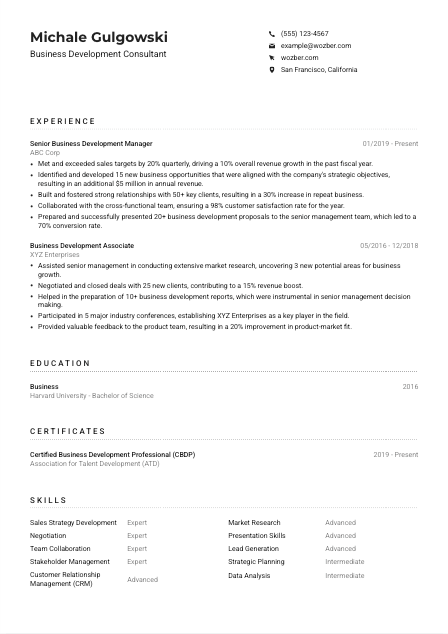
Place the job title directly below your name when it accurately reflects the work you do. "Business Development Consultant" is a clean choice here because it immediately aligns your background with pipeline growth, partnership development, and revenue generation rather than leaving the reader to infer your direction.
List a reliable phone number and a professional email address, then check both for formatting errors. If a hiring manager wants to move you into a screening call after reviewing your sales numbers or proposal wins, your contact details should never create a delay.
Some business development openings are tied to a region because client meetings, local market knowledge, or office presence matter. In this example, San Francisco, California belongs in the header because the role specifically mentions being based there or relocating. Use location this way when it removes a clear hiring question.
If you include LinkedIn or a personal website, make sure it supports the same story as your resume. For business development candidates, that usually means consistent job titles, credible career progression, and visible indicators of commercial work such as partnerships, market focus, or industry presence.
Your header should answer the practical basics in seconds: who you are, how to reach you, what role you do, and whether any stated logistics are already covered. That keeps the reader focused on your business results, not missing details.




This is the section that carries the most weight for a Business Development Consultant. Hiring teams look for revenue contribution, new business generation, client retention, deal activity, and the kind of cross-functional work that keeps accounts growing after the contract is signed.
Before rewriting bullets, mark the responsibilities and requirements that define the role. Here, the major themes are new business development, market research, competitive analysis, stakeholder relationships, collaboration across teams, proposal writing, and hitting sales targets. Those are the ideas your experience section should reflect in plain business language.
Start with your current or most recent role and list company name, title, and dates in a clean structure. Business development careers often show progression from associate or account-facing positions into larger revenue ownership, and that upward movement is easier to spot when the chronology is straightforward.
Avoid generic lines such as "responsible for sales" or "managed client relationships." Show what changed because of your work. The sample resume does this well by tying business development activity to concrete outcomes, including new opportunities created, repeat business growth, proposal conversion, and customer satisfaction rates. That gives the reader a clearer picture of how you operate.
Metrics make commercial impact easier to trust. Prioritize figures tied to quota attainment, revenue growth, deal volume, conversion rate, average contract value, renewal lift, partner expansion, or client retention. Examples like "exceeded sales targets by 20% quarterly" and "added $5 million in annual revenue" work because they connect activity directly to business performance.
Keep the section centered on work that proves you can find opportunities, build relationships, negotiate effectively, and contribute to strategic growth. If an accomplishment does not strengthen that case, move it down, shorten it, or remove it. Focus creates a much stronger read than trying to capture every task you have ever handled.
After reading your experience section, a reviewer should understand how you generate pipeline, how you move business forward, and what commercial results followed. For this role, the clearest resumes connect actions to revenue, relationships, and growth decisions.
Education is usually a supporting section for experienced business development professionals, but it still matters when a posting names a degree requirement. Keep it clean and relevant so the reader can confirm the academic baseline without digging.
Start by checking the exact educational baseline in the posting. This role asks for a bachelor's degree in Business, Marketing, or a related field, so your degree should be listed in a way that makes that connection obvious if you meet it.
List your degree, school, field of study, and graduation year or date. That is usually enough. Straightforward formatting helps both ATS parsing and human review, especially when the hiring team is moving quickly through multiple sales and business development resumes.
If your degree aligns directly with the role, name it clearly. In the example, "Bachelor of Science" with a field in Business gives immediate relevance because it matches the stated requirement without extra explanation.
Coursework, honors, competitions, or leadership activities are most useful when they support your commercial profile. For instance, projects in market analysis, sales strategy, entrepreneurship, or client communication can add value for an early-career candidate. For someone with several years of revenue-focused experience, they are usually secondary.
Business development rewards people who keep sharpening their market knowledge and sales approach. If you are working toward a recognized credential or have completed relevant training in negotiation, account growth, or strategic selling, that ongoing development can reinforce your commitment to the field.
Your education section only needs to confirm the academic foundation and, where useful, show relevant business grounding. Keep it concise so your commercial experience remains the main story.
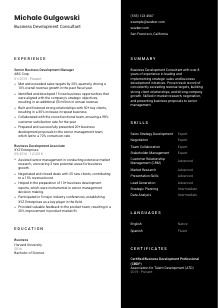
Certifications carry extra weight when a job posting names one explicitly or allows a short window to earn it after hire. In business development, the right credential can reinforce your knowledge of structured selling, relationship management, and professional standards.
Prioritize credentials that directly match the role requirements. Here, the Certified Business Development Professional, or CBDP, deserves top placement because the employer called it out specifically. If you do not have it yet but are actively pursuing it, note that honestly.
For each certificate, list the full name, issuing organization, and the year earned or current validity period. That is enough to show legitimacy and recency without overloading the section.
Some credentials are active, some expire, and some are in progress. Use wording that makes the status easy to understand. In the example, showing the CBDP with dates helps the reader quickly place it in your professional timeline.
If your target roles value consultative selling, account strategy, or market expansion work, additional certifications in those areas can support your resume over time. Add them when they deepen your fit for the kind of business development work you are pursuing, not just to lengthen the list.
This section should show that your business development knowledge is current and relevant to the role's demands. One well-matched credential is far more persuasive than a scattered list with no clear connection to revenue work.
The best skills sections for business development are selective and commercial. They should mirror the way the role is performed, from prospecting and negotiation to CRM use, stakeholder management, and presentation work for decision-makers.
Start with the exact skills named in the ad, then add the ones clearly required by the responsibilities. In this case, prospecting, negotiation, closing, market research, competitive analysis, relationship management, presentation skills, and cross-functional collaboration are all relevant targets for your list.
Every skill should connect to your experience, summary, or certifications. If you claim negotiation expertise, your work history should show deals closed, pricing discussions led, or revenue gained. The sample resume pairs skills like lead generation and stakeholder management with measurable client and growth outcomes, which makes the list more credible.
Put the most important commercial skills first. For a Business Development Consultant, that often means business development strategy, lead generation, negotiation, closing, client relationship management, proposal development, market research, and CRM-related work before broader soft skills. This ordering helps both ATS review and human scanning.
Keep only the skills that support your ability to generate business, manage opportunities, and convert interest into revenue. If a skill does not strengthen that case, it does not need the space.
Language ability matters differently depending on market coverage, client base, and internal communication needs. For business development roles, list languages clearly when they are required or when they expand your ability to work across regions, partners, or customer groups.
If the job requires fluent English, list English at the top with an accurate proficiency level. That immediately addresses a stated requirement and avoids any doubt about your ability to handle client conversations, proposals, and internal reporting.
Additional languages can support work with broader customer segments or international accounts, but they should come after the required one. In the example, Spanish is a useful secondary language because it expands communication range without distracting from the core requirement.
Choose standard terms such as native, fluent, intermediate, or basic. Clear labels are more useful than vague descriptions because they help the employer judge whether you can negotiate, present, or simply communicate at a working level.
If your business development work involves regional expansion, multilingual clients, or cross-border partnerships, additional languages become more valuable. If not, keep the section lean and focused on what is genuinely useful for the roles you are targeting.
Language claims are easy to test in interviews, sales calls, and written exercises. Rate yourself honestly so your resume sets the right expectation for client communication, presentations, and relationship-building.
Your language section should quickly confirm required communication ability and, where relevant, show extra reach into customer or partner markets. Accuracy matters more than variety.
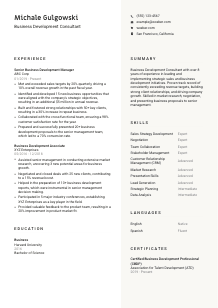
For a Business Development Consultant, the summary should quickly frame your commercial range. It needs to show the level you operate at, the type of growth work you handle, and the results you have produced, all without slipping into generic sales language.
Start with your title or close equivalent, then add years of experience and a focus area that matches the role. A line such as "Business Development Consultant with 8+ years of experience driving market expansion and client growth" gives the reader immediate context.
Choose outcomes that support the job's priorities, such as exceeding targets, winning new business, increasing repeat revenue, or improving proposal conversion. The sample summary works because it references consistent target performance, relationship building, and company growth rather than relying on generic claims.
Include a few skills that match the role's day-to-day work, such as market research, negotiation, stakeholder management, closing, or executive presentations. Keep the selection tight and aligned with what your experience section can back up.
Aim for a short paragraph of three to five lines. Every phrase should help the reader understand how you contribute to revenue growth, strategic expansion, or client development. If a sentence sounds broad enough for any sales role, tighten it.
A hiring manager should be able to read your summary and immediately place you at the right level of business development work. Keep it focused on growth, relationships, and measurable results so the rest of the resume lands faster.
A Business Development Consultant resume should make commercial value easy to follow from top to bottom. When your title, experience, skills, and summary all point to prospecting strength, relationship ownership, market insight, and revenue results, the document reads like a clear business case.
Wozber's free resume builder can help you tighten that alignment with ATS-friendly resume templates, targeted wording, and ATS resume scanner support that highlights missing requirements and improves ATS optimization. The finished resume should make it easy to judge one thing above all: your ability to create and convert growth opportunities.




