



Use Wozber and land your dream job
Create Resume
No registration required
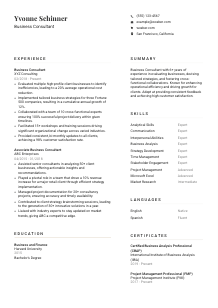
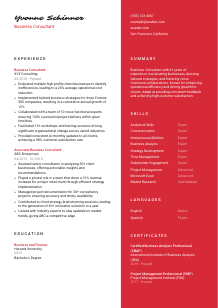
Offering strategic solutions, but your resume seems directionless? Explore this Business Consultant resume example, created with Wozber free resume builder. It shows how to position your consultancy prowess to match job demands, ensuring your career roadmap stays on the path to success!
Business consulting resumes are screened for one thing very quickly: whether you can diagnose business problems, shape workable solutions, and carry initiatives through change. Hiring teams look past broad claims about strategy and focus on scope, client impact, operational improvement, workshop leadership, and the kind of cross-functional work that actually moves revenue, cost, or process performance.
When the resume is tailored well, those consulting strengths are easier to pick up in both human review and ATS screening. Wozber's free resume builder helps you line up your wording with the posting, keep an ATS-friendly resume format, and surface the parts of your background that show you can evaluate businesses, guide implementation, and maintain strong client relationships.
For consulting roles, the header needs to establish professional credibility fast and remove any practical friction before the reader reaches your project work. Keep it clean, current, and aligned with the opening so the hiring team can immediately place you as a Business Consultant candidate they can contact and consider without extra questions.
Use your full name in a slightly larger font than the rest of the header so it reads clearly on screen and in print. Consulting is a client-facing field, and a polished presentation matters. Your name should feel as clear and professional as the decks, reports, and recommendations you would be expected to deliver.
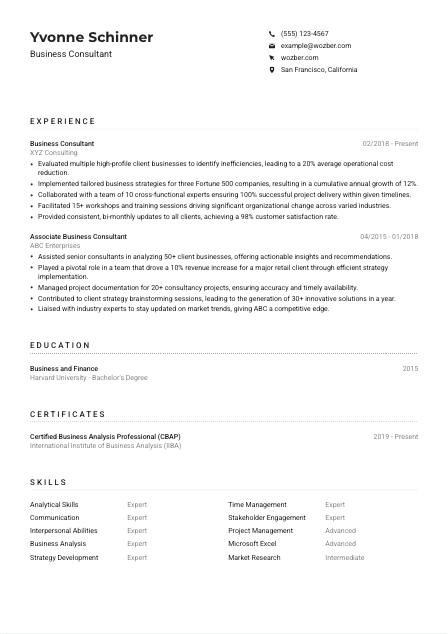
Place "Business Consultant" under your name when that is the role you are targeting. This helps frame your experience immediately, especially if your past titles vary slightly, such as Associate Business Consultant, Strategy Analyst, or Operations Consultant. In the example, using the exact target title closes the gap between prior consulting experience and the employer's opening.
If the job calls for a specific location, include your city and state exactly. Here, San Francisco, California matters because the posting requires candidates to be based there. If you are relocating, make that clear in a way that removes uncertainty rather than leaving the employer to guess.
Include LinkedIn or a professional website if it supports your consulting background with consistent titles, project scope, recommendations, or industry expertise. For Business Consultants, a strong profile can reinforce experience in process improvement, client advisory work, change initiatives, and stakeholder management. Make sure the dates and accomplishments match your resume.
This section should answer the basics immediately: who you are, what role you do, how to reach you, and whether you meet any practical requirement such as location. When those details are clean, the reader can move straight to your consulting experience.




This is the section that carries the most weight for a Business Consultant. Employers want to see how you assessed business performance, what problems you solved, how you worked across functions, and what changed because of your recommendations. Generic task lists will not do much here. Outcome-driven bullets tied to business performance will.
Start by identifying the recurring work themes in the job description, then reflect them in your bullets using your own results. For this role, that means evaluating business weaknesses, developing tailored strategies, collaborating with cross-functional teams, facilitating workshops, and giving regular client updates. Those are not just keywords for ATS optimization. They are the consulting workflow the employer wants to hire for.
List roles in reverse chronological order and make your progression visible. A move from Associate Business Consultant to Business Consultant tells a useful story about increased client ownership, stronger strategic input, and broader delivery responsibility. The example does this well by showing a clear path from supporting analysis and documentation to leading evaluations, strategies, and workshops.
Each bullet should connect your work to a business outcome. Cost reduction, revenue growth, customer satisfaction, process efficiency, delivery success, and adoption of change are all native measures in consulting work. The sample bullets are effective because they quantify consulting outcomes, such as a 20% average operational cost reduction, 12% annual growth, and a 98% customer satisfaction rate, instead of stopping at "analyzed" or "advised."
Cut responsibilities that do not strengthen your case for this target role. A Business Consultant resume should prioritize diagnostics, business analysis, process improvement, stakeholder management, implementation support, and measurable project outcomes. Administrative details belong only when they prove project coordination, documentation discipline, or delivery reliability in a consulting setting.
Mirror relevant terms from the posting where they truthfully match your work. Phrases such as "operational efficiency," "tailored business strategies," "organizational change," and "cross-functional teams" help your resume sound aligned without feeling forced. Wozber's AI resume builder can help identify this language and map it naturally to the right experience bullets so the resume reads clearly to both recruiters and ATS systems.
Your experience section should show that you do more than advise. It should make clear that you can diagnose issues, guide execution, and improve business performance in ways clients can measure.
Education matters here because it establishes the business foundation behind your consulting judgment. It will not outweigh experience, but it still needs to line up with the role's academic requirement and be presented clearly enough that the reader can confirm it at a glance.
If the posting asks for a bachelor's degree in Business, Finance, or a related field, make that information easy to find. Do not bury the field of study or use vague labels. In this case, a Bachelor's Degree in Business and Finance directly supports the requirement and should be written in full.
List degree, field, school, and graduation year in a clean order. Consulting resumes do not need decorative formatting in this section. Clarity is enough, especially when the hiring team is scanning quickly between your qualifications and your project history.
When your degree aligns closely with the role, do not undersell it. A background in business, finance, economics, operations, or a related discipline supports work such as analyzing performance, building recommendations, and understanding financial or operational tradeoffs. The example's Business and Finance degree strengthens that connection immediately.
You do not need to turn this into a full academic profile. Include honors, research, business competitions, or major projects only if they point to consulting-relevant strengths such as analysis, presentation, market research, operations, or team problem-solving. For experienced candidates, this section should stay concise.
If you hold consulting-adjacent credentials such as PMP or CBAP, make sure the degree section does not feel disconnected from the rest of your qualifications. Education shows your academic base. Certifications show applied discipline in delivery, business analysis, or project execution. Together, they present a more complete consulting profile.
This section only needs to do a few things well: confirm the required degree, show relevant field knowledge, and support the rest of your consulting background without taking focus away from your results.
For Business Consultants, certifications can strengthen credibility when they connect directly to client delivery, structured analysis, or project execution. They are especially useful when the employer has named a preferred credential, as this one does with PMP and CBAP.
When a job description calls out specific certifications, list those first if you have them. PMP and CBAP both carry weight because they point to structured project leadership and business analysis capability, two areas that often sit at the center of consulting engagements. In the example, including both immediately strengthens alignment with the role.
Choose certifications that reinforce the kind of consulting work you want to do. A short list of relevant credentials is more convincing than a long list of unrelated courses. For this profession, project management, business analysis, process improvement, change management, or industry-specific certifications usually add the most value.
Show the issue date or active period when it helps establish recency and current standing. This is particularly useful for certifications tied to ongoing professional maintenance. Dates can reassure employers that your framework knowledge is current, especially in roles involving project delivery, stakeholder coordination, and formal analysis methods.
Consulting work changes with markets, tools, and delivery expectations, so current learning matters. Keep this section updated as you renew certifications or add new ones. It tells employers that your methods are not frozen and that you continue to build capability in areas that affect client outcomes.
Relevant credentials add useful depth when they support the work your resume already shows. For a Business Consultant, they are most effective when they reinforce how you manage projects, analyze business needs, and deliver structured recommendations.
A Business Consultant skills section should read like a toolkit you actually use on engagements. That means balancing analytical ability with delivery and client-facing strengths. The best lists reflect how consulting work gets done: diagnosing issues, building recommendations, managing stakeholders, and helping teams implement change.
Start with the posting and pull out the capabilities that drive the work. Here, analytical skills, problem-solving, project management, communication, and interpersonal abilities are explicitly requested. Add related consulting skills you genuinely use, such as business analysis, strategy development, stakeholder engagement, workshop facilitation, process improvement, financial modeling, or market research, depending on your background.
Do not turn this section into a master inventory. Select the skills that support the target role and that also appear in your experience bullets. If you list stakeholder engagement, project management, or strategy development, the hiring team should be able to find those strengths reflected in your actual work. The example keeps this balance well by combining core consulting capabilities with tools like Microsoft Excel.
Put the highest-priority consulting skills near the top so the first scan lands on what matters most. For this opening, analytical thinking, business analysis, communication, project management, and stakeholder-facing skills deserve prominent placement. Wozber can help structure this in an ATS-compliant resume so the section stays readable while still reflecting the employer's language.
This section works best when it reinforces your project history rather than trying to replace it. The most persuasive skill list points directly back to consulting work you have already delivered.
Language skills matter in consulting because so much of the work depends on interviews, presentations, workshops, negotiation, and client updates. Even when only one language is required, this section can still help clarify whether you can operate comfortably in the communication demands of the role.
If the posting states that English fluency is essential, list English clearly and at the top with an honest proficiency level such as Native or Fluent. This role makes communication central, so employers will want immediate confirmation that you can handle meetings, written recommendations, and client-facing discussions in English.
Additional languages can be useful in consulting firms with international clients, multilingual teams, or expansion work across markets. They are not required for every Business Consultant role, but they can widen the kinds of stakeholders you can work with. In the example, Spanish adds breadth without distracting from the core English requirement.
Use realistic levels rather than optimistic ones. If you might be asked to lead a workshop, present recommendations, or manage client updates in that language, your stated level needs to hold up in practice. Clear labels keep expectations accurate from the start.
A second language matters most when it supports the consulting environment you are targeting. It can help in cross-border projects, regional market analysis, customer research, training sessions, or change management across distributed teams. Include it when it adds real value to the kind of work you want to do.
If you are learning a language that supports your target market or client base, it can be worth noting at a basic level, provided the rest of the section remains honest and concise. In consulting, language learning can reflect adaptability and cultural range, but only include it if it feels professionally relevant rather than filler.
For this role, the key point is clear English fluency. Any additional language should strengthen your profile by showing broader client reach or market flexibility, not simply add another line to the page.
The summary should give a quick, credible picture of the kind of consultant you are and the business results you tend to deliver. This is where you establish your level, your focus, and two or three strengths that match the target role. Keep it tight and specific enough that it could only describe a Business Consultant, not any general business professional.
Before writing, decide what your background actually emphasizes. That might be operational improvement, business analysis, growth strategy, transformation delivery, process redesign, or client advisory work across multiple functions. Your summary should reflect the shape of your consulting practice, not a generic statement about being results-driven.
Start with a direct line such as "Business Consultant with 6+ years of experience" if that reflects your background. This gives immediate context on seniority and profession. In the example, that opening works because the experience level clears the role's 5-year requirement right away.
Add two or three role-relevant strengths from the posting and from your own history. For this opening, useful themes include evaluating businesses, developing tailored strategies, driving operational efficiency, collaborating across functions, and maintaining high client satisfaction. Keep the wording close to the actual work you have done so the summary connects naturally to the experience section.
Aim for three to five lines with enough substance to show your consulting value quickly. The strongest summaries mention scope and outcomes, not just personality traits. A line about improving efficiency, driving growth, or supporting successful project delivery says far more than broad claims about being strategic or hardworking.
A well-written summary should prepare the reader for the evidence that follows. By the time they reach your experience section, they should already understand your level, your consulting strengths, and the kind of business impact you are known for.
A Business Consultant resume should make three things obvious: you can analyze how a business is operating, recommend practical improvements, and help those changes land across teams and stakeholders. If those points are visible in your summary, experience, skills, and certifications, your resume is doing its job.
Use Wozber's free resume builder to tighten the structure, align your language with the posting, and create an ATS-friendly resume template that keeps your consulting achievements easy to read. With the right tailoring, your application should show exactly how you improve performance, deliver projects, and build client trust.




