



Use Wozber and land your dream job
Create Resume
No registration required
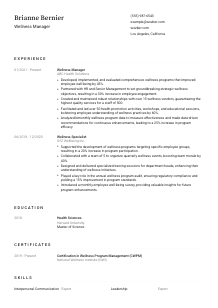
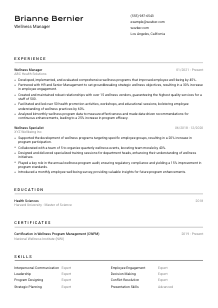
Promoting healthy vibes, but your resume feels under the weather? Perk up with this Wellness Manager resume example, created with Wozber free resume builder. Learn how to effortlessly bring your wellness leadership in line with job specifics, helping your career journey stay in tip-top shape!

Wellness Managers are hired to turn broad well-being goals into programs people actually use. On paper, that means your resume needs to show more than interest in health promotion. It should make your program design, employee engagement results, vendor coordination, and cross-functional work with HR or leadership easy to spot.
Screening often narrows quickly when resumes stay too general about workshops, benefits, or wellness initiatives. Using Wozber's free resume builder to tailor your wording and create an ATS-compliant resume helps surface the terms employers search for, from wellness program management to participation outcomes, so your experience reads clearly as operational leadership rather than general people support.
For a Wellness Manager, the header should confirm that you are straightforward to contact and already aligned with the role's practical requirements. Keep it clean, professional, and focused on details that remove friction for the employer.
Use your full name at the top in a clear, readable style. Hiring teams reviewing wellness leadership resumes move quickly, so your name should be easy to find and easy to remember.
Place "Wellness Manager" under your name if it reflects the role you are pursuing. This immediately frames your background around program ownership, employee well-being strategy, and stakeholder leadership rather than a broader health promotion label.
Include a reliable phone number and a professional email address. If you also link to LinkedIn or a professional profile, make sure it reinforces your resume with relevant work such as wellness initiatives, speaking engagements, or health promotion leadership.
If the employer asks for a specific location, state it clearly in your header. Here, Los Angeles, California is a stated requirement, so listing that location the way the sample resume does helps remove an avoidable screening barrier.
A website or profile link should add context, not clutter. For this profession, that might include a profile showing wellness program leadership, community health work, certifications, or presentations delivered to employees or leadership teams.
These details should confirm that you are reachable, professionally presented, and logistically aligned with the opening before the reader reaches your program results.




This section carries the most weight for a Wellness Manager. Employers want to see that you have owned programs, increased participation, worked across departments, and used data to improve outcomes, not simply supported wellness activities from the sidelines.
Mark the responsibilities and requirements that define the role. In this case, that includes comprehensive wellness programming, participation outcomes, partnership with HR and senior management, budget alignment, vendor management, employee education, and program analysis. Those are the themes your experience bullets should cover.
List your positions in reverse chronological order and make sure your recent roles show increasing responsibility. A title like "Wellness Manager" or "Wellness Specialist" already helps, but the bullets need to clarify whether you designed initiatives, led workshops, managed vendors, or reported results to leadership.
Replace task-only statements with accomplishment-focused bullets that show scale and impact. The sample resume does this well with results like improving employee well-being by 45%, increasing engagement by 30%, and lifting program efficacy by 25%. Those numbers make the work tangible and show that the candidate measured what happened after implementation.
Wellness work becomes more credible when you show operating context. Mention the employee population served, how often you analyzed data, how many workshops you led, or how many vendors you managed. Details like a staff of 500, bimonthly reporting, or 50-plus sessions help the reader understand scale and consistency.
Prioritize roles and bullets that support wellness strategy, health promotion, employee engagement, education, and program evaluation. If earlier experience is less relevant, keep it brief or remove it so the resume stays focused on the work most connected to a Wellness Manager's day-to-day responsibilities.
A strong experience section makes it easy to see that you can build programs, influence participation, work with leadership, and improve results over time.
For this role, education is a clear qualification check. Degrees in nutrition, health sciences, or related fields help establish subject-matter grounding in employee well-being, prevention, and health promotion.
If you hold a bachelor's degree in Nutrition, Health Sciences, or a related field, list it clearly. When you also have a master's degree, include it prominently because it strengthens your profile for roles that involve program strategy, leadership communication, or organizational planning.
Present each entry with degree, field of study, school, and graduation year. This format is easy for both recruiters and ATS systems to read, and it quickly confirms that you meet the stated academic requirement.
When your education directly matches the posting, let that alignment work for you. The sample resume pairs a Master of Science in Health Sciences with a Bachelor of Science in Nutrition, which closely reflects what this employer asked for without extra explanation.
If you are earlier in your career, relevant coursework or academic projects can add useful context. Topics such as public health, behavior change, program evaluation, nutrition science, or health communication can support your case when professional experience is still growing.
Honors, leadership roles, or research work belong here only when they reinforce your wellness profile. For example, a capstone on employee health behavior or leadership in a campus wellness initiative can strengthen the section if it connects directly to program design or health promotion.
Your education section should quickly show that you meet the field requirements and have a solid foundation for designing credible wellness initiatives.
Certifications matter most when they reinforce the kind of program leadership the job requires. In wellness management, the right credential shows current practice knowledge and a serious commitment to the field.
If the employer mentions a preferred credential, include it exactly as recognized in the market. Here, Certification in Wellness Program Management, or CWPM, is worth highlighting because it directly supports the role's focus on structured wellness program leadership.
Feature certifications tied to wellness program design, health promotion, behavior change, occupational well-being, or related leadership areas. Leave out certifications that do not strengthen your case for managing employee wellness strategy or vendor-supported services.
Include completion dates or an active date range when relevant. In a field shaped by changing best practices, benefit trends, and employee health priorities, current credentials carry more weight than undated entries.
If you do not yet hold a preferred certification, pursuing one can strengthen future applications. For Wellness Managers, ongoing professional development in program management, data analysis, mental health promotion, or workplace well-being can help you stay aligned with employer expectations.
The right credential supports your experience with a recognized standard in wellness practice and can give added weight to your program management background.
A Wellness Manager's skills section should read like the toolkit behind program delivery and employee engagement. Focus on abilities that support strategy, communication, implementation, and measurement.
Read the posting for stated skills and for the work behind them. Here, interpersonal communication, leadership, presentation skills, wellness program design, vendor management, strategic planning, and data analysis are all central to how the role is performed.
Choose skills that connect directly to responsibilities you can back up in your experience section. If you list employee engagement, workshop facilitation, or decision-making, make sure your bullets show where you improved participation, led sessions, or shaped program changes based on data.
Keep the list focused on capabilities most relevant to running effective wellness programs. The sample resume handles this well by emphasizing leadership, program designing, strategic planning, employee engagement, presentation skills, vendor relationship management, and data analysis rather than filling space with generic strengths.
The best skills lists support the same picture shown elsewhere on the resume: someone who can plan wellness initiatives, engage employees, and manage results.
Communication is central to wellness management, especially when you are presenting programs, leading workshops, and building trust across a diverse employee population. Your language section should support that part of the role without overstating it.
If the role calls for English communication, list English first and note your proficiency accurately. This immediately confirms a core requirement for presentations, vendor coordination, reporting, and employee education.
Place the language most important to the job first, then add others that could be useful in the workplace. For many employee-facing wellness roles, additional languages can support accessibility, participation, and rapport across different teams or communities.
Additional language ability can be a practical advantage when wellness initiatives depend on trust and clear communication. In the sample resume, Spanish adds value because it may help in workshops, one-on-one interactions, or outreach in a diverse workforce.
Use clear labels such as Native, Fluent, Intermediate, or Basic. Inflated language claims can create problems quickly in a role where speaking, presenting, and responding to employee questions are part of the job.
For Wellness Managers, language skills are most relevant when they improve participation and understanding. If another language helps you deliver sessions, explain wellness resources, or build stronger engagement with employees, it is worth including.
This section works best when it clearly supports your ability to communicate wellness guidance, lead sessions, and connect with the employee population you serve.
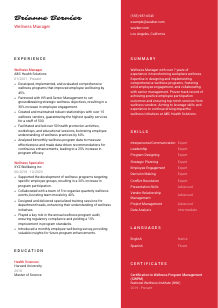
Your summary should quickly establish your level, your specialty, and the kind of outcomes you deliver. For a Wellness Manager, that usually means showing experience in program design, employee engagement, cross-functional leadership, and measurable improvement.
Start with the parts of the role that matter most, such as workplace wellness strategy, health promotion, program implementation, and evaluation. This keeps the summary tied to the operational side of the job rather than broad enthusiasm about wellness.
Your first line should state your years of experience and your professional lane. A phrase like "Wellness Manager with 7+ years of experience in workplace wellness and health promotion" gives immediate context and positions you for a role requiring at least 5 years.
Use the next lines to highlight what you are known for. The sample summary points to comprehensive wellness programs, employee engagement, collaboration with senior management, and positive participation outcomes, which closely mirrors the employer's priorities.
Aim for a short paragraph that can be read in seconds. Three to five lines is usually enough to connect your experience, your strengths, and the value you bring without repeating the full experience section.
A well-written summary tells the reader, right away, that you understand workplace wellness at both the program and leadership level and can deliver results employees actually engage with.
A Wellness Manager resume works best when every section supports the same message: you can design relevant programs, engage employees, work effectively with HR and leadership, and improve outcomes with data. That is the thread hiring teams look for across your title, achievements, skills, and summary.
Use Wozber's free resume builder to organize that story in an ATS-friendly resume format, then refine the language with Wozber's ATS resume scanner so the final version reflects the posting's priorities clearly and credibly. When the tailoring is done well, your resume makes your readiness to lead workplace wellness programs much easier to judge.




