



Use Wozber and land your dream job
Create Resume
No registration required
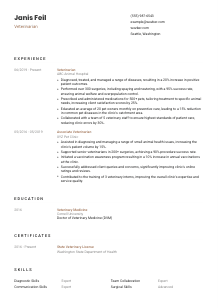
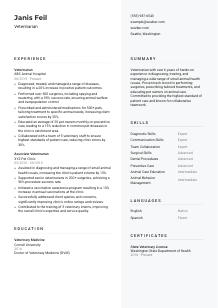
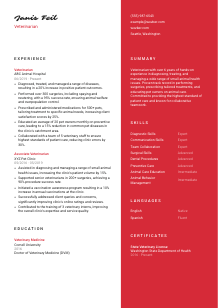
Healing paws, but your resume feeling sickly? Check out this Veterinarian resume example, created with Wozber free resume builder. Learn how to blend your animal-caring expertise with job specifics, crafting a career journey that's as healthy and robust as your furry patients!
Veterinary resumes are read through the lens of patient care, clinical judgment, and day-to-day caseload reality. Hiring teams want to see whether you can move from routine wellness exams to diagnostics, surgery, dental work, treatment planning, and client conversations without losing accuracy or pace. A resume that stays generic often hides the very details that matter most in small animal practice.
A tailored resume changes what stands out first. When your language reflects the clinic's work, such as small animal experience, surgical scope, preventive care, and team coordination, it becomes much easier for screening systems and practice leaders to connect your background to the caseload they need covered. Wozber's free resume builder helps you shape that experience into an ATS-compliant resume that quickly surfaces your clinical range, licensure status, and ability to deliver reliable patient care.
The top of your resume should tell a clinic exactly who you are, what role you perform, and whether basic logistics are already aligned. In veterinary hiring, that means clear identity, a professional title, and contact details that make outreach simple during a busy interview process.
Use your full name prominently at the top so it anchors the document cleanly. Keep the formatting simple and professional. In a clinical field where precision matters, flashy styling adds nothing, while a clear heading makes the resume easier to scan during a fast review between appointments or surgery blocks.
Place "Veterinarian" directly under your name if that is the role you are targeting. Matching the title used in the posting helps both ATS filtering and human review, especially when clinics are sorting among associate veterinarians, medical directors, emergency vets, and specialty candidates.
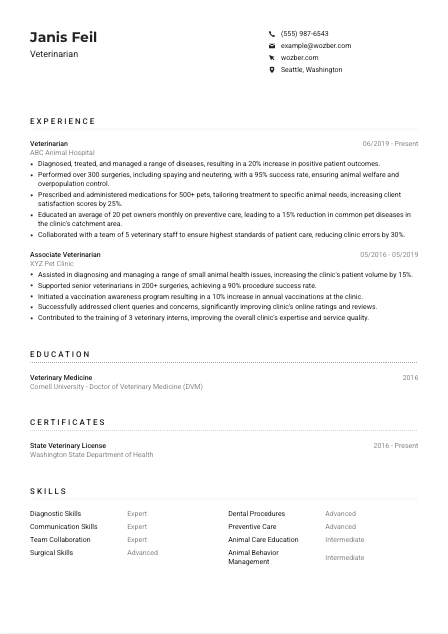
If the job requires local presence, include your city and state. For the example opening, listing "Seattle, Washington" immediately supports the employer's location requirement and removes an early question about relocation or commute feasibility. For other veterinarian roles, only include location detail to the extent that it helps confirm your practical availability.
A website, LinkedIn profile, or professional bio page can help if it reinforces your credentials, clinical interests, continuing education, or association activity. Only include it if the content is current and consistent with your resume. For veterinarians, that might mean highlighting DVM credentials, licenses, dentistry training, shelter work, or conference participation rather than a generic social profile.
This section should answer basic operational questions fast: who you are, how to reach you, what role you practice in, and whether location aligns. That clarity lets the reader move straight to your clinical background.




Veterinary experience is where a clinic decides whether your background matches its caseload, pace, and standard of care. Titles alone are not enough. Your bullets should show what kinds of patients you treated, what procedures you handled, how you worked with technicians and staff, and what results followed from your care.
Before editing this section, mark the duties and capabilities the clinic repeats or emphasizes. In this example, the priorities are small animal practice, diagnostics, surgery, dental procedures, vaccinations, client education, and teamwork. Those are the themes your experience bullets should reflect, using the same professional language when it matches your real work.
Use reverse-chronological order and make each role easy to scan with title, employer, and dates. Recent practice experience carries the most weight because it shows your current caseload exposure, procedural confidence, and familiarity with modern workflows in general practice or hospital settings.
Focus each bullet on work that matters in veterinary medicine: diagnosing conditions, managing treatment plans, performing spays and neuters, handling dental procedures, prescribing medications, improving preventive care uptake, or guiding owners through treatment decisions. The sample resume does this well by tying routine responsibilities to outcomes such as patient improvement, client satisfaction, and reduced clinic errors.
Quantified details make veterinary experience more credible. Procedure volume, success rates, patient counts, vaccination growth, client education activity, or team size all help define your scope. Saying you performed more than 300 surgeries or managed medications for 500+ pets gives a hiring manager a much stronger read on your level than a broad claim about being "experienced."
Keep the section tightly aligned with the type of veterinary work you want next. If the role is in small animal practice, prioritize companion animal diagnostics, surgery, dentistry, wellness care, and client communication over unrelated research, administrative tasks, or species areas that are not central to the opening. Every bullet should support your ability to step into the clinic's workflow with minimal ramp-up time.
The experience section should leave no doubt about the medicine you practice, the procedures you perform, and the level of responsibility you already carry. When those details are clear, your resume starts to sound like someone the clinic can trust with patients, clients, and a full appointment book.
For veterinarians, education is not a soft background detail. It confirms that you hold the professional foundation required to practice medicine, pursue licensure, and take clinical responsibility for diagnosis, treatment, surgery, and preventive care.
If the job asks for a Doctor of Veterinary Medicine, list your DVM clearly and exactly. That degree is the main educational checkpoint for the role, so it should be impossible to miss. In the example, "Doctor of Veterinary Medicine (DVM)" from Cornell University answers that requirement immediately.
Present degree, field, school, and graduation year in a clean order. This is one of the quickest sections a hiring team reviews, often alongside licensure, so clarity matters more than extra description.
Use the formal degree name rather than abbreviating loosely or rephrasing it. Exact wording helps with ATS matching and avoids any ambiguity, especially when employers are screening for accredited veterinary education as a baseline requirement.
If coursework, clinical rotations, externships, or concentration areas support the position, include them briefly. This is most useful for early-career veterinarians or for roles that value a specific focus such as small animal medicine, surgery, dentistry, or preventive care protocols.
Awards, leadership, research, or veterinary association involvement can help when they reinforce your professional direction. Keep these additions relevant. A student surgery award, shelter medicine project, or leadership role in a veterinary association adds more value here than general campus activities.
This section should confirm your veterinary education without forcing the reader to hunt for it. Once your DVM is easy to spot, the clinic can move on to the practical question that matters next: how you have applied that training in practice.
In veterinary hiring, credentials often determine whether an application can move forward at all. A clinic may like your experience, but if state licensure or continuing education status is unclear, the process can stall immediately.
Review the posting for mandatory credentials before listing anything else. Here, the critical item is a valid state veterinary license with compliance on continuing education. That should appear ahead of optional training because it confirms you can legally practice in the state.
Order this section by relevance, not by prestige. For most veterinarian roles, an active state license belongs at the top. The sample resume handles this correctly by listing the Washington State veterinary license first, which directly supports eligibility for the Seattle role.
Include the issuing body and dates so the employer can quickly understand whether the credential is current. For licenses, "2016 - Present" communicates active standing more clearly than leaving timing unstated. If a certification expires, show that date plainly.
Beyond licensure, include certifications or CE that sharpen your match for the practice. Dentistry courses, ultrasound training, fear-free handling, anesthesia, or surgery-focused education can strengthen your profile when they relate to the employer's caseload and services.
A clinic should be able to confirm your practice eligibility from this section in seconds. Once licensure and relevant training are easy to find, the rest of your resume can do the heavier work of showing clinical range and patient-care results.
A veterinarian's skills section should read like a practical snapshot of how you work in clinic, not a list of generic strengths. The best version combines clinical competencies with the interpersonal abilities that shape owner communication, treatment compliance, and collaboration with technicians and support staff.
Read the job description with an eye for actual clinic work. In this case, the role calls for diagnostic, surgical, and dental skills, routine check-ups, vaccinations, communication, and teamwork. Those are stronger anchors than broad terms because they map directly to what you would be doing each day.
Use the same terminology the clinic uses if it reflects your experience accurately. "Diagnostic skills," "dental procedures," "preventive care," and "team collaboration" are all easy for ATS tools and human reviewers to connect to the role. Wozber's AI resume builder can help you spot those recurring terms and align your wording naturally rather than stuffing keywords.
Place the most role-critical abilities first, with clinical skills leading for most veterinarian jobs. The example resume gets this balance right by putting diagnostics, communication, collaboration, surgery, and dental work near the top. Keep the list focused enough that each skill supports the kind of medicine the clinic needs delivered.
If someone reading this section can already imagine you handling exams, discussing treatment options, coordinating with technicians, and moving confidently through common procedures, the list is doing its job.
Veterinary medicine depends on clear communication as much as clinical knowledge. You need to explain symptoms, treatment options, medication instructions, surgical aftercare, and preventive plans in language pet owners understand, while also working smoothly with a clinical team.
If the posting specifies language ability, place that first. For this role, fluent English is a stated requirement, so it should appear clearly in the section to confirm you can manage consultations, medical explanations, and day-to-day clinic communication.
Use standard labels such as "Native," "Fluent," or "Intermediate." Inaccurate ratings can create problems quickly in a profession where communication affects consent, treatment compliance, and client trust.
Extra languages can be a real advantage in companion animal practice, especially in diverse communities where owners may be more comfortable discussing symptoms and care plans in another language. In the sample resume, Spanish adds practical value without being treated as a requirement for every veterinarian role.
Only list languages you can actually use in a professional setting. If you can explain medication schedules, discharge instructions, and preventive care guidance in a second language, that is worth showing. If not, leave it off rather than overstating your ability.
Language skills matter because they affect medical accuracy and owner follow-through. Clear conversation can improve history-taking, reduce confusion about treatment plans, and support better compliance with vaccines, medications, and recheck visits.
This section is most effective when it reinforces your ability to guide owners clearly and work smoothly across the clinic. For a client-facing veterinarian, that has direct value in patient outcomes and day-to-day trust.
The summary is where you give the reader a fast, accurate picture of your clinical background. For veterinarian roles, that means years of experience, practice type, procedural strengths, and the kind of patient care environment you know how to support.
Before writing the summary, identify the two or three priorities the clinic cares about most. In this posting, that includes small animal clinical experience, surgery and dentistry, preventive care, and collaborative communication. Those themes should shape what you mention first.
State that you are a veterinarian and include your years of relevant experience. The example summary does this effectively with more than 6 years in small animal health, which immediately places the candidate above the posting's minimum of 3 years of clinical experience.
Follow with the capabilities that define your practice, such as diagnosing a broad range of conditions, performing common surgeries, prescribing treatment plans, or educating pet owners on preventive care. Keep the language specific enough that the clinic can connect your background to its actual services.
Aim for 3 to 5 lines that sound grounded, not promotional. This section works best when it reads like a concise clinical profile, not a mission statement. If you use Wozber to tailor it, make sure the final wording still reflects your real caseload, strengths, and professional style in an ATS-friendly resume format.
Your summary should make the rest of the resume easier to read by establishing your experience level, practice focus, and core strengths right away. When that opening is sharp, a hiring team can quickly place you in the kind of veterinarian role you are prepared to handle.
A veterinarian resume works best when it makes the essentials obvious: DVM qualification, active licensure, small animal clinical experience, procedural range, owner communication, and teamwork inside the clinic. Those details carry far more weight than generic statements about passion or dedication.
Use Wozber to organize that information in an ATS-friendly resume template, align your language with the job description, and strengthen ATS optimization without losing the specifics of your real practice. The finished resume should make it easy for a clinic to see how you will handle patients, support clients, and contribute from day one.




