



Use Wozber and land your dream job
Create Resume
No registration required
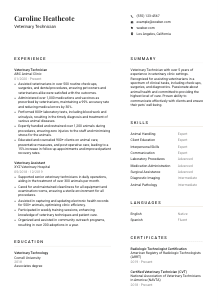
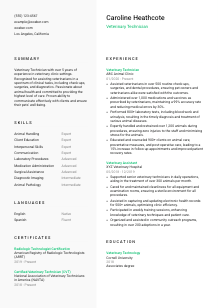
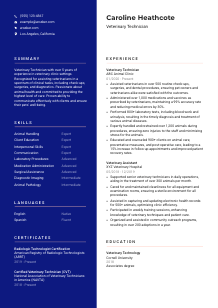
Paw-sitively caring for critters, but your resume feels ruff? Check out this Veterinary Technician resume example, created with Wozber free resume builder. Learn how to showcase your animal expertise to match job needs, leading you to career pathways as unique as a cat's curiosity!
Veterinary technicians work where clinical precision and calm animal handling meet. Hiring teams look for resumes that make day-to-day patient care visible: assisting during exams and procedures, running lab work accurately, administering medications safely, and communicating clearly with worried pet owners in a busy clinic setting.
A tailored resume changes how quickly that clinical scope comes through, especially when an ATS scans for terms tied to veterinary workflow, credentials, and hands-on care. Wozber's free resume builder helps you line up your wording with the posting, keep an ATS-friendly resume format, and show that your experience translates directly to safe, reliable support in the treatment room.
Clinic hiring starts with practical basics. Your contact details should immediately confirm who you are, what role you perform, and whether you meet straightforward requirements such as location and communication readiness.
Use your full name in a clean, readable format at the top of the page. In a field built on trust, accuracy, and client-facing communication, your header should feel as professional as the charting and patient care you provide.
Place "Veterinary Technician" directly under your name when that reflects your actual qualification. This helps the employer quickly connect your resume to the role they are filling, especially when they are screening for licensed technician candidates rather than assistants or kennel staff.
List a current phone number and a professional email address. Veterinary clinics often move quickly when scheduling interviews or trial shifts, so make it easy to reach you without distractions or outdated information.
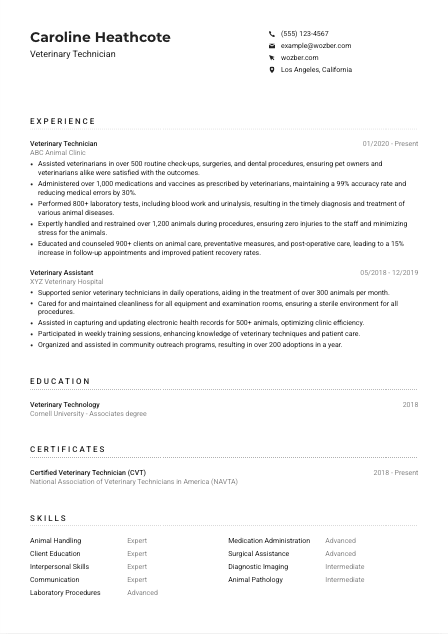
If the job asks for someone based in a specific area, include your city and state. In the example, "Los Angeles, California" directly addresses the employer's local requirement and removes an avoidable question early in the review process.
A LinkedIn profile can be useful if it supports your resume with consistent job titles, certifications, or clinic experience. Only include it when it is current and reinforces your work with patient care, lab procedures, client communication, or related veterinary responsibilities.
This section does not need personality or filler. It needs to confirm that you are a reachable, appropriately titled candidate who can step into the clinic hiring process without extra follow-up.




For veterinary technician roles, experience is where employers look for proof that you can function in a clinical setting. Focus on work that shows patient handling, procedural support, medication accuracy, diagnostics, documentation, and client education under real clinic conditions.
Read the posting for the core responsibilities that define the role. Here, that includes assisting with routine check-ups, surgeries, and dental procedures, administering medications and vaccines, running blood work and urinalysis, handling animals safely, and educating clients. Your experience bullets should mirror that clinical mix when it reflects your background.
For each position, list employer, title, and dates, then use bullets that show the kind of caseload and work environment you handled. The example does this well by leading with hands-on veterinary technician work in a clinic, then backing it up with procedure volume, medication administration, and lab testing rather than vague task descriptions.
Veterinary employers already know a technician assists with care. What they need to see is how well you performed that care. Instead of writing "helped with surgeries," write bullets that show volume, accuracy, safety, turnaround time, or client follow-through. A line about increasing follow-up appointments or supporting timely diagnosis says much more than a generic duty ever will.
Metrics fit naturally in this profession when they describe patient volume, medication accuracy, number of lab tests, reduced errors, or safe restraint during procedures. The sample's figures such as 1,000+ medications administered with 99% accuracy and 800+ laboratory tests make the candidate's pace and reliability much easier to understand.
Prioritize experience that proves readiness for technician-level responsibilities. If an older role included general support tasks, keep the bullets that connect to patient care, electronic records, sterile prep, or workflow support, and cut details that do not strengthen your case for clinical competence.
Your experience section should leave no doubt that you can contribute in exam rooms, treatment areas, and client conversations from day one. Wozber can help you shape those bullets into an ATS-friendly resume format that keeps the clinical substance easy to spot.
Veterinary technician hiring often begins with formal training requirements. Your education section should make it easy to see that you completed the right program and have the academic foundation for laboratory work, pharmacology, anesthesia support, and patient care.
When a posting asks for an Associate degree in Veterinary Technology from an AVMA-accredited program, make that credential easy to find. Lead with the degree name and field so the reviewer does not have to search for whether you meet a core eligibility requirement.
List degree, field of study, school, and graduation year or date in a consistent structure. Simple formatting helps both ATS parsing and human review, especially when credentials are a firm screening point for veterinary technician roles.
If your program was in Veterinary Technology, say that directly rather than using a broad science label. Specific wording matters here because employers are checking for technician training that supports clinical procedures, diagnostics, and animal care standards.
You do not always need coursework, but it can help early-career candidates. If you recently graduated, consider including clinical rotations, anesthesia training, radiology coursework, or lab diagnostics experience that connects to the work in the posting.
Academic awards, high achievement in veterinary coursework, or leadership in animal-health programs can add value when they reinforce your technical preparation. Keep these details only if they support your readiness for clinic work rather than crowding the section.
For this profession, education is often a screening checkpoint before your experience is even discussed. Present it clearly so the employer can quickly see that your training supports the procedures and patient care the role requires.
In veterinary medicine, certifications are not decoration. They often determine whether you can legally practice, support certain procedures, or move forward in the hiring process at all.
If the employer asks for an active state Veterinary Technician license or CVT or RVT certification, list that credential at the top of this section. In the example, the CVT is the certification that directly answers the posting, so it deserves the most visible placement.
Choose certifications that strengthen your ability to perform the job. Technician licensure, radiology credentials, anesthesia-related training, fear-free handling, or animal CPR can all be relevant depending on the clinic. Skip anything that does not connect to patient care or veterinary operations.
Show whether a credential is current by listing the year earned and, if applicable, "Present." For licensed clinical roles, currency matters because employers need to know you can step into the position without certification gaps.
Veterinary clinics value technicians who keep their skills current, whether through continuing education, specialty training, or expanded procedural competence. Refresh this section regularly so it reflects where you can add value today, not just where you started.
This section should quickly confirm that you meet licensure expectations and bring current veterinary training into the clinic. In an ATS-compliant resume, clear credential wording also helps your application surface for the right searches.
A veterinary technician skills section should read like a clinic-ready toolkit. Focus on the abilities that support patient handling, diagnostics, treatment support, documentation, and communication with veterinarians and pet owners.
Use the job description to identify the work the clinic actually needs done. Here that includes veterinary equipment and software, lab testing, medication administration, animal restraint, and strong communication. Those requirements point to a balanced skills section with both clinical and client-facing capability.
List the skills you use in veterinary settings, not every ability you have ever developed. Relevant entries might include animal handling, laboratory procedures, surgical assistance, medication administration, diagnostic imaging, electronic medical records, and client education. The example works because the selection stays close to technician responsibilities.
A shorter, sharper list is more useful than a long inventory. Prioritize the abilities most likely to matter in exam rooms, treatment areas, and client discharge conversations, and use wording that matches the posting naturally so both recruiters and ATS systems can connect your background to the role.
The right skills list helps a clinic picture how you will function on shift, from restraint and lab work to owner communication. Wozber's ATS resume scanner can help you align this language with the job ad without turning the section into a keyword dump.
Veterinary technicians spend a surprising amount of time translating clinical information into clear guidance for pet owners. If language ability helps you communicate more effectively with clients or team members, it is worth showing here.
When a posting specifies English communication, list English prominently with your proficiency level. That directly addresses a stated requirement and supports the client education side of the job, from explaining medications to reviewing post-operative instructions.
Additional languages can be a real asset in busy community clinics. In the example, fluent Spanish is useful because it can improve communication with pet owners in a multilingual service area. Treat this as a strength, not a requirement for every veterinary technician role.
Be clear about your level, such as Native, Fluent, Conversational, or Basic. In a clinical environment, accurate self-reporting matters because misunderstandings around dosage instructions, symptoms, or follow-up care can affect patient outcomes.
Even when not required, another language can strengthen your resume if it helps with intake conversations, discharge education, scheduling, or community outreach. Keep the section practical and tied to how you communicate in veterinary settings.
Language ability can reflect adaptability and stronger rapport with clients, but keep the emphasis on real use. The value lies in helping owners understand treatment plans and care instructions clearly, especially in emotionally charged visits.
This section works best when it reinforces a practical advantage in client communication and clinic service. For veterinary technician roles, that means clearer education, smoother intake, and better support for owners making care decisions.
Your summary should give a clinic a quick read on your level, setting, and strongest contributions. Keep it grounded in veterinary work, with enough detail to show what kind of technician you are and where you add value fastest.
Before writing, identify the work the clinic needs covered most urgently. If the posting emphasizes procedures, diagnostics, medication administration, and client education, your summary should bring those elements forward instead of relying on broad statements about loving animals.
A direct opener works well here. Something like "Veterinary Technician with over 5 years of experience in veterinary clinic settings" quickly establishes level and environment, which helps separate technician candidates from assistants, interns, or general animal care applicants.
Use the next lines to name the work you actually do well, such as supporting surgeries and dental procedures, performing lab testing, administering medications, or educating clients on post-operative care. The example summary succeeds because it points to a broad but clearly clinical range of responsibilities.
Aim for a short paragraph that reads cleanly and stays rooted in real practice. If you mention strengths, tie them to settings or outcomes, such as clinic experience, diagnostic support, patient care quality, or client communication, rather than leaning on generic enthusiasm alone.
By the end of this section, a hiring manager should understand your level, your clinical range, and the kind of support you bring to veterinarians and pet owners. Wozber's free resume builder can help you refine that opening into an ATS-compliant resume that stays concise while sounding specific.
A veterinary technician resume works when it makes clinical competence easy to recognize. Clear credentials, hands-on experience, relevant skills, and a summary grounded in patient care give hiring teams a straightforward picture of how you will perform in the clinic.
Use Wozber to organize each section, tailor your language to the posting, and strengthen ATS optimization without losing the practical details that matter in veterinary medicine. The finished resume should make your readiness for exams, procedures, diagnostics, medication support, and client education easy to judge.




