



Use Wozber and land your dream job
Create Resume
No registration required
Primping pooches, but your resume looks a bit scruffy? Tidy up your career narrative with this Pet Groomer resume example, created with Wozber free resume builder. Learn how to align your grooming skills with job specifics, creating a career profile groomed to perfection!
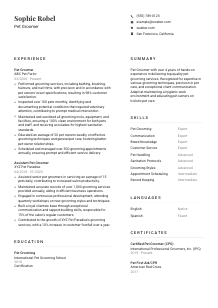
Pet grooming gets judged in the details. A hiring manager wants to see that you can handle animals calmly, execute breed-appropriate cuts, keep sanitation standards tight, and notice when a skin issue, ear problem, or nail condition should be flagged for veterinary follow-up. Your resume should make that day-to-day judgment and care visible, not just state that you love animals.
When the resume is tailored well, the first read becomes much clearer. Wozber's free resume builder helps you line up your grooming experience, certifications, and service language with the posting in an ATS-friendly resume format, so employers can quickly see whether you cover the core work, from bathing and trims to owner communication and record keeping. That matters in a role where practical salon readiness is the first question.
Pet grooming is hands-on, local, and appointment-driven, so your contact section needs to confirm that you are reachable, professional, and available for the market you are applying to.
Use your full name as the clearest header on the page. Keep it larger than the rest of the text so the salon manager can immediately connect your application, certifications, and experience history without searching.
Place "Pet Groomer" directly under your name if that is the job you are applying for. Matching the posting title helps with ATS alignment and tells the reader right away that your background is centered on grooming work rather than general pet care, kennel support, or retail.
List a phone number you answer reliably and a professional email address. For pet grooming roles, missed calls can mean missed working interviews, trial shifts, or appointment-based hiring follow-ups, so accuracy here matters more than people think.
If the employer asks for local availability, include your city and state. In this example, San Francisco, California should appear clearly because the posting names it as a requirement. That immediately removes a common point of hesitation for salon employers hiring around client demand and schedule coverage.
A LinkedIn profile, portfolio site, or social page can work if it shows grooming results, client-facing professionalism, or steady work history. Only include it if the content is current and consistent with your resume. A clean gallery of breed-specific cuts or before-and-after grooming work can support your application better than a generic profile.
Your contact details should confirm three things fast: who you are, which grooming role you want, and how easily a salon can reach you. When those basics are handled well, the rest of the resume can focus on your technical grooming work.




This section carries the most weight for a Pet Groomer because employers want proof that you can groom safely, manage volume, communicate with owners, and keep standards high in a live salon setting.
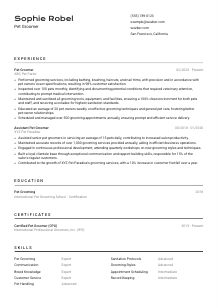
Read the job description closely and mirror the real work using your own experience. For this role, that includes bathing, brushing, haircuts, nail trims, pet inspection, sanitation, owner education, scheduling, and service records. The sample resume does this well by using the same service language the employer uses, which helps both ATS matching and human review.
Start with your most recent grooming position and work backward. For each role, include job title, employer name, and dates. That structure helps hiring managers trace how you moved from assistant-level work into more independent grooming, client handling, or higher-volume salon responsibility.
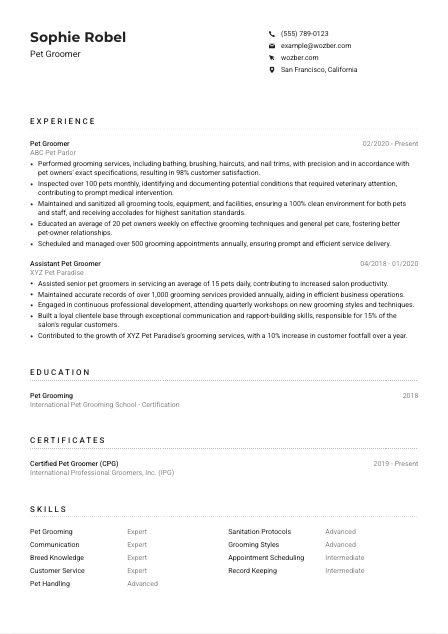
Do not stop at "responsible for grooming pets." Show scale, quality, or business impact. The example bullets mention 98% customer satisfaction, 100 pets inspected monthly, and 500 appointments managed annually. Those numbers tell the employer you can handle volume while maintaining owner trust, pet safety, and reliable operations.
A grooming resume gets stronger when it shows care beyond styling. Mention cleaning protocols, tool sanitation, safe restraint and handling, and cases where you spotted coat, skin, ear, or nail issues that needed veterinary attention. That kind of judgment is highly relevant because grooming salons depend on staff who protect both animals and workplace hygiene.
Each bullet should reinforce your value in a grooming environment. Prioritize grooming techniques, breed familiarity, owner communication, scheduling, repeat clientele, and sanitation standards over unrelated duties. If you have earlier pet industry experience, frame it around pet handling, customer service, or record accuracy so it still strengthens your case for grooming work.
A hiring manager should be able to picture you taking a dog from check-in to handoff, handling the grooming work safely, documenting what matters, and keeping the space clean for the next appointment. If your experience section shows that workflow clearly, it is doing its job.
Hands-on grooming experience often leads the decision, but education still matters when the employer asks for a diploma, formal training, or a recognized grooming foundation.
If the posting asks for a high school diploma or equivalent, make sure it appears on the resume. It is a simple requirement, but leaving it out can create an avoidable screen-out in an ATS or during an initial review.
List the school or training provider, the credential, the field of study, and the completion date. Pet grooming employers do not need a long academic narrative here. They need to see that your training background is legitimate and easy to verify.
Formal pet grooming education deserves clear placement because it directly supports the role. In the example, a grooming certification from the International Pet Grooming School does exactly that. If you completed breed-specific grooming courses, handling programs, or coat-care training, include them when they strengthen your technical profile.
Short courses can help if they add something practical, such as animal handling, canine anatomy, salon sanitation, pet first aid, or advanced clipping techniques. Include them when they explain how you built the skills behind your grooming experience.
Awards, distinctions, or memberships can stay if they are connected to animal care, grooming training, or disciplined technical development. Skip extra academic detail that does not help the employer understand your grooming preparation more clearly.
For pet grooming, education works best when it confirms the essentials and backs up your technical training. Keep it concise, relevant, and clearly tied to the work you do in the salon.
Certifications matter in pet grooming because they show formal training, current standards, and a serious approach to animal handling, safety, and grooming technique.
This posting asks for certification from a recognized pet grooming school or organization, so lead with that. A credential such as Certified Pet Groomer can strengthen your application because it tells the employer you were trained against industry standards rather than learning only informally.
Choose certificates tied to grooming practice, pet handling, coat and skin care, sanitation, or animal safety. A shorter list of directly relevant credentials will land better than a longer list of unrelated training items.
Include the year earned and note whether the certification is current if renewals apply. In a grooming role, current credentials suggest that your methods, safety knowledge, and professional standards are up to date.
Workshops on breed trims, hand-stripping, low-stress handling, or updated grooming techniques can add useful depth. The sample experience mentions quarterly workshops, which is a strong example of how to show that your skills continue to develop beyond your initial training.
Well-chosen certifications tell the employer that your grooming work is backed by formal instruction and current practice. In a field built on trust, animal safety, and technique, that adds real weight.
The skills section should reflect how pet grooming is actually done, from handling and clipping to client communication and appointment flow.
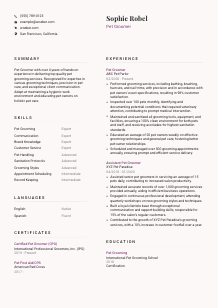
Pull the employer's language into your skills section where it truthfully matches your background. Here, that means pet grooming, breed knowledge, grooming styles and techniques, communication, and owner-facing service. This kind of wording helps ATS optimization while keeping your resume grounded in the work.
A Pet Groomer needs both. Technical skills may include bathing, brushing, de-shedding, clipping, scissoring, nail trims, coat assessment, pet handling, and sanitation protocols. Soft skills should focus on owner consultation, listening to grooming instructions, explaining aftercare, and staying calm with anxious pets and busy schedules.
Do not crowd the section with every skill you have ever used. Choose the ones that support the actual job: safe handling, breed-specific grooming knowledge, customer service, scheduling, and record keeping. The sample resume does this effectively by combining hands-on grooming skills with operational ones such as appointment scheduling and service documentation.
If the list reads like a real shift in a grooming salon, it is probably on the right track. Keep the emphasis on practical grooming ability, owner communication, and clean, safe execution.
Pet grooming is highly client-facing. Owners need to explain preferences clearly, and groomers need to discuss coat condition, handling issues, aftercare, and any health concerns noticed during the service.
This posting specifically asks for strong English communication, so list English at the top with an accurate proficiency level. That tells the employer you can handle intake conversations, service notes, scheduling, and care recommendations without confusion.
If you speak additional languages, include them when you can use them in real customer interactions. In a diverse service market, another language can help with consultations, repeat business, and clearer owner instructions at drop-off and pickup.
Use clear labels such as Native, Fluent, Conversational, or Basic. Avoid overstating your ability. Grooming jobs involve live communication with clients, sometimes around sensitive topics like matting, behavior, or skin issues, so honest proficiency matters.
A second language is most valuable when it improves client experience and trust. For example, being able to explain coat maintenance or home brushing routines in a client's preferred language can strengthen retention and referrals.
For a Pet Groomer, language ability matters because service quality includes the handoff conversation, not just the groom itself. If a language helps you take instructions accurately or educate owners more effectively, it belongs here.
Language skills are most useful on a grooming resume when they support better consultations, clearer care guidance, and smoother client relationships. Keep the section honest and tied to real service value.
Your summary should quickly show how much grooming experience you have, what kind of work you handle confidently, and why an employer can trust you with both pets and owners.
Before writing the summary, identify the employer's priorities. In this case, the essentials are professional grooming experience, certification, breed and technique knowledge, strong communication, sanitation, and the ability to spot conditions that may need veterinary attention. Those are the points to build around, not generic enthusiasm for animals.
Lead with a direct line such as "Pet Groomer with 4+ years of professional experience." That gives immediate context and helps the reader place the rest of your background. The sample summary handles this well by starting with experience level and grooming identity right away.
Mention the parts of your work that matter most for the target role, such as breed-specific grooming, owner communication, sanitation standards, or pet condition checks. Use short, grounded proof points. For example, educating pet owners regularly or maintaining high sanitation standards says much more than broad claims about being passionate or hardworking.
Aim for three to five lines. A Pet Groomer summary should feel practical and credible, with enough detail to suggest salon readiness without repeating the full experience section. Save the deeper metrics and bullet-level achievements for the roles below.
A well-written summary should tell the employer, within a few seconds, that you can groom professionally, communicate well with owners, and work to safe, clean standards. That is the impression you want carrying into the rest of the resume.
A Pet Groomer resume works when it shows more than affection for animals. It should present clear grooming experience, reliable handling, sanitation discipline, owner communication, and the kind of judgment that keeps pets safe and clients coming back.
Use Wozber's free resume builder to tighten that message in an ATS-compliant resume, refine your wording with role-specific terms, and organize everything in an ATS-friendly resume template. The final result should make one thing easy to judge: you are ready to step into a grooming salon and do the work well.




