



Use Wozber and land your dream job
Create Resume
No registration required
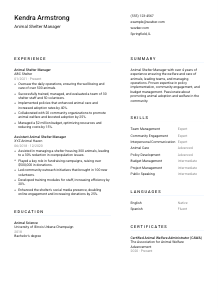
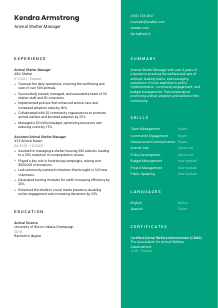
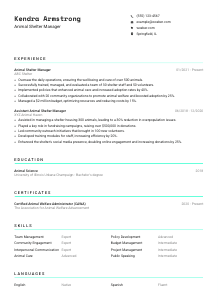
Rescuing furballs, but your resume feels caged? Browse this Animal Shelter Manager resume example, created with Wozber free resume builder. Learn how to blend your compassion and organizational skills to match job criteria, ensuring your career strides proudly alongside every wagging tail!
Animal shelter management sits at the intersection of animal care, staff leadership, public trust, and daily operational control. A resume for this work needs to show more than compassion. It needs to show that you can run safe shelter operations, guide staff and volunteers, improve adoption outcomes, manage resources responsibly, and keep animal welfare standards consistent under pressure.
Hiring teams quickly look for proof of hands-on shelter leadership, care oversight, and program results, especially when responsibilities span staffing, adoption performance, policy development, and budget control. Wozber's free resume builder helps you shape that experience into an ATS-friendly resume format, so core requirements such as shelter management experience, team supervision, and animal welfare credentials are easy to recognize early.
Shelter leadership roles often move quickly from resume review to interview scheduling, so your header should answer the practical questions first. Clear contact details, a matching job title, and location information help the employer confirm that you are reachable, aligned with the opening, and ready for the operational realities of the position.
Use your full name in the most visible text on the page. Keep the formatting professional and easy to read. In a people-facing leadership role where you will work with staff, volunteers, veterinarians, adopters, and community partners, a clear header sets a competent tone from the start.
Place "Animal Shelter Manager" directly under your name when that is the role you are pursuing. This immediately connects your resume to the position and helps both hiring managers and ATS tools place you in the right candidate pool. If your recent title was assistant manager or operations lead, your resume can still target the manager title as long as the experience supports it.
List a phone number you answer regularly and a professional email address, ideally in a format such as firstname.lastname@email.com. Shelter environments are fast paced, and interview requests may come from administrators, board members, or municipal contacts, so remove any friction from reaching you.
When a posting names a location, include your city and state if you already live there. If you are planning to relocate, make that clear in a concise way. For this opening, Springfield, IL is a stated requirement, so showing local availability or relocation readiness prevents your application from being screened out for logistics before your shelter experience is reviewed.
Include LinkedIn or another professional profile only if it supports your application with aligned experience, volunteer leadership, community work, or board involvement. Make sure the dates, titles, and achievements match your resume. Consistency matters when the role involves public credibility and organizational oversight.
This section should confirm that you are easy to contact, correctly aligned to the role, and positioned to meet any location requirement attached to the opening. Get those basics right and the reader can move straight to your shelter leadership experience.




For an Animal Shelter Manager, experience is where your resume earns credibility. Employers want to see how you handled animal volume, supervised teams, improved care or adoption processes, worked with the public, and managed the operational demands that come with running a shelter day to day.
Read the job description with a highlighter mentality. Mark the responsibilities and qualifications that define success, such as daily shelter operations, staff and volunteer management, policy development, community collaboration, adoption support, and budget oversight. Those points should directly shape the bullets you choose and the language you use.
Start with your most recent position and work backward. For leadership roles, include employer name, title, and dates in a clean format so the reader can quickly track your progression from hands-on shelter work to broader operational responsibility. If you moved from assistant manager into full shelter management, that upward path is worth making obvious.
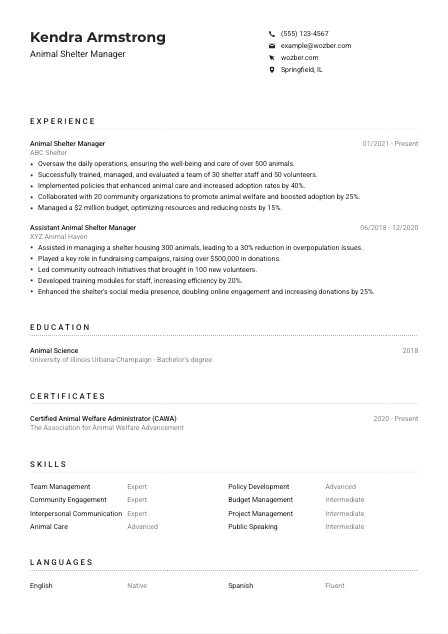
Every role should show what you were responsible for and what changed because of your work. Instead of saying you "managed operations," describe the scope and result. The example resume does this well by showing oversight of 500+ animals, supervision of 30 staff and 50 volunteers, and policy changes that raised adoption rates. That kind of wording tells the employer how large the operation was and what you improved.
Quantify results wherever the work naturally supports it. Useful metrics in this field include number of animals housed, adoption rate increases, volunteer growth, donation totals, cost reduction, training completion, intake or overcrowding reduction, and budget size. A line like "increased adoption rates by 40%" or "managed a $2 million budget" carries more weight than broad claims about impact.
Prioritize roles that demonstrate animal welfare operations, people management, public engagement, and resource control. If you have older experience in fundraising, outreach, veterinary support, or nonprofit administration, include it only when it strengthens your case for shelter leadership. The aim is to show that your background supports the full operating scope of the position, not just a general love of animals.
The strongest experience sections make it easy to see the scale you managed, the teams you led, the care standards you upheld, and the outcomes you improved. When those points are concrete, your resume reads like someone who can step into a live shelter operation and lead it well.
Education matters here because shelter managers are often expected to combine animal care knowledge with operational judgment. A degree in Animal Science, Veterinary Medicine, or a related field helps establish that foundation, especially when the role includes policy decisions, care standards, and staff guidance.
If the employer calls for a bachelor's degree in Animal Science, Veterinary Medicine, or a related field, make sure that qualification is easy to find. Place your degree, field of study, school, and graduation year in a straightforward format. When your education matches the requirement directly, as it does in the sample with a bachelor's degree in Animal Science, that alignment should be unmistakable.
List each entry with degree, field, institution, and date. Avoid extra detail unless it strengthens your candidacy. Shelter hiring teams are often reviewing resumes while balancing operational demands, so a simple structure helps them confirm the requirement quickly.
If your degree title closely matches the posting, use the formal wording that appears on your diploma and, where appropriate, the posting itself. For example, writing "Bachelor's degree, Animal Science" creates an immediate connection to the stated requirement and helps with ATS matching.
Coursework can help if you are early in your career, changing from a related field, or applying to a shelter with specialized needs. Topics such as animal behavior, shelter medicine, public health, nonprofit management, or population care may be worth mentioning when they support your practical experience. If you already have several years of shelter leadership, keep this section lean.
Honors, research, student leadership, or animal welfare projects can strengthen this section when they connect to shelter work. Choose items that reinforce care standards, handling experience, community outreach, or leadership rather than filling space with unrelated campus activities.
Your education section should quickly answer whether you meet the academic requirement and whether your training supports the operational and welfare responsibilities of the role. Keep it direct, relevant, and easy to verify.
Certifications are especially useful in animal welfare leadership because they show continued development beyond degree requirements. They can reinforce your grasp of shelter administration, welfare standards, compliance, and best practices in areas that directly affect daily operations and care quality.
Start with any certification the employer mentions, even when it is listed as preferred rather than required. Here, certification in Animal Welfare Administration or an equivalent credential is a plus, so a relevant certification deserves prominent placement rather than being buried lower on the resume.
Prioritize certifications tied to animal welfare administration, shelter operations, humane handling, nonprofit leadership, or related compliance areas. The sample credential, Certified Animal Welfare Administrator, works well because it supports the management side of the role as well as the animal welfare mission.
Add completion or active dates, especially for certifications that require maintenance or continuing education. That gives the employer a clearer sense of whether your training reflects current standards in shelter operations, policy, and care practices.
If you have pursued updated training in leadership, animal handling, disease prevention, volunteer management, or community outreach, include the credentials that best support the target role. Shelter management changes with regulation, funding pressures, and care expectations, so current learning is a real asset.
Relevant credentials strengthen the case that you can lead a shelter with current knowledge of animal welfare practice and administration. They are especially useful when they connect directly to the responsibilities listed in the posting.
The skills section should read like the operating toolkit of an Animal Shelter Manager. That means balancing animal care knowledge with leadership, policy execution, communication, budgeting, volunteer coordination, and community-facing work that supports adoptions and public trust.
Use the posting to identify the skills that matter most in the role. For this type of opening, that includes team management, interpersonal communication, animal care oversight, policy development, community collaboration, and budget management. Start there before adding secondary abilities.
A shelter manager needs more than empathy and people skills. Include the mix of capabilities that reflects the full scope of the job, such as animal care, staff supervision, volunteer coordination, policy implementation, adoption programming, inventory control, budgeting, and public engagement. The sample skills list works because it combines leadership strengths with operational ones.
Order your skills so the most role-relevant items appear at the top. If the posting emphasizes leadership and communication, those should appear before more general strengths. Keep the section tight enough that every listed skill supports a likely responsibility in the role.
When this section is well chosen, it reinforces the picture already built by your experience. The reader should see a manager who can care for animals, lead people, run programs, and handle the practical demands of shelter operations.
Animal shelter managers spend a great deal of time communicating, whether with staff, volunteers, adopters, donors, rescue partners, or the public. Language skills matter when they improve everyday communication, community outreach, and service access, especially in organizations with broad local engagement.
This posting specifically asks for superior English language skills, so list English clearly and place it first. If your proficiency is native or fully professional, say so directly. That helps confirm your readiness for staff communication, public interaction, documentation, and policy work.
If you speak additional languages, include them when they would help in adopter conversations, volunteer coordination, outreach events, or partnerships with local organizations. In some communities, bilingual ability can make shelter services more accessible and strengthen public engagement.
Describe your level honestly with terms such as Native, Fluent, Intermediate, or Basic. In a role that depends on communication with both internal teams and the public, overstating language ability can create problems quickly.
Tailor this section to the community the organization serves. If a shelter regularly works with multilingual residents, rescue networks, or outreach campaigns, those language skills become more relevant than they would be in a less public-facing operation.
Additional languages are worth listing when they support the work, not just because they are impressive on paper. A second language can help with adoption counseling, community education, volunteer recruitment, or donor relations, all of which can matter in shelter management.
For this role, language skills are most valuable when they strengthen how you lead teams and serve the community around the shelter. Keep the section honest, relevant, and tied to the work.
Your summary should give a quick, accurate picture of the kind of shelter leader you are. In a few lines, it should connect your years of experience to the operational scope you have handled and the outcomes you have delivered, from animal care standards to adoption growth and team oversight.
Before writing, identify the few priorities the employer cares about most. For this role, that likely includes shelter operations, animal welfare, staff and volunteer management, community collaboration, and resource oversight. Those themes should shape the summary rather than generic leadership language.
Start with a direct line that names your profession and level, such as an Animal Shelter Manager with 4+ years of experience in shelter operations and animal welfare leadership. That immediately establishes your lane and helps the reader understand your background before they reach the experience section.
Mention the areas where your background aligns most closely with the role, such as policy implementation, adoption improvement, team leadership, community outreach, or budget management. The sample summary works because it stays close to the actual requirements instead of filling the space with broad personality traits.
Aim for three to five lines with concrete wording. Skip soft claims that are not supported elsewhere in the resume. A short summary that mentions shelter leadership, animal care oversight, and measurable program results will do more work than a longer paragraph built on general enthusiasm.
A good summary tells the reader what scale of shelter work you know, what leadership ground you have covered, and where you have produced results. Once that is clear, the rest of the resume has a strong structure to build on.
A tailored Animal Shelter Manager resume should make three things easy to see right away: your command of daily shelter operations, your ability to lead staff and volunteers, and your track record in improving animal care, adoption outcomes, or resource use. When those points are supported with specific metrics, relevant education, and targeted skills, your application reads like someone prepared for the realities of the job.
Use Wozber's free resume builder, ATS resume scanner, and ATS-friendly resume templates to tighten your wording, align your experience with the posting, and build an ATS-compliant resume that keeps the focus on your shelter leadership. The final version should make it easy to judge whether you can run the shelter well from day one.