



Use Wozber and land your dream job
Create Resume
No registration required
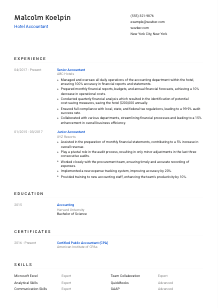
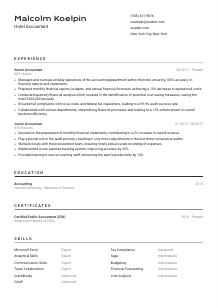
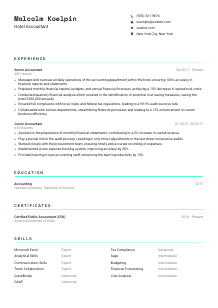
Balancing hotel books, but your resume doesn't check in? Browse this Hotel Accountant resume example, created with Wozber free resume builder. Learn how to align your financial finesse with job criteria smoothly, ensuring your career accounts for success, not vacancies!
Hotel accounting sits closer to operations than many finance candidates expect. The work is not limited to closing the books. It touches occupancy-driven revenue, departmental spend, audit preparation, tax compliance, and the daily discipline that keeps a property financially steady. Your resume needs to show that you can manage accounting accurately inside a hotel environment, where reporting deadlines and operational decisions move fast.
A tailored resume changes how quickly hiring teams can tell whether your background comes from hospitality finance or from a more general accounting track. With Wozber's free resume builder and an ATS-friendly resume format, you can line up your experience with the posting's language around budgeting, forecasting, GAAP, and cross-department process improvement so the first read points to hotel-ready financial judgment.
This section is brief, but it still carries hiring value. For a Hotel Accountant, clear contact details confirm basic eligibility fast and keep the focus on your accounting background instead of avoidable admin issues.
Use your full name as the most visible text at the top of the page. Keep it clean and professional. Finance hiring tends to favor resumes that feel orderly from the first line, and that starts with a header that is easy to read.
Place "Hotel Accountant" directly beneath your name when that matches the role you are pursuing. This helps frame your experience around hospitality finance from the start, especially if your past titles include broader labels such as Senior Accountant or Staff Accountant.
List a current phone number and an email address built around your name. Small mistakes in this section can stall an interview request. In finance roles where accuracy matters, even the basics should reflect attention to detail.
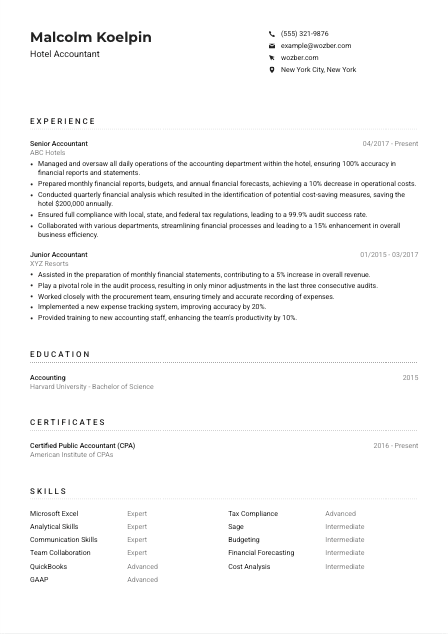
If the posting requires a specific location, include your city and state exactly. Here, New York City, New York is a stated requirement, so matching that in your header removes an early question about availability. Treat location tailoring as job-specific guidance, not a rule for every Hotel Accountant resume.
A LinkedIn profile can support your application when it aligns with the resume and includes hospitality accounting experience, software familiarity, or endorsements tied to reporting, budgeting, or audit work. Skip it if the profile is outdated. Consistency matters more than having another link.
When your header is accurate, location-ready, and aligned to the target title, the hiring team can move straight to your financial experience. That is exactly where a Hotel Accountant resume should earn attention.




This is the section that usually decides whether a Hotel Accountant resume moves forward. Hiring teams want to see accounting work tied to hotel operations, measurable financial control, and the ability to support management with reliable reporting and analysis.
Read the job description for the recurring finance themes, then mirror them in your bullet points. For this role, the priorities are daily accounting operations, financial reports, budgets, forecasts, cost analysis, revenue optimization, tax compliance, and collaboration across departments. Those are the functions your experience should surface first.
List roles in reverse chronological order with job title, employer, and dates. If your hotel experience is recent, that alone helps. If your background includes non-hospitality accounting work, keep the structure simple so the reader can quickly spot the positions most relevant to hotel finance.
Each bullet should show what you managed, improved, or protected. Hotel accounting is often judged by the quality of reporting, the reliability of compliance, and the effect of analysis on cost control or operational efficiency. The sample resume does this well by tying work to results such as lower operating costs, annual savings, and improved process efficiency instead of repeating generic accounting duties.
Quantify with figures that belong naturally in accounting work: cost reductions, annual savings, audit outcomes, reporting accuracy, revenue changes, forecast performance, or process efficiency gains. Metrics such as "saved $200,000 annually," "reduced operational costs by 10%," or "achieved a 99.9% audit success rate" tell a hotel employer far more than broad claims about impact.
Cut accomplishments that do not support the target role. Prioritize financial reporting, reconciliations, budgeting, forecasting, tax compliance, GAAP adherence, expense tracking, internal controls, and coordination with teams like procurement, operations, or front office leadership. Relevance in this section comes from showing how your accounting work supports hotel performance, not from listing every achievement you have ever had.
A well-shaped experience section shows that you can do more than maintain records. It shows that your reporting, controls, and analysis help a hotel run more efficiently and make better financial decisions.
For Hotel Accountant roles, education usually works as a qualification check before the deeper review starts. Keep it easy to read and make sure the degree listed supports the accounting or finance foundation the employer asked for.
If you have a Bachelor's degree in Accounting, Finance, or a related field, make that clear immediately. This posting asks for that background directly, so your degree should not be buried or described vaguely.
List your degree, field of study, school, and graduation year. A simple structure helps hiring teams confirm the credential quickly, especially when they are reviewing candidates with similar levels of accounting experience.
Use the formal degree title and major where possible. "Bachelor of Science in Accounting" is stronger than a shortened or generic label because it directly reflects the educational requirement and supports your finance credibility.
Relevant coursework, hospitality finance projects, or academic distinctions can help early-career candidates. If you already have several years of accounting experience, keep this section lean unless a specialization genuinely adds value to the role.
Professional credentials such as a CPA should still appear in the certificates section, but they can also reinforce the story your education tells. In the example resume, the accounting degree establishes the core qualification, while the CPA adds another layer of trust for a finance role with compliance and reporting responsibility.
Your education section does not need extra flourish. It needs to confirm that you have the accounting foundation to handle reporting, analysis, and compliance work in a hotel setting.
Certifications matter most when they add practical trust to your accounting profile. In hotel finance, they can help distinguish candidates who can handle compliance-heavy work, stronger controls, and higher-level financial analysis.
Start with credentials that directly support accounting judgment and regulatory knowledge. In this posting, a CPA is listed as a plus, so that belongs at the top if you have it. It immediately supports your fit for reporting, tax, and GAAP-related responsibilities.
Only include certifications that sharpen your case for the role. Accounting, auditing, tax, financial analysis, or systems-related credentials are useful. General certificates that do not connect to hotel finance, reporting, or compliance can dilute the section.
If a credential is active, renewed, or recently earned, include the date range or issue date. That helps show currency, especially in areas where standards, reporting practices, or software expectations continue to shift.
If you are working toward a credential or adding training in accounting systems, revenue analysis, or hospitality finance controls, include it when it is credible and current. Employers often value candidates who keep pace with changes in finance practice and technology.
A focused certificates section adds weight when the job includes audits, tax compliance, forecasting, or senior reporting support. Keep it relevant, current, and tied to the kind of financial responsibility the hotel expects you to manage.
A Hotel Accountant skill list should read like the toolset and judgment needed to run clean financial operations in a property environment. That means balancing accounting software and spreadsheet strength with analysis, communication, and process discipline.
Start with the technical and interpersonal skills the employer actually named. Here, that includes Microsoft Excel, accounting software such as QuickBooks or Sage, analytical ability, organization, and communication. Matching that language helps both ATS optimization and human review.
Lead with skills tied to the day-to-day work of the role: financial reporting, budgeting, forecasting, GAAP, tax compliance, reconciliations, cost analysis, and revenue-related review. The sample resume strengthens this by combining software skills with finance-specific capabilities instead of listing only broad traits.
Do not overload the section with every tool or soft skill you have used. Put the most relevant items first, especially those that support hotel accounting operations and management reporting. A shorter, better-ranked list is easier to scan and easier for ATS systems to map accurately.
Your skills list should look like the toolkit of someone who can close books, build reports, manage controls, and communicate financial findings to hotel leadership. That combination is what makes the section useful.
Language ability is not always central in accounting roles, but hospitality changes that slightly. Hotels operate in service environments with diverse teams and guests, so language skills can support smoother communication across departments and locations.
If the posting specifies language fluency, list it clearly at the top of this section. Here, English fluency is a significant requirement, so it should appear first and be labeled honestly.
Include other languages when they are relevant to the hotel's guest mix, team composition, or local market. In some properties, bilingual communication can help with vendor coordination, department support, or internal training, even when the role is primarily finance-based.
Choose straightforward labels such as Native, Fluent, Advanced, or Intermediate. That gives the employer a realistic sense of how you can communicate in meetings, emails, or cross-functional conversations.
A beginner-level language is worth listing only if you can actually use it in a workplace context. For a Hotel Accountant, this section is secondary to accounting ability, so keep it credible and concise.
Language ability can add range, especially in hospitality, but it should remain a supporting detail. In the example resume, English and Spanish complement the accounting experience rather than competing with it, which is the right balance.
Use this section to confirm required fluency and add any extra communication value that fits the hotel environment. Then let the rest of the resume carry the financial case.
The summary sits at the top of the resume, so it should establish your accounting level, hospitality relevance, and strongest business contribution in a few lines. For this role, that usually means connecting your finance background to reporting quality, cost control, compliance, or process improvement.
Before writing, identify the two or three themes the role emphasizes most. In this posting, those themes are hotel accounting operations, financial reporting and forecasting, compliance, and financial analysis that improves efficiency or savings. Build the summary around those points instead of writing a generic accounting profile.
Start with your title or specialty, years of experience, and the environment you know best. A line such as "Hotel Accountant with 6+ years of experience in hospitality finance" quickly tells the reader both your level and your industry context.
Bring in a few core strengths that mirror the role, such as budgeting, financial forecasting, GAAP compliance, tax oversight, or cost analysis. If you can point to a clear result, even better. The example summary works because it combines specialization with outcomes like process improvement and cost savings.
Aim for three to four lines. Every phrase should pull its weight. Skip broad personality claims and focus on the parts of your background that would matter to a hotel controller, finance director, or general manager reviewing the resume.
A sharp summary makes your direction clear before the reader reaches your work history. It should position you as someone who understands hotel finance, manages details reliably, and contributes to stronger financial control.
Once your resume reflects hotel accounting work in concrete terms, the hiring team can quickly connect your background to the daily financial demands of the property. That means clear reporting experience, credible cost analysis, compliance awareness, and results that matter in hospitality operations.
Use Wozber's free resume builder to shape that content into an ATS-compliant resume, then refine it with an ATS resume scanner so the language, structure, and priorities line up with the role. The final read should make one thing easy to judge: you can manage hotel accounting with accuracy and business awareness.




